
Cloud & Infrastructure • 6 days ago • Jessica Mahone
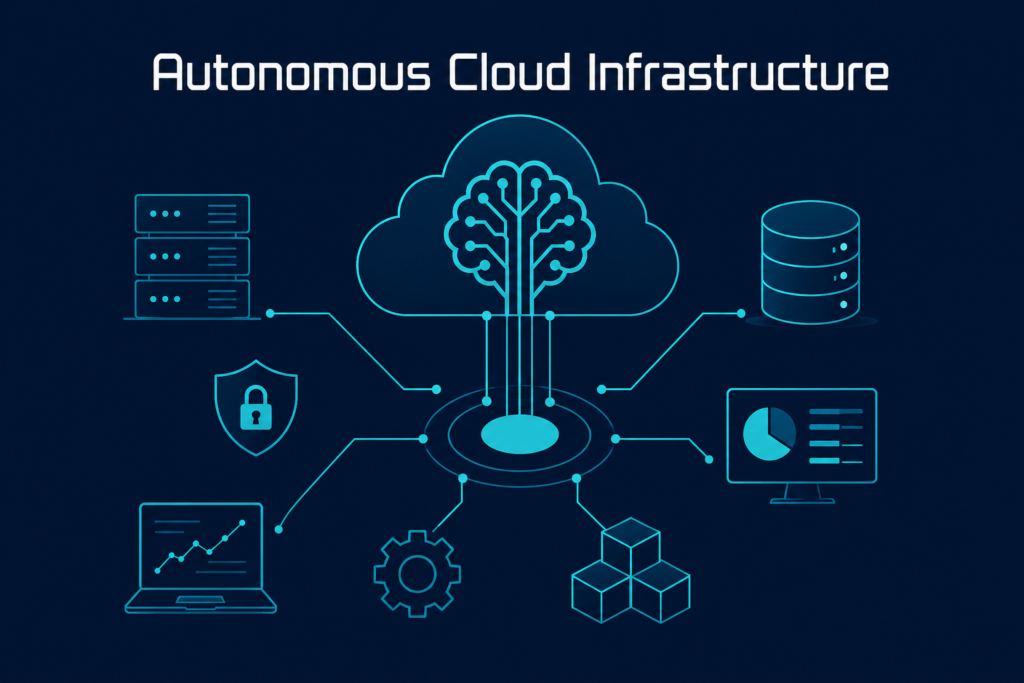
Cloud infrastructure has evolved far beyond virtual machines and storage services.
Modern enterprises operate thousands of interconnected applications, distributed workloads, databases, APIs, edge devices, containers, and AI services across multiple cloud environments. Every second, infrastructure scales, routes traffic, balances workloads, allocates storage, detects failures, and protects critical business operations.
Yet despite these technological advances, one challenge remains remarkably human:
Infrastructure still depends heavily on manual decision-making.
Operations teams monitor dashboards, investigate alerts, approve scaling events, optimize resources, and resolve performance issues that often could have been prevented before they occurred.
A new paradigm is emerging to address this challenge—Autonomous Cloud Infrastructure.
Rather than waiting for administrators to react, autonomous platforms continuously observe, predict, optimize, heal, and secure themselves through intelligent automation.
The future of enterprise infrastructure is not simply cloud-native.
It is self-operating.
The Evolution from Automation to Autonomy
Automation has long been a cornerstone of cloud operations.
Scripts provision servers, workflows deploy applications, and policies trigger scaling events.
However, automation follows predefined instructions.
Autonomy goes much further.
An autonomous infrastructure platform understands operational conditions, evaluates multiple options, predicts outcomes, and selects the most effective action without requiring explicit human intervention. Instead of following rules, it makes informed operational decisions.
This distinction represents one of the most significant shifts in enterprise infrastructure strategy.
Complexity Has Outgrown Human Operations
Enterprise infrastructure is becoming too dynamic for manual oversight alone.
A single customer transaction may involve:
- Multiple cloud providers
- API gateways
- AI inference services
- Distributed databases
- Identity platforms
- Container clusters
- Analytics pipelines
- Security inspection layers
Every component generates operational signals.
Monitoring millions of events across thousands of interconnected services creates a level of complexity that traditional operations teams struggle to manage in real time.
Autonomous infrastructure addresses this challenge by continuously interpreting operational data and acting immediately when conditions change.
Infrastructure That Predicts Instead of Reacts
Traditional monitoring alerts administrators after an issue occurs.
Autonomous platforms identify early indicators before business impact becomes visible.
They analyze patterns such as:
- Gradual latency increases
- Memory consumption trends
- Network congestion
- Resource imbalance
- Storage growth
- Traffic anomalies
- Application dependency changes
- User behavior fluctuations
Instead of reporting failures, the infrastructure predicts them. Corrective actions begin before customers notice performance degradation.
This transforms operations from reactive maintenance into proactive optimization.
Self-Healing Systems Reduce Operational Risk
Infrastructure failures are inevitable.
What determines resilience is the speed and intelligence of recovery.
Self-healing cloud environments continuously evaluate infrastructure health and automatically restore services when disruptions occur.
Common autonomous actions include:
- Restarting failed workloads
- Rebalancing traffic
- Migrating applications
- Replacing unhealthy instances
- Rebuilding containers
- Scaling affected services
- Isolating faulty components
- Reconnecting dependent systems
Recovery becomes an integrated capability rather than a manual incident response process.
Business continuity improves dramatically.
Intelligent Resource Allocation Maximizes Efficiency
Cloud resources often remain underutilized because organizations prioritize availability over optimization.
Autonomous infrastructure continuously evaluates resource demand against actual consumption.
Instead of static provisioning, computing capacity adjusts dynamically based on workload characteristics.
Infrastructure can automatically:
- Consolidate workloads
- Resize compute instances
- Shift processing locations
- Optimize storage tiers
- Balance network traffic
- Schedule background processing
- Allocate GPU resources
- Reduce idle capacity
The result is infrastructure that operates closer to optimal efficiency without compromising performance.
Security Becomes Adaptive
Static security models struggle to protect highly dynamic cloud environments.
Autonomous platforms integrate security directly into operational intelligence.
Rather than applying fixed policies, infrastructure continuously evaluates trust based on real-time conditions.
Adaptive capabilities include:
- Behavioral anomaly detection
- Identity-aware access control
- Automated workload isolation
- Continuous policy validation
- Dynamic segmentation
- Risk-based authentication
- Threat-aware routing
- Intelligent response orchestration
Security evolves alongside the infrastructure instead of slowing it down.
AI Is the Operational Brain of Modern Infrastructure
Artificial intelligence is increasingly embedded within cloud operations.
Instead of simply generating reports, AI interprets infrastructure behavior across thousands of variables simultaneously.
It correlates performance metrics, application dependencies, financial costs, user demand, and security events to generate optimized operational decisions.
This enables enterprises to move beyond infrastructure management toward infrastructure intelligence.
The cloud environment becomes capable of learning from experience and continuously improving its own operational efficiency.
Human Expertise Remains Essential
Autonomous infrastructure does not eliminate infrastructure teams.
It changes their role.
Instead of spending time resolving repetitive operational issues, engineers focus on:
- Platform architecture
- Governance strategy
- Security frameworks
- Innovation initiatives
- Business alignment
- Performance engineering
- Service design
- Long-term optimization
Routine operations become automated while human expertise shifts toward strategic value creation.
Technology amplifies people instead of replacing them.
Measuring Infrastructure Maturity
Organizations adopting autonomous operations evaluate success differently from traditional IT environments.
Key performance indicators include:
- Mean time to self-recovery
- Autonomous remediation rate
- Predictive incident prevention
- Infrastructure utilization efficiency
- Automated optimization coverage
- Policy compliance consistency
- Service resilience
- Operational intervention reduction
These metrics reflect infrastructure intelligence rather than simple uptime.
The focus shifts from maintaining systems to enabling business continuity and innovation.
The Rise of Infrastructure That Thinks
Enterprise infrastructure is evolving from passive technology into an active participant in business operations. It no longer exists merely to host applications.
It continuously evaluates operational conditions, predicts future demand, optimizes resources, strengthens security, and protects digital experiences with minimal human intervention.
Autonomous Cloud Infrastructure represents the convergence of cloud computing, AI, automation, observability, and operational intelligence into a single adaptive ecosystem.
Organizations embracing this model gain more than efficiency.
They gain infrastructure capable of evolving alongside the business itself.
As digital ecosystems continue to grow in scale and complexity, the most valuable infrastructure will not necessarily be the fastest or the largest.
It will be the infrastructure intelligent enough to manage itself.