
Enterprise Software (SaaS) • 10 days ago • Neha Jamwal
Enterprise software has evolved dramatically over the past few decades. Early systems focused on digitizing records. Cloud-based Software-as-a-Service (SaaS) platforms simplified deployment and collaboration. Artificial intelligence introduced automation and predictive insights.
Yet despite these advances, most enterprise software still requires users to manually coordinate actions across multiple applications.
A sales manager updates forecasts. A finance team adjusts budgets. Procurement places orders. Operations modify schedules.
Every application performs its individual function, but the responsibility for connecting them remains with people.
A new software paradigm is beginning to emerge.
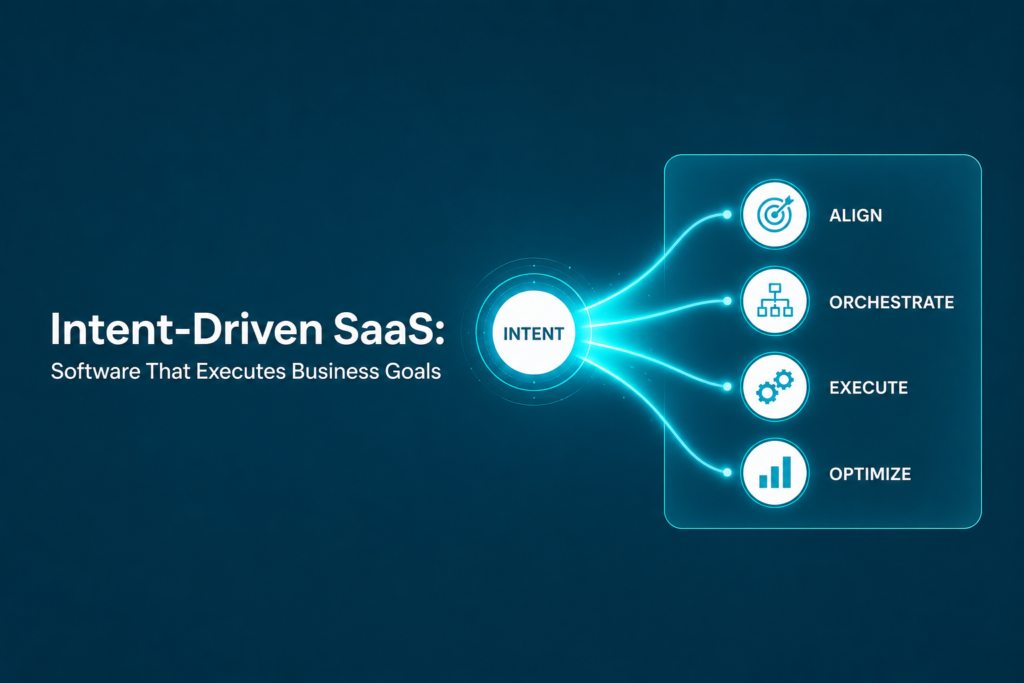
Intent-Driven SaaS shifts enterprise software from task execution to goal execution. Instead of asking users what action to perform next, the platform understands business intent and orchestrates the required activities automatically across applications, workflows, and AI services.
The software no longer manages processes. It delivers outcomes.
This shift could redefine the future of enterprise software.
What Is Intent-Driven SaaS?
Intent-Driven SaaS is an enterprise software architecture where business objectives become the primary input for execution. Instead of navigating multiple screens and workflows, users define an outcome.
For example:
“Reduce inventory shortages while maintaining profitability.”
The platform interprets the intent, evaluates enterprise context, coordinates relevant systems, recommends actions, and automates execution where appropriate.
Business goals become executable instructions.
The software understands purpose rather than isolated transactions.
Why Traditional SaaS Creates Operational Friction
Most SaaS platforms optimize individual departments. CRM manages customers. ERP manages finance. HR platforms manage employees. Procurement systems manage suppliers. Project management tools coordinate tasks.
Although integrations connect data, business intent remains fragmented across applications. Employees become the integration layer. They transfer information, coordinate approvals, and align priorities manually.
Intent-Driven SaaS removes this dependency by orchestrating enterprise activities around shared objectives.
From Workflows to Outcomes
Traditional software executes predefined workflows. Intent-driven platforms execute desired outcomes.
Instead of following static sequences, the software continuously evaluates changing conditions. A supply chain disruption may automatically trigger procurement adjustments. Customer demand may influence manufacturing schedules. Budget constraints may reprioritize investments. The enterprise responds dynamically rather than procedurally.
Outcomes become more important than process compliance.
Enterprise Context Becomes the Core Platform
Intent cannot be understood without context.
A request to improve customer retention requires understanding support interactions, product usage, contracts, billing history, and service quality.
Intent-Driven SaaS continuously combines operational data with enterprise knowledge. It understands relationships across departments. Recommendations become context-aware rather than application-specific. This significantly improves decision quality while reducing manual coordination.
Artificial Intelligence Evolves into Business Orchestration
Many AI capabilities remain confined within individual applications. Intent-Driven SaaS positions AI as an orchestration engine. AI interprets goals. It identifies dependencies. It evaluates constraints. It recommends execution paths. It monitors outcomes and adjusts strategy continuously.
Artificial intelligence becomes an enterprise coordinator rather than simply a productivity assistant.
Characteristics of Intent-Driven SaaS Platforms
Future enterprise software platforms are likely to exhibit several defining capabilities:
- Goal-based user interaction
- Context-aware recommendations
- Cross-application orchestration
- Continuous optimization
- Autonomous workflow generation
- Embedded governance
- AI-assisted decision-making
- Event-driven execution
- Dynamic policy enforcement
- Adaptive business logic
These capabilities enable software to align technology with business objectives rather than isolated functions.
Why This Model Improves Enterprise Agility
Business priorities change constantly. Traditional workflows often require redesign whenever organizational strategy changes. Intent-Driven SaaS adapts automatically. The objective remains constant while execution paths evolve according to current business conditions.
Organizations become more resilient because software responds to change instead of resisting it. Enterprise agility becomes an architectural capability.
The Technology Stack Behind Intent-Driven SaaS
Building this next generation of enterprise software requires multiple advanced technologies working together.
Key enabling capabilities include:
- Knowledge graphs
- Semantic computing
- Agentic AI
- Machine reasoning
- Enterprise metadata platforms
- Event-driven architecture
- Decision intelligence engines
- Process mining
- Business capability models
- Autonomous orchestration services
Together, these technologies create software capable of understanding business objectives and coordinating execution intelligently.
Challenges to Adoption
Intent-Driven SaaS requires organizations to define business goals consistently across departments. Poor metadata, fragmented data models, and inconsistent governance can reduce effectiveness. Software vendors must move beyond feature-centric design toward enterprise intelligence platforms. Customers must invest in knowledge architecture alongside digital transformation.
The transition is significant, but the long-term benefits include lower operational complexity and greater strategic alignment.
Why Intent Will Become the New Enterprise Interface
The next evolution of enterprise software may eliminate traditional navigation menus and complex workflows. Users will simply express business objectives. The platform will determine how those objectives should be achieved. Interfaces become conversational. Execution becomes autonomous.
Enterprise software becomes proactive instead of reactive. The interaction model shifts from operating software to collaborating with intelligent systems.
Conclusion
Intent-Driven SaaS represents a profound shift in enterprise software architecture.
By placing business objectives at the center of execution, organizations can reduce operational friction, improve cross-functional coordination, and unlock greater value from artificial intelligence. Rather than managing tasks, future enterprise platforms will manage outcomes. Rather than connecting applications, they will connect intentions.
As enterprise complexity continues to increase, software that understands why businesses act—not just how they act—may become the defining competitive advantage of the next generation of SaaS innovation.