
Enterprise Software (SaaS) • 4 days ago • Jessica Mahone
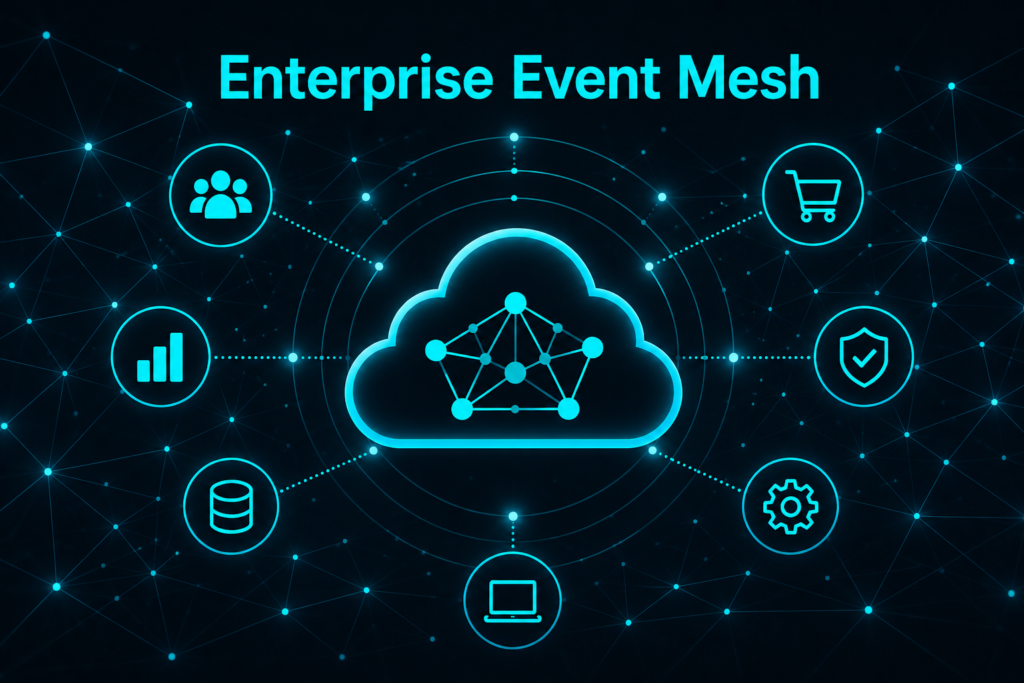
Enterprise software has undergone a remarkable evolution. Organizations have moved from isolated applications to cloud-native platforms, integrated workflows, and AI-powered automation. Yet one major challenge continues to slow digital transformation: most enterprise systems still communicate too slowly.
Information often travels from one application to another through scheduled synchronizations, API calls, or batch processing. By the time data reaches downstream systems, the business context may have already changed.
In a world where customer expectations, supply chains, cybersecurity threats, and financial transactions evolve every second, delayed information creates delayed decisions. This challenge has fueled the emergence of one of the most important yet least understood SaaS architectural concepts: the Enterprise Event Mesh.
Rather than moving data on request, an event mesh enables enterprise applications to continuously publish and consume business events in real time, creating an intelligent software ecosystem where every application remains instantly aware of operational change. For modern B2B enterprises, this architecture represents the foundation of truly responsive business operations.
What Is an Enterprise Event Mesh?
An Enterprise Event Mesh is a distributed communication layer that allows enterprise applications to exchange business events across multiple cloud platforms, SaaS products, data centers, and business units.
Instead of relying on direct point-to-point integrations, applications publish events into the mesh, where relevant systems automatically subscribe and react. An approved purchase order. A completed payment. A customer complaint. A shipment delay. A contract renewal.
Every business event becomes immediately available to systems that need it. The enterprise evolves from disconnected software into a continuously synchronized digital ecosystem.
Why Traditional SaaS Integrations Create Bottlenecks
Most enterprise integrations depend on predefined connections between applications. As organizations adopt more SaaS products, integration complexity grows exponentially. Each new application increases maintenance requirements, operational dependencies, and upgrade risks.
Over time, IT teams spend more effort maintaining integrations than creating innovation. An event mesh eliminates this complexity by replacing direct connections with intelligent event distribution. Applications become loosely coupled while remaining highly connected.
From Data Synchronization to Event Awareness
Conventional enterprise software synchronizes information after changes occur. Event-driven SaaS architecture distributes change itself. The difference is significant. Instead of periodically checking whether inventory has changed, systems are instantly notified when inventory changes. Instead of polling for new customer orders, applications react the moment an order is created.
The enterprise shifts from passive synchronization to active awareness. Business operations become significantly more responsive.
Creating a Living Enterprise Software Ecosystem
Enterprise applications often operate like independent departments. Each system stores valuable information but rarely shares it efficiently. An event mesh transforms isolated software into a collaborative ecosystem. Customer service receives immediate updates when invoices are paid. Finance reacts instantly to procurement approvals. Supply chain systems respond automatically to inventory movements. Marketing adapts campaigns based on purchasing behavior. Every application contributes to one continuous operational conversation.
The result is greater coordination without greater complexity.
Accelerating Enterprise Automation
Automation depends on timely information. Delayed events delay workflows. An event mesh enables automation engines to react immediately when business conditions change. Common automation scenarios include:
- Customer onboarding
- Contract lifecycle management
- Invoice processing
- Employee provisioning
- Order fulfillment
- Compliance reporting
- Fraud detection
- Asset management
- Subscription lifecycle management
- Partner ecosystem integration
Automation becomes event-driven rather than schedule-driven. Business processes execute with greater speed and precision.
Improving Enterprise Resilience
Modern enterprises require software architectures capable of adapting to change. Traditional integrations often fail when one application becomes unavailable.
An event mesh introduces resilience through distributed communication. Events remain available until subscribing systems recover. Applications continue operating independently without disrupting the broader ecosystem. Operational continuity improves because communication is decoupled from application availability. Resilience becomes part of architecture rather than an afterthought.
Artificial Intelligence Benefits from Continuous Events
Artificial intelligence performs best when operating on fresh information. Historical datasets provide valuable insights, but real-time events enable real-time intelligence. An event mesh continuously supplies AI systems with operational signals across the enterprise. This enables:
- Predictive maintenance
- Dynamic pricing
- Customer behavior analysis
- Demand forecasting
- Intelligent routing
- Fraud prevention
- Resource optimization
- Operational anomaly detection
AI evolves from periodic analysis to continuous decision support. The business becomes increasingly adaptive.
Eliminating Data Silos Without Replacing Applications
Many organizations attempt to eliminate data silos through large-scale software consolidation. These projects are expensive, disruptive, and often difficult to sustain. An event mesh provides an alternative approach. Existing SaaS investments remain in place while communication improves across platforms. Departments preserve specialized applications while participating in a shared operational ecosystem. Transformation occurs through connectivity rather than replacement. Technology investments continue delivering value without extensive migration initiatives.
Enabling the Autonomous Enterprise
Future enterprise software will increasingly coordinate itself. Applications will trigger workflows, allocate resources, update records, and initiate business processes without manual intervention. An event mesh provides the communication foundation required for autonomous operations. Every software platform becomes both a producer and consumer of business intelligence. Operational decisions occur closer to real-time. The enterprise behaves as one coordinated digital organism instead of multiple disconnected systems.
The Future of Enterprise SaaS Architecture
The next competitive advantage in enterprise software will not come from acquiring more applications. It will come from enabling existing applications to communicate intelligently.
Enterprise Event Mesh architecture transforms software ecosystems into living networks where information flows continuously, decisions accelerate naturally, and automation responds instantly to business change. As organizations pursue AI, hyperautomation, and intelligent operations, event-driven communication will become a foundational architectural capability.
The future of SaaS lies not simply in cloud software but in software that continuously shares awareness across the enterprise. Businesses that embrace this invisible communication layer will operate faster, collaborate more effectively, and build digital ecosystems capable of adapting to change as it happens. In the evolving world of enterprise software, speed of information will increasingly define speed of innovation.
And the event mesh may become the unseen technology powering both.