Enterprise Software (SaaS) • 2 days ago • Melvin Hall
Enterprise software has become the operational backbone of modern organizations. Sales platforms manage customer relationships, finance applications control transactions, procurement systems govern purchasing, and human resource platforms coordinate workforce operations.
While these systems perform their individual functions effectively, they often share one common weakness. Business policies are scattered. Approval rules exist in one application. Compliance controls exist in another. Access permissions differ across platforms. Automation logic varies between departments.
As enterprises continue expanding their SaaS ecosystems, inconsistent governance becomes one of the biggest barriers to efficiency, security, and scalability.
This challenge has led to the emergence of a powerful architectural concept known as the SaaS Policy Engine.
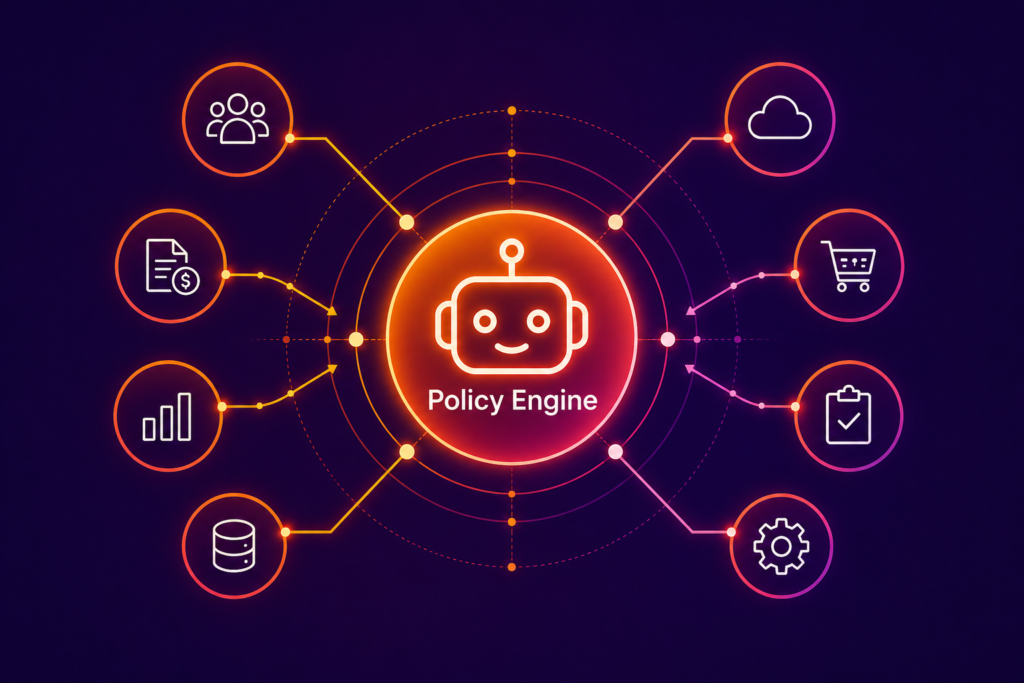
Rather than functioning as another business application, a policy engine acts as a centralized intelligence layer that defines, distributes, and enforces business rules consistently across the entire enterprise software landscape.
For organizations pursuing digital maturity, this invisible software layer may become one of the most valuable components of enterprise architecture.
What Is a SaaS Policy Engine?
A SaaS Policy Engine is a centralized decision framework that manages business rules, governance standards, compliance requirements, and operational policies across multiple enterprise applications. Instead of embedding policies separately within every software platform, organizations define governance once and apply it consistently everywhere.
Every application references the same source of business logic. This creates predictable and transparent enterprise operations while reducing administrative complexity. Policies become organizational assets rather than application-specific configurations.
Why Enterprise SaaS Governance Is Becoming More Complex
Large organizations often operate hundreds of cloud applications. Each platform introduces its own permission model, approval workflows, automation rules, and compliance settings. Over time, these independent configurations become difficult to maintain. A policy updated in one system may remain outdated elsewhere. Operational inconsistencies emerge. Security risks increase. Compliance audits become more challenging.
Without centralized governance, software ecosystems gradually become fragmented despite significant technology investment.
Separating Business Logic from Business Applications
Traditional enterprise software combines application functionality with operational rules. Whenever business policies change, multiple systems require independent updates. A SaaS Policy Engine separates governance from execution. Applications focus on operational tasks while the policy engine determines whether actions are permitted, restricted, escalated, or automated. This separation creates greater agility because governance evolves independently from software deployment cycles.
Organizations adapt more quickly to changing business requirements.
Creating Consistent Enterprise Decisions
Different departments often interpret policies differently. Expense approvals vary between business units. Vendor onboarding follows inconsistent processes. Customer discounts require different authorization paths.
These inconsistencies create confusion and operational inefficiency. A centralized policy engine standardizes decision-making. Every employee, department, and application follows identical governance principles regardless of location or platform. Consistency becomes scalable.
Enterprise Use Cases
A SaaS Policy Engine supports governance across numerous operational scenarios.Common applications include:
- Purchase approval rules
- Customer discount governance
- Vendor onboarding validation
- Employee access control
- Contract approval workflows
- Financial authorization policies
- Regulatory compliance checks
- Data retention management
- Subscription governance
- Identity and permission management
The organization gains centralized control while preserving departmental flexibility.
Accelerating Enterprise Automation
Automation succeeds only when business rules remain reliable. If governance differs across systems, automated workflows become unpredictable. Policy engines provide a trusted decision framework for enterprise automation. Workflow platforms can instantly evaluate whether actions satisfy organizational requirements before execution.
Automation becomes both faster and safer. Intelligence is embedded directly into operational processes.
Supporting Artificial Intelligence Responsibly
AI increasingly influences enterprise decisions. However, organizations require confidence that automated recommendations align with business policies.
A SaaS Policy Engine creates governance boundaries for intelligent systems. AI-generated actions can be validated against predefined business rules before execution. This combination enables innovation without sacrificing accountability. Artificial intelligence operates within trusted organizational guardrails.
Simplifying Compliance Across the Enterprise
Regulatory requirements continue evolving across industries. Organizations frequently update internal policies to remain compliant. Without centralized governance, implementing policy changes across numerous SaaS applications can become time-consuming and error-prone. A policy engine distributes updates automatically across connected platforms. Compliance becomes proactive rather than reactive. Audit preparation becomes significantly simpler because governance remains centralized and traceable.
Improving Enterprise Agility
Business strategy changes frequently. New products launch. Markets expand. Approval structures evolve. Risk tolerance shifts.
Traditional software architectures require multiple system modifications whenever governance changes. Policy engines allow organizations to update business rules once while instantly influencing connected applications. Technology responds at the speed of business strategy rather than software development. This agility becomes a competitive advantage.
Building Trust Through Transparent Governance
Employees and customers increasingly expect transparent decision-making. When software behaves inconsistently, confidence declines. Centralized policy management creates explainable outcomes because every decision follows documented organizational rules.
Approvals, restrictions, exceptions, and automated actions become traceable and understandable. Transparency strengthens governance while improving employee and customer trust. The enterprise becomes more predictable and accountable.
The Future of Enterprise SaaS Governance
As organizations continue expanding their cloud software portfolios, governance complexity will increase alongside technological capability. The enterprises that succeed will not necessarily own the most software. They will operate the most coordinated software ecosystems.
SaaS Policy Engines represent a shift toward centralized business intelligence where governance becomes reusable, adaptable, and consistently enforced across every application. This architecture transforms fragmented software environments into unified operational platforms capable of supporting automation, artificial intelligence, compliance, and continuous innovation.
The future of enterprise SaaS will be shaped not only by smarter applications but also by smarter governance. And at the center of that transformation will be policy engines quietly ensuring that every digital decision reflects the values, rules, and objectives of the business itself.