
Emerging tech & Deep tech • 8 days ago • Neha Jamwal
For decades, enterprises have relied on reports to understand the past and dashboards to monitor the present. Predictive analytics extended that capability by estimating future outcomes based on historical trends.
However, a new generation of deep technology is moving beyond prediction into simulation.
Welcome to the era of the Enterprise Physics Engine.
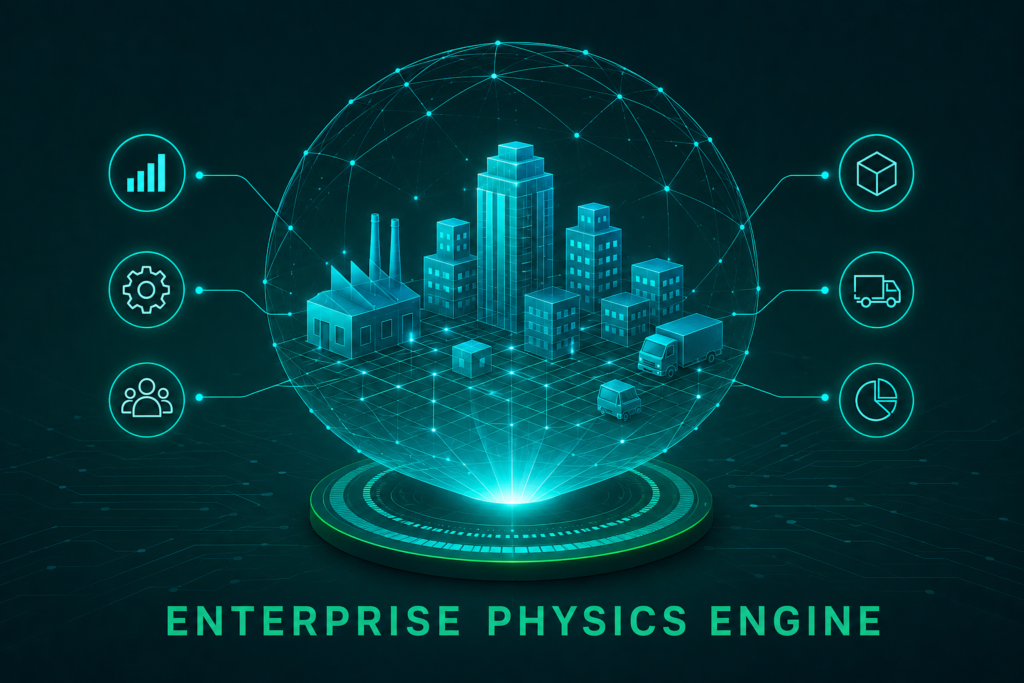
Borrowing inspiration from the gaming and robotics industries, a physics engine calculates how objects interact within a virtual environment according to defined rules. In the enterprise world, the same principle can be applied to business operations. An Enterprise Physics Engine creates a computational model of an organization where customers, suppliers, products, AI agents, regulations, inventory, capital, and human decisions interact according to business logic.
Instead of asking “What happened?”, leaders can ask “What will happen if multiple variables change simultaneously?”
This technology has the potential to redefine strategic planning, operational resilience, and autonomous enterprise management. The next competitive advantage may come not from better analytics but from better simulation.
What Is an Enterprise Physics Engine?
An Enterprise Physics Engine is a computational framework that models enterprise behavior by simulating interactions between business entities and operational constraints. Every object inside the organization becomes part of a dynamic system.
Customers influence demand. Demand affects production. Production impacts suppliers. Suppliers affect logistics. Logistics changes customer satisfaction. Financial outcomes shift investment priorities. Instead of isolated analytics, the enterprise becomes a continuously evolving digital ecosystem. The model behaves according to business “physics.”
Why Business Complexity Demands Simulation
Modern enterprises operate across thousands of interconnected variables. Global supply networks. Cloud infrastructure. AI agents. Regulatory frameworks. Partner ecosystems. Customer channels. Small changes can create large downstream consequences.
Traditional reporting cannot capture these nonlinear relationships. Simulation enables organizations to understand ripple effects before they occur. Complexity becomes observable. Uncertainty becomes manageable.
From Static Models to Living Systems
Enterprise architecture diagrams often become outdated shortly after creation. Process documentation captures intended workflows but rarely reflects operational reality.
An Enterprise Physics Engine continuously updates itself using operational events and enterprise data. It evolves alongside the business. The organization gains a living representation of itself rather than a static blueprint. Decision-making becomes based on current enterprise behavior instead of historical documentation.
AI Needs an Environment to Think
Artificial intelligence performs best when it understands context. Most enterprise AI models process isolated tasks such as forecasting demand or classifying documents.
An Enterprise Physics Engine provides a simulated environment where AI can test decisions before execution. Autonomous agents can evaluate multiple strategies. Operational risks can be measured. Business outcomes can be compared. The enterprise effectively creates a safe sandbox for intelligent experimentation.
Simulating Strategic Decisions
One of the greatest strengths of an Enterprise Physics Engine is scenario modeling. Leadership teams can simulate initiatives such as:
- Expanding into a new geography
- Introducing autonomous customer service
- Redesigning pricing models
- Closing manufacturing facilities
- Changing sourcing strategies
- Implementing new compliance policies
- Consolidating technology platforms
- Increasing automation levels
- Reorganizing business units
- Launching subscription business models
Rather than relying solely on executive intuition, decisions become supported by computational experimentation.
The Convergence of Deep Technologies
Enterprise Physics Engines do not exist in isolation. They integrate several advanced technologies:
- Knowledge graphs
- Machine reasoning
- Digital twins
- Event-driven architecture
- Agentic AI
- Semantic data models
- Decision intelligence
- Reinforcement learning
- Process mining
- Enterprise observability
Together, these technologies create an enterprise capable of understanding and simulating its own behavior.
Governance Through Simulation
Regulatory compliance and operational governance often rely on retrospective audits. Simulation introduces proactive governance. Business policies become executable constraints. Potential violations can be identified before operational execution. AI recommendations are evaluated against governance rules. Risk management becomes preventive rather than corrective. Organizations gain confidence to innovate while maintaining control.
Enterprise Resilience by Design
Business resilience depends on anticipating disruption. An Enterprise Physics Engine enables organizations to stress-test operations before crises emerge. Executives can evaluate resilience against supplier failures, cyber incidents, workforce shortages, market volatility, infrastructure outages, and regulatory changes. Weaknesses become visible before they impact customers. Resilience evolves from planning into continuous simulation.
Building the Foundation
Organizations interested in Enterprise Physics Engines should invest in:
- Unified enterprise data architecture
- Semantic metadata frameworks
- Business capability mapping
- Knowledge graph technologies
- AI governance platforms
- Event streaming infrastructure
- Digital twin capabilities
- Process intelligence
- Decision automation
- Simulation environments
These foundational capabilities enable enterprises to move from descriptive analytics toward dynamic business modeling.
Why This Deep Tech Could Reshape Enterprise Strategy
The future enterprise will increasingly rely on autonomous systems making operational decisions in real time. These systems require more than data. They require understanding. Enterprise Physics Engines provide the computational environment where intelligent systems can evaluate consequences before acting. Organizations gain the ability to simulate strategy, optimize execution, and continuously adapt to changing conditions. Business transformation becomes a science rather than an experiment.
Conclusion
The next wave of emerging technology will not simply make enterprises faster. It will make them more aware. Enterprise Physics Engines represent a profound shift from analyzing business activity to simulating business reality. By combining AI, knowledge models, digital twins, semantic architecture, and intelligent simulation, organizations can navigate uncertainty with greater precision and confidence. In the future of deep technology, the most successful enterprises may not be those with the most data. They may be those that can simulate the future before anyone else.