
Emerging tech & Deep tech • 12 hours ago • Shruti Das
The digital enterprise has evolved through multiple technological eras. First came automation, where repetitive tasks were delegated to software. Then analytics enabled organizations to measure performance through data. Artificial intelligence introduced prediction and intelligent recommendations.
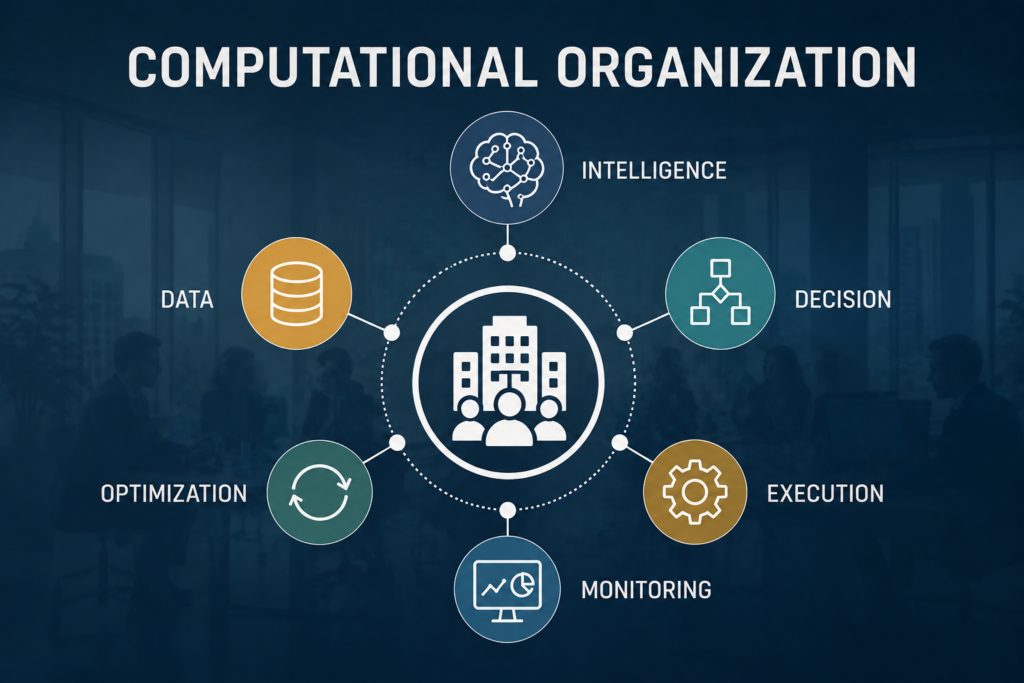
Now, a new frontier is emerging—Computational Organizations. This deep technology concept views an enterprise not simply as a collection of departments and systems, but as a computational system capable of sensing, reasoning, adapting, and continuously optimizing itself. Rather than relying on periodic transformation programs, computational organizations evolve in real time through interconnected intelligence.
Business capabilities become algorithms. Decisions become dynamic computations. Organizational knowledge becomes executable. The enterprise begins behaving like a living digital system. As markets become increasingly volatile and AI becomes embedded across operations, computational organizations may become the defining architecture for the next generation of intelligent businesses.
What Is a Computational Organization?
A Computational Organization is an enterprise where operational decisions, business rules, knowledge, workflows, and governance are represented as computational models that continuously adapt based on changing conditions. Instead of managing business through static processes, the organization calculates the most effective course of action using real-time intelligence. Every interaction becomes part of an adaptive decision network. Customer behavior influences pricing. Supply chain events influence manufacturing. Financial signals influence investment priorities. Risk indicators influence governance policies. The enterprise becomes a dynamic computational ecosystem.
From Static Structures to Adaptive Systems
Traditional organizational models are hierarchical and relatively static. Departments operate independently. Policies change infrequently. Decision-making follows predefined approval chains. Computational Organizations replace rigidity with adaptability. Operational logic adjusts based on live business conditions. AI agents collaborate with business rules. Processes reorganize dynamically. Resources are allocated according to enterprise priorities rather than organizational boundaries. The business evolves continuously instead of periodically.
Why Enterprise Complexity Requires Computational Thinking
Modern organizations manage thousands of interconnected dependencies. Applications, customers, partners, regulations, assets, suppliers, and AI systems influence one another constantly. Human intuition alone cannot evaluate every possible interaction. Computational thinking enables enterprises to process these relationships mathematically. Business scenarios become simulations. Constraints become algorithms. Optimization becomes continuous. The organization gains the ability to solve complexity rather than simply react to it.
Enterprise Knowledge Becomes Executable
Most enterprise knowledge exists in documents, presentations, emails, and employee experience. Computational Organizations transform this knowledge into executable intelligence. Policies become decision engines. Governance becomes automated logic. Business capabilities become reusable services. Operational expertise becomes computational assets. Knowledge no longer resides only in people. It becomes part of the organization’s digital infrastructure. This significantly improves continuity, scalability, and resilience.
Artificial Intelligence Requires Computational Foundations
Generative AI can generate responses. Predictive AI can forecast outcomes. Computational Organizations provide the operational framework that converts intelligence into coordinated action. AI recommendations are evaluated against enterprise constraints. Resources are optimized automatically. Business objectives remain aligned across departments. Artificial intelligence becomes part of enterprise execution rather than an isolated technology layer. The organization develops systemic intelligence.
The Rise of Decision Networks
Decision-making is shifting from hierarchical approval chains toward distributed intelligence. Computational Organizations create decision networks where information flows instantly across business capabilities. Operational events trigger autonomous evaluations. Context determines action. Governance remains embedded throughout the process. Instead of waiting for manual intervention, enterprises calculate responses based on objectives, constraints, and real-time conditions. Decision latency decreases while organizational agility increases.
Characteristics of Computational Organizations
Enterprises adopting this model typically demonstrate:
- Adaptive workflows
- AI-assisted governance
- Continuous optimization
- Event-driven decision-making
- Knowledge-driven automation
- Context-aware operations
- Dynamic resource allocation
- Intelligent policy execution
- Cross-functional orchestration
- Self-improving business capabilities
These characteristics collectively enable enterprises to respond to complexity with precision and speed.
Technology Foundations
Building a Computational Organization requires multiple emerging technologies working together. Key foundations include:
- Knowledge graphs
- Semantic computing
- Agentic AI
- Machine reasoning
- Event streaming platforms
- Decision intelligence systems
- Enterprise digital twins
- Metadata management
- Business capability models
- Autonomous orchestration platforms
Together, these technologies create a computational operating model capable of evolving continuously.
Challenges and Organizational Readiness
Technology alone cannot create a Computational Organization. Success requires standardized business definitions, strong governance, high-quality data, and collaboration between business and technology teams. Organizations must rethink decision ownership, process design, and enterprise architecture. The transition is as much organizational as technological. However, enterprises that build these foundations early will possess significant strategic advantages as autonomous technologies mature.
Why Computational Organizations Represent the Next Wave of Deep Tech
Every technological revolution has changed how enterprises operate. Computational Organizations redefine how enterprises think. Instead of relying on fragmented systems and manual coordination, businesses become integrated intelligence networks capable of calculating optimal responses continuously. Transformation evolves from project-based modernization into perpetual adaptation. The organization itself becomes software. Its capabilities become algorithms. Its knowledge becomes executable. Its strategy becomes computational.
Conclusion
Computational Organizations represent one of the most transformative concepts emerging from deep technology. By combining semantic understanding, AI, reasoning engines, enterprise knowledge, and adaptive decision-making into a unified computational framework, organizations gain the ability to evolve continuously in response to changing conditions. The future enterprise will not simply digitize operations. It will compute them. In the next era of innovation, competitive advantage will belong to organizations that can process complexity as efficiently as computers process information.