
Digital Transformation • 3 days ago • Jessica Mahone
For decades, organizations have approached digital transformation through implementation. A new ERP platform is deployed. A customer experience solution is introduced. An AI model is integrated into operations. Only after deployment do leaders discover process bottlenecks, adoption challenges, integration gaps, or unexpected business risks. Transformation has traditionally been reactive.
A new concept is changing that paradigm.
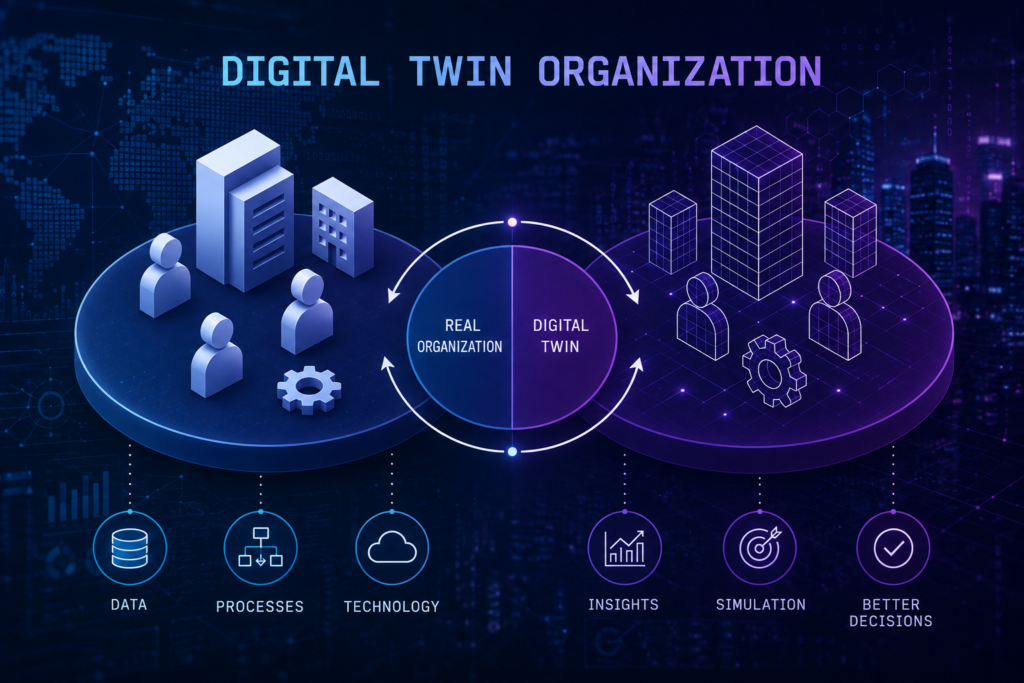
The Digital Twin Organization (DTO) is an intelligent virtual representation of an enterprise that mirrors its people, processes, technology, data flows, and operational interactions. Unlike traditional dashboards that simply report performance, a Digital Twin Organization enables leaders to simulate future business scenarios before implementing change.
Instead of asking, “What happened?” Organizations begin asking, “What will happen if we change this capability?” This shift transforms digital transformation from experimentation into prediction. As enterprises become increasingly complex, Digital Twin Organizations are emerging as one of the most strategic capabilities for building resilient, data-driven businesses.
What Is a Digital Twin Organization?
A Digital Twin Organization is a dynamic digital model that reflects how an enterprise actually operates. It combines operational data, business processes, technology dependencies, organizational structures, and performance metrics into a continuously updated virtual representation. Unlike static process documentation, the twin evolves alongside the organization. Changes in one area immediately reveal potential impacts elsewhere.
The enterprise becomes observable, measurable, and simulatable. Decision-making becomes evidence-driven instead of assumption-driven.
Why Traditional Transformation Carries Hidden Risk
Many transformation programs focus on implementing technology without fully understanding operational dependencies. A seemingly simple process change may affect compliance, customer experience, finance, supply chains, or workforce productivity. These hidden relationships often become visible only after deployment. The consequences include project delays, budget overruns, and reduced business value.
A Digital Twin Organization exposes these dependencies before change occurs. Leaders gain confidence by understanding enterprise-wide impact before making investment decisions.
Simulating Business Before Executing Business
One of the most powerful capabilities of a Digital Twin Organization is simulation. Organizations can model scenarios such as:
- Introducing AI into customer service
- Consolidating business units
- Expanding into new markets
- Automating procurement
- Modernizing legacy applications
- Redesigning approval workflows
- Changing pricing strategies
- Optimizing workforce allocation
- Migrating infrastructure
- Launching digital products
Rather than relying on assumptions, leaders evaluate simulated outcomes supported by enterprise data. Transformation becomes predictable rather than experimental.
Connecting Data, Processes, and Technology
Most enterprises maintain separate views of operations. Process teams document workflows. Technology teams manage applications. Data teams govern information assets. Business leaders monitor performance metrics.
The Digital Twin Organization unifies these perspectives into a single enterprise model. Processes connect to systems. Systems connect to data. Data connects to decisions. The result is a comprehensive understanding of how the organization functions as an integrated ecosystem.
Artificial Intelligence Makes the Twin Smarter
Artificial Intelligence significantly enhances the value of a Digital Twin Organization. AI continuously analyzes operational patterns, identifies anomalies, predicts bottlenecks, and recommends optimization opportunities. Instead of manually reviewing thousands of operational indicators, executives receive prioritized insights supported by predictive intelligence. The digital twin evolves from a passive model into an active strategic advisor. AI strengthens enterprise foresight.
Transformation Becomes Continuous
Traditional transformation programs often occur in large phases separated by long planning cycles. Digital Twin Organizations support continuous improvement. Every operational change updates the enterprise model. Every improvement creates new organizational intelligence. Every business outcome enriches future simulations. Transformation becomes an ongoing capability rather than a periodic initiative. The enterprise learns continuously.
Governance Gains Real-Time Visibility
Governance is frequently challenged by limited visibility into operational complexity. Digital Twin Organizations improve governance by connecting business objectives with operational execution. Leadership gains visibility into:
- Process dependencies
- Technology relationships
- Data ownership
- Operational risks
- Compliance impacts
- Resource utilization
- AI interactions
- Business capability maturity
- Change propagation
- Enterprise performance
Governance shifts from reactive oversight to proactive management.
Measuring Organizational Health
Beyond financial reporting, Digital Twin Organizations enable enterprises to monitor operational health. Organizations can assess:
- Process efficiency
- Decision latency
- Customer journey performance
- Technology utilization
- Cross-functional collaboration
- Data quality
- Automation maturity
- Workforce productivity
- Operational resilience
- Innovation readiness
These indicators provide a holistic view of enterprise capability rather than isolated departmental metrics.
Why Digital Twins Will Redefine Enterprise Strategy
As organizations become increasingly interconnected, isolated decision-making becomes unsustainable. Every transformation initiative affects multiple business capabilities simultaneously. Digital Twin Organizations provide leaders with the ability to understand complexity before acting. This predictive capability reduces uncertainty, improves investment prioritization, and accelerates strategic execution. Organizations gain the confidence to innovate because they can evaluate potential outcomes before committing resources. Transformation becomes intelligent by design.
Building a Digital Twin Organization
Organizations seeking long-term transformation should invest in:
- Enterprise process mapping
- Business capability modeling
- Integrated operational data
- Metadata management
- AI-powered analytics
- Event-driven architecture
- Cross-functional governance
- Simulation capabilities
- Continuous monitoring
- Enterprise observability
The objective is not simply visualizing the business. It is understanding how the business behaves under change.
Conclusion
Digital transformation is evolving from technology implementation to enterprise intelligence. The Digital Twin Organization represents this evolution by creating a living model of how an enterprise operates, adapts, and grows. By simulating change before execution, organizations reduce risk, improve governance, accelerate innovation, and make more informed strategic decisions.
The enterprises that thrive in the future will not be those that change the fastest. They will be those that understand the consequences of change before it happens.