
Enterprise Software (SaaS) • 2 days ago • Melvin Hall
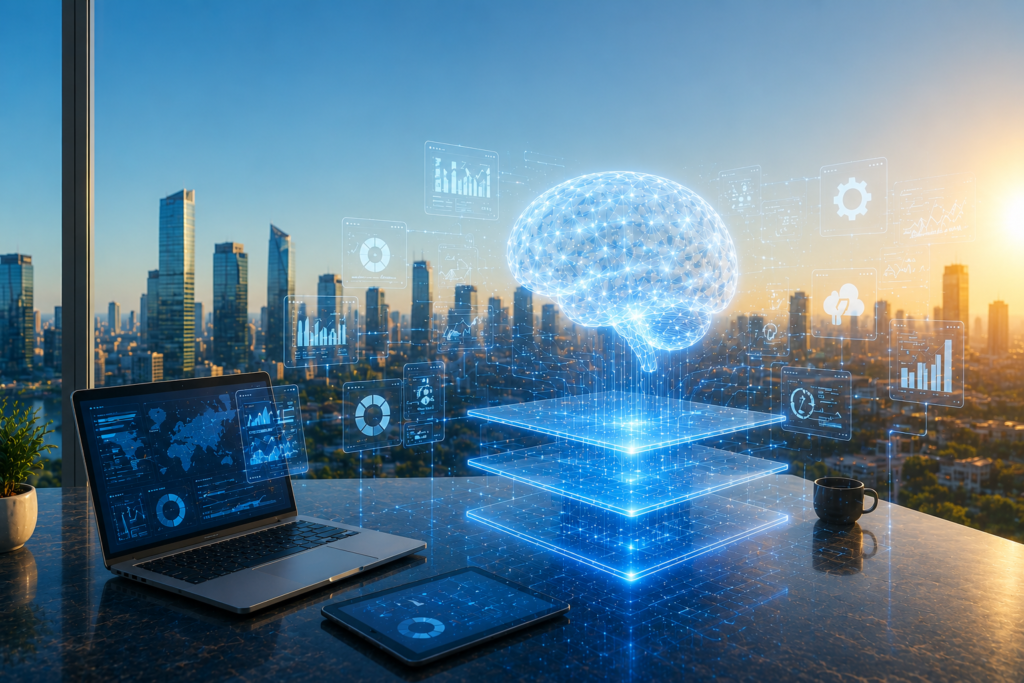
Enterprise software has traditionally been designed to help organizations record information, automate repetitive tasks, and standardize business processes. Customer relationship management platforms tracked sales opportunities, finance systems managed transactions, HR applications stored employee records, and collaboration tools facilitated communication. While these capabilities remain essential, enterprise software is undergoing a profound transformation. Increasingly, software is no longer limited to storing and processing information—it is beginning to understand it.
Artificial intelligence is moving beyond standalone applications and becoming a native capability embedded directly within enterprise SaaS platforms. Instead of requiring organizations to adopt separate AI products, modern enterprise applications are integrating intelligent features into everyday workflows. Employees can receive contextual recommendations, automate complex decisions, generate business insights, summarize documents, predict outcomes, and interact with software using natural language without leaving the applications they already use.
This evolution represents one of the most significant shifts in enterprise software since the transition from on-premises systems to cloud computing. Rather than replacing enterprise SaaS, artificial intelligence is fundamentally redefining what enterprise software is capable of accomplishing.
Enterprise Software Is Evolving from Systems of Record to Systems of Intelligence
For many years, enterprise applications primarily served as systems of record. Their purpose was to capture business information accurately, maintain historical records, and provide reliable reporting. While this remains an important function, organizations increasingly expect software to contribute actively to decision-making rather than simply presenting data.
Modern SaaS platforms analyze operational patterns, identify anomalies, recommend actions, prioritize work, and assist employees before they even recognize potential issues. Instead of asking users to search through reports, intelligent software proactively surfaces the information most relevant to current business objectives. This transition allows enterprise applications to become active participants in business operations rather than passive repositories of information.
Embedded AI Creates Better User Experiences
One of the biggest advantages of intelligent enterprise software is that artificial intelligence becomes nearly invisible to the end user. Employees are not required to learn entirely new applications or dramatically change their workflows. Instead, AI capabilities appear naturally within familiar interfaces where work is already being performed.
A sales representative receives recommendations for the next best customer action. A finance manager identifies unusual spending patterns before reviewing reports. Human resources professionals receive assistance drafting job descriptions. Customer support teams automatically summarize lengthy service conversations before responding. Because intelligence is integrated into existing workflows, organizations experience stronger adoption than they often achieve with standalone AI tools. Employees simply perform their work more efficiently without feeling that they are using separate artificial intelligence products.
AI Is Expanding Beyond Automation
Automation has long been a defining characteristic of enterprise software. Traditional automation follows predefined business rules that execute repetitive tasks consistently. Artificial intelligence introduces a new layer of capability. Rather than simply executing instructions, intelligent software evaluates context, identifies patterns, predicts future outcomes, generates content, and assists with complex decision-making. This shift enables organizations to automate knowledge work in addition to operational processes. Examples include drafting reports, summarizing contracts, identifying customer sentiment, forecasting inventory demand, recommending pricing strategies, and prioritizing service requests. The software becomes capable of assisting employees with cognitive tasks rather than only repetitive activities.
Context Is Becoming the New Competitive Advantage
Artificial intelligence produces the greatest business value when it understands organizational context. Generic AI systems generate useful responses, but enterprise SaaS platforms possess significant advantages because they already understand customer relationships, operational workflows, financial records, employee responsibilities, project histories, and organizational processes. This contextual awareness allows intelligent enterprise software to provide recommendations that are both accurate and immediately relevant.
Rather than generating generic answers, embedded AI operates using business-specific information while respecting organizational governance and security policies. The result is significantly more practical assistance within daily business operations.
Trust Determines AI Adoption
Organizations are enthusiastic about artificial intelligence, but they also recognize that enterprise software operates in environments where accuracy, compliance, accountability, and security are essential. Employees must understand how recommendations are generated, managers need confidence in automated decisions, and executives require governance over how AI interacts with sensitive business information. Successful enterprise SaaS vendors therefore focus not only on delivering intelligent features but also on ensuring those capabilities remain transparent, explainable, and controllable.
Trust becomes the foundation upon which meaningful AI adoption is built. Without trust, even sophisticated intelligence features remain underutilized.
Characteristics of Intelligent Enterprise SaaS
Although implementations vary across industries, leading enterprise software platforms increasingly share several AI-driven capabilities:
- Natural language interaction
- Intelligent workflow recommendations
- Predictive analytics
- Automated content generation
- Document summarization
- Conversational search
- Smart knowledge retrieval
- Personalized user experiences
- Decision support
- Continuous learning from business data
Together, these capabilities transform enterprise software from operational systems into intelligent business assistants.
Human Expertise Remains Essential
Despite rapid advances in artificial intelligence, enterprise SaaS is not eliminating the need for human expertise. Strategic decisions, ethical judgment, customer relationships, negotiations, creative thinking, and organizational leadership remain fundamentally human responsibilities. AI performs best when augmenting professionals rather than replacing them. Employees gain the ability to spend less time gathering information, creating repetitive documentation, or searching through large datasets and more time solving meaningful business problems. Organizations that position AI as a productivity partner typically achieve stronger adoption than those presenting it as a replacement for human expertise.
Intelligent SaaS Requires Responsible Governance
Embedding artificial intelligence into enterprise software introduces new governance responsibilities. Organizations must establish policies covering data quality, user permissions, privacy, auditability, model transparency, and responsible AI usage. Without strong governance, intelligent capabilities may introduce operational risks despite their potential productivity benefits. Leading enterprises therefore integrate AI governance into existing software governance frameworks, ensuring innovation remains aligned with compliance, security, and organizational values. Responsible governance enables organizations to adopt AI confidently while maintaining stakeholder trust.
The Future of Enterprise SaaS Will Be Defined by Intelligence
The next generation of enterprise software will be distinguished less by the number of features it offers and more by how intelligently those features support business outcomes. Employees will increasingly expect software to anticipate needs, recommend actions, automate knowledge work, surface relevant information, and simplify complex decisions without requiring extensive manual effort.
Organizations selecting enterprise SaaS platforms will evaluate not only functionality but also the quality of embedded intelligence, governance capabilities, and the ability to integrate AI seamlessly into existing workflows. Software that merely stores information will gradually give way to software that helps organizations understand, interpret, and act upon that information.
Intelligence Is Becoming the New Standard for Enterprise Software
Artificial intelligence is no longer an optional enhancement for enterprise SaaS—it is becoming a foundational capability that reshapes how organizations interact with technology. The greatest value does not come from replacing existing applications with entirely new AI systems but from making the software employees already rely on significantly smarter, faster, and more intuitive.
As intelligent capabilities continue expanding across business applications, enterprise software will increasingly function as a collaborative partner that supports decision-making, accelerates productivity, and uncovers opportunities hidden within organizational data. Companies that embrace this evolution thoughtfully, balancing innovation with governance and trust, will be better positioned to build more responsive, efficient, and competitive digital enterprises.
Ultimately, the future of Enterprise SaaS belongs not simply to software that manages business processes, but to software that actively helps businesses make better decisions every single day.