
Emerging tech & Deep tech • 12 days ago • Shruti Das
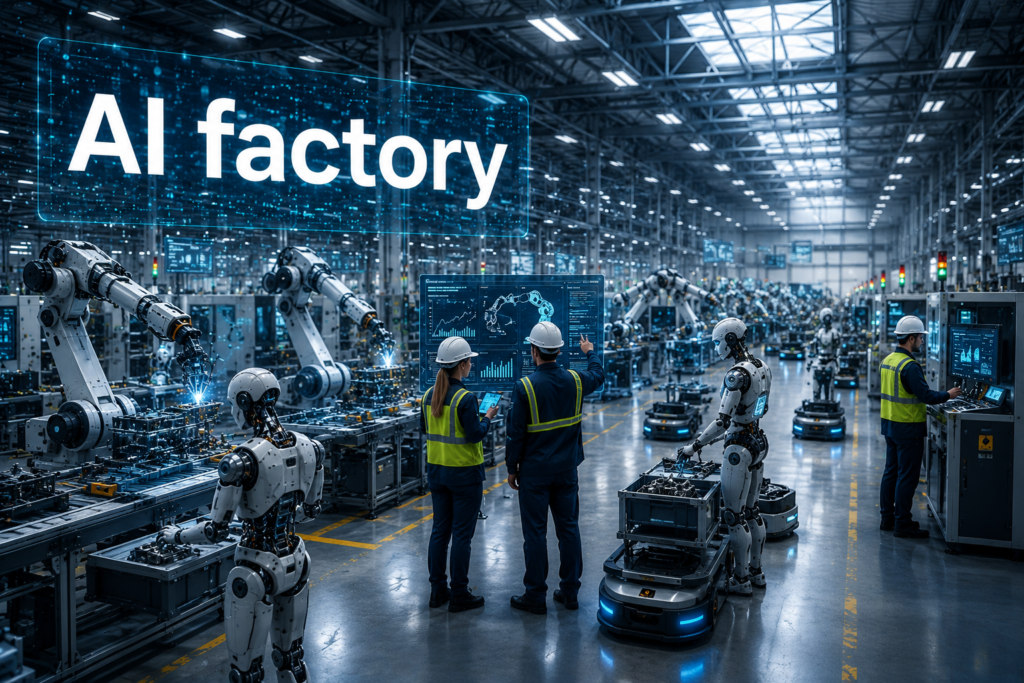
Artificial intelligence has rapidly evolved from an experimental capability into a strategic business asset. Enterprises across industries are embedding AI into customer experiences, business operations, software development, cybersecurity, analytics, and decision-making. However, as organizations scale their AI ambitions, many are discovering that conventional IT infrastructure was never designed to support the computational intensity of modern AI workloads. Training sophisticated models, running inference at scale, managing massive datasets, and delivering real-time intelligence require an entirely new class of infrastructure. This need has given rise to a transformative concept known as the AI Factory—a purpose-built ecosystem where data, computing power, networking, storage, and software operate together to continuously produce enterprise intelligence. Just as traditional factories transformed raw materials into physical products, AI factories transform raw data into insights, predictions, automation, and competitive advantage.
Unlike a standard data center, an AI factory is not simply a room filled with powerful servers. It is an integrated production environment engineered specifically for the AI lifecycle. Every component, from graphics processors and high-speed networking to distributed storage and orchestration software, is optimized to ensure that AI models can be trained, refined, deployed, and improved with maximum efficiency. Instead of viewing AI as another application running inside existing infrastructure, enterprises are beginning to treat AI as a production capability that requires its own operational foundation.
Why Traditional Infrastructure Is No Longer Enough
Enterprise infrastructure has historically been designed around business applications such as ERP systems, databases, collaboration platforms, and web services. These workloads demand stability, reliability, and predictable resource consumption. AI workloads behave very differently. They consume enormous computational resources, move vast quantities of data between storage and processors, and often require thousands of parallel calculations to complete complex learning tasks.
As organizations expand AI adoption, they frequently encounter bottlenecks that traditional infrastructure cannot easily overcome. Network latency slows distributed training. Storage systems struggle to feed data quickly enough to processors. Conventional scheduling systems cannot efficiently allocate specialized AI hardware. Infrastructure teams are forced to spend significant effort optimizing environments that were never intended for AI at scale.
This is precisely where AI factories become essential. Rather than adapting legacy infrastructure to meet AI demands, enterprises build environments where every architectural decision is optimized for intelligence production from the beginning.
What Defines an AI Factory?
An AI factory combines advanced infrastructure technologies into a unified operating model. Its purpose extends far beyond running machine learning models. Instead, it creates a continuous pipeline where enterprise data becomes valuable business intelligence through automated, repeatable processes. Several capabilities distinguish an AI factory from conventional infrastructure:
- High-performance accelerated computing for AI training and inference.
- Ultra-fast networking capable of transferring enormous datasets with minimal latency.
- Distributed storage architectures designed for AI-scale data access.
- Automated orchestration of AI pipelines from development through production.
- Continuous monitoring and optimization of model performance.
- Secure governance for enterprise AI workloads and sensitive data.
Rather than functioning as isolated technology components, these capabilities operate together as a coordinated production system that continually generates business value.
AI Factories Are Becoming Enterprise Production Lines
Manufacturing transformed global economies by standardizing production, improving efficiency, and enabling consistent quality. AI factories represent a similar shift for knowledge work. Instead of producing physical goods, they manufacture predictions, recommendations, automation, simulations, and intelligent decision support.
Every business interaction generates data. Customer purchases, application logs, operational metrics, financial transactions, supply chain events, and employee activities all become raw materials flowing into the AI factory. Sophisticated models process this information, identify meaningful patterns, and continuously improve their accuracy as additional data becomes available.
The result is an enterprise capable of learning from every interaction rather than merely recording it. Intelligence becomes a continuously generated asset instead of an occasional analytical exercise.
The Building Blocks of an AI Factory
While AI factories may differ across industries, several foundational layers remain consistent.
Accelerated Computing Modern AI depends on specialized processors capable of performing massive parallel computations far more efficiently than traditional CPUs. These accelerators dramatically reduce model training times while enabling increasingly sophisticated AI applications.
Intelligent Data Infrastructure Data must move seamlessly between storage, processing systems, and AI models without creating performance bottlenecks. Modern storage architectures emphasize speed, scalability, resilience, and intelligent data management rather than simply increasing capacity.
High-Speed Networking AI clusters exchange enormous volumes of information during distributed processing. High-bandwidth, low-latency networking ensures that thousands of processors operate as a synchronized system rather than isolated machines competing for resources.
AI Orchestration Platforms Managing hundreds of AI models manually quickly becomes impractical. Orchestration platforms automate resource allocation, workload scheduling, model deployment, version management, and lifecycle governance across the enterprise.
Beyond Technology: AI Factories Transform Business Operations
The significance of AI factories extends well beyond infrastructure modernization. They fundamentally change how organizations create business value. Instead of developing isolated AI projects for individual departments, enterprises establish centralized platforms capable of serving multiple business functions simultaneously. Marketing teams improve customer segmentation. Finance identifies fraud more effectively. Operations optimize supply chains. Human resources enhance workforce planning. Product teams accelerate innovation through predictive insights. This shared infrastructure reduces duplication, improves governance, and enables knowledge generated in one business domain to strengthen intelligence across the organization.
Perhaps more importantly, AI factories shorten the distance between experimentation and production. Ideas that once required months of infrastructure preparation can now move rapidly from concept to deployment because the underlying platform is already designed to support enterprise-scale AI.
Challenges Enterprises Must Address
Building an AI factory is not simply a hardware investment. Success depends upon careful architectural planning, governance, and operational maturity. Organizations must establish clear strategies for data quality, model governance, infrastructure utilization, security, compliance, and operational monitoring. Poor-quality data will produce unreliable intelligence regardless of computing power. Similarly, inadequate governance can create ethical, regulatory, and operational risks as AI becomes embedded within critical business processes.
Infrastructure scalability presents another important consideration. AI demand continues growing rapidly, requiring architectures capable of expanding without significant redesign. Enterprises that adopt modular, software-defined infrastructure are better positioned to accommodate future technologies as AI workloads become increasingly sophisticated.
Finally, energy efficiency is becoming an important strategic consideration. AI processing consumes significantly more power than traditional enterprise applications. Organizations must balance computational performance with sustainability objectives by investing in efficient cooling, intelligent workload scheduling, and optimized resource utilization.
AI Factories Will Define the Next Generation of Competitive Advantage
Every major technological revolution has been supported by a corresponding infrastructure revolution. Industrial machinery enabled mass manufacturing. The internet transformed global communication. Cloud computing democratized digital services. AI factories represent the next foundational platform for enterprise innovation.
Organizations that invest in AI factories are not simply purchasing more powerful infrastructure. They are creating environments where intelligence can be produced continuously, refined automatically, and delivered across every business function. The ability to transform data into actionable insight at enterprise scale will increasingly separate market leaders from competitors still relying on fragmented AI initiatives and conventional infrastructure.
As artificial intelligence becomes deeply integrated into enterprise software, customer experiences, cybersecurity, operations, and strategic decision-making, the organizations that succeed will be those capable of producing intelligence as efficiently as previous generations produced software. AI factories are rapidly becoming the production engines behind that transformation, enabling enterprises to shift from experimenting with AI to operating as truly intelligent businesses.