
Cybersecurity • 6 hours ago • Shruti Das
Enterprise technology environments have become too dynamic for security governance to rely on manual oversight alone. Every day, development teams deploy new applications, infrastructure platforms provision cloud resources automatically, APIs expose additional business capabilities, artificial intelligence systems gain access to enterprise knowledge, and software pipelines introduce thousands of configuration changes across increasingly distributed environments. What once required weeks of infrastructure planning can now occur within minutes through automation, fundamentally changing how organizations deliver technology.
While this acceleration has enabled unprecedented business agility, it has also exposed a significant weakness in traditional security governance. Policies that were originally designed for relatively stable environments now struggle to keep pace with continuous software delivery, cloud-native architectures, and autonomous infrastructure. Security teams often document governance requirements in lengthy policy manuals, compliance frameworks, or operational procedures, yet those documents depend heavily on people interpreting and applying them consistently. As the pace of enterprise change increases, maintaining that consistency becomes increasingly difficult.
The challenge is not that organizations lack security policies. Most enterprises have well-defined standards covering identity management, infrastructure configuration, encryption, data protection, network segmentation, access control, and regulatory compliance. The real challenge is ensuring that these policies are enforced automatically, consistently, and continuously across environments that may change thousands of times each day.
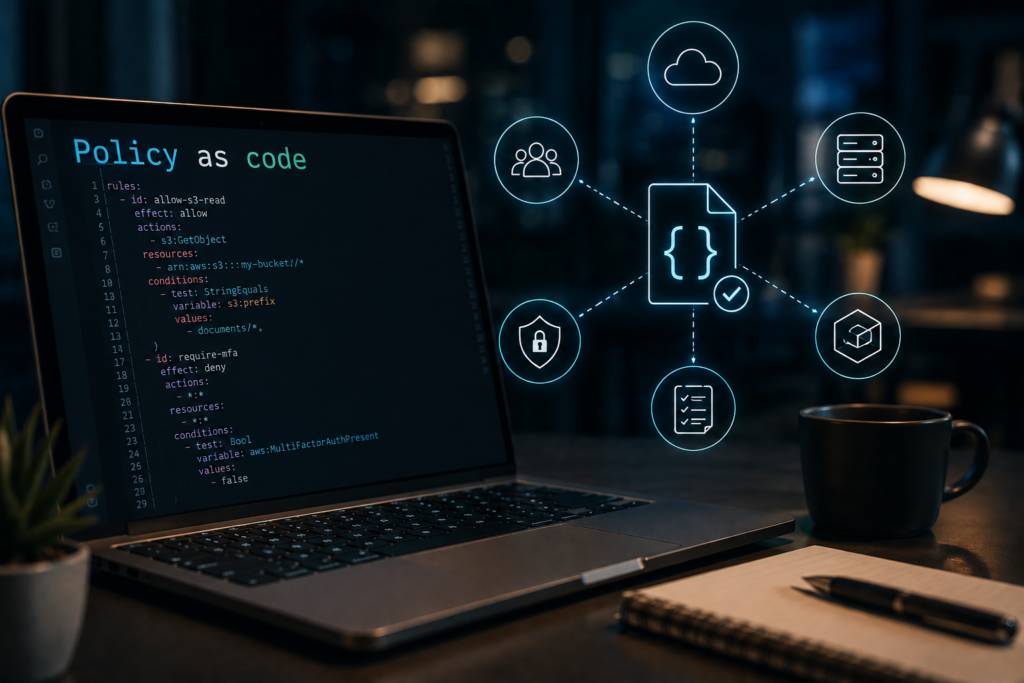
This is where Policy-as-Code Security represents an important evolution in enterprise governance. Rather than treating policies as static documents that guide human decision-making, Policy-as-Code transforms governance into executable rules that can be validated, enforced, and monitored automatically throughout the technology lifecycle. Security policies become active participants in enterprise operations, ensuring that governance scales alongside cloud platforms, development pipelines, AI services, and digital transformation initiatives.
The objective is not to replace human judgment with automation. Instead, it is to eliminate repetitive governance tasks while allowing security professionals to focus on higher-value decisions involving business risk, architecture, and organizational strategy.
Why Traditional Governance Cannot Keep Pace
Enterprise governance has historically relied on reviews, approvals, documentation, and periodic audits. These approaches were well suited to environments where infrastructure changed relatively slowly and software releases occurred only a few times each year. Security teams had sufficient time to review architecture diagrams, inspect configurations, validate compliance requirements, and approve deployments before systems entered production.
Modern enterprises operate under very different conditions. Continuous integration and continuous delivery pipelines deploy software multiple times each day. Cloud infrastructure scales automatically according to demand. Containers are created and terminated within seconds. APIs are published rapidly to support new digital services, while AI-powered applications continuously evolve through new models, datasets, and business capabilities.
Under these conditions, governance based primarily on manual review becomes increasingly difficult to sustain. Security teams risk becoming operational bottlenecks, while development teams face pressure to move faster than traditional approval processes can accommodate. As a result, organizations often encounter inconsistent policy enforcement, configuration drift, delayed compliance validation, and security controls that vary between cloud platforms, business units, or development teams.
Policy-as-Code addresses these challenges by embedding governance directly into enterprise delivery processes. Instead of verifying compliance after changes occur, organizations can evaluate policies automatically as infrastructure is provisioned, applications are deployed, APIs are published, or AI systems are introduced into production.
From Documentation to Executable Governance
Policies have traditionally existed as documents describing how systems should be configured and operated. Although these documents provide valuable guidance, they frequently require manual interpretation before they influence enterprise operations. Different teams may apply the same policy in different ways, creating inconsistencies that become increasingly difficult to identify as environments grow more complex.
Policy-as-Code introduces a fundamentally different model. Governance rules are expressed in machine-readable formats that technology platforms can evaluate automatically. Instead of asking whether a security engineer remembered to review a configuration, enterprise systems validate that configuration against predefined governance requirements before it reaches production.
Consider a cloud storage service being provisioned by an automated deployment pipeline. Rather than relying on a later audit to discover whether encryption has been enabled or public access has been disabled, Policy-as-Code evaluates these requirements immediately. If the proposed configuration violates enterprise policy, the deployment can be corrected before the resource becomes operational.
The same principle applies across a wide range of enterprise technologies. Identity platforms can verify that privileged access follows organizational standards. APIs can be evaluated against authentication and data protection requirements before publication. Infrastructure deployments can validate network segmentation, logging, and encryption settings automatically. AI services can be assessed to ensure that access to enterprise knowledge aligns with governance policies before deployment proceeds. By converting governance into executable rules, organizations reduce dependence on manual interpretation while improving consistency across the enterprise.
Governance as a Continuous Enterprise Capability
One of the most significant advantages of Policy-as-Code is that governance becomes continuous rather than event-driven. Traditional compliance activities often occur before deployments, during scheduled audits, or after security incidents have already highlighted operational weaknesses. This creates periods where infrastructure or applications may drift away from approved configurations without immediate visibility.
Policy-as-Code enables governance to operate continuously throughout the lifecycle of enterprise technology. Every infrastructure modification, software deployment, identity change, API publication, or configuration update can be evaluated automatically against organizational standards. Rather than waiting for periodic assessments, enterprises receive immediate feedback whenever proposed changes conflict with governance requirements.
This continuous approach is particularly valuable in cloud-native environments where infrastructure changes frequently and automated deployment pipelines introduce new capabilities at high speed. By integrating governance directly into operational workflows, organizations reduce the likelihood of security drift while allowing development teams to maintain delivery velocity.
Importantly, continuous governance does not imply inflexible governance. Policies can evolve alongside business priorities, regulatory requirements, and technology strategies. As new risks emerge or enterprise architectures change, governance rules can be updated centrally and applied consistently across every environment without requiring individual teams to reinterpret policy documents or modify manual procedures.
Building a Policy-as-Code Security Architecture
Policy-as-Code Security is not simply a development practice or an extension of infrastructure automation. It is an enterprise governance architecture that transforms organizational security requirements into executable policies capable of operating consistently across cloud platforms, applications, APIs, identities, AI services, and software delivery pipelines. Rather than relying on individual teams to interpret governance documents, the architecture enables enterprise platforms to evaluate security requirements automatically before changes become operational.
A mature Policy-as-Code architecture typically consists of several interconnected layers. The policy definition layer captures organizational requirements for identity management, data protection, network security, infrastructure configuration, regulatory compliance, and operational governance. These policies are then translated into machine-readable rules that can be evaluated consistently regardless of the underlying technology platform. An enforcement layer integrates with cloud environments, Infrastructure-as-Code templates, CI/CD pipelines, API gateways, identity platforms, and runtime environments, ensuring that governance decisions occur wherever enterprise changes take place. Finally, a reporting and analytics layer provides continuous visibility into policy compliance, exceptions, operational trends, and governance maturity across the enterprise.
This architecture ensures that governance is no longer confined to periodic reviews or isolated security tools. Instead, it becomes an integrated capability that accompanies every technology decision, allowing organizations to apply consistent security standards while maintaining the speed required by modern software delivery.
Embedding Governance into Enterprise Operations
One of the defining characteristics of Policy-as-Code Security is that governance becomes part of everyday operational workflows rather than a separate approval process. Security policies are evaluated during infrastructure provisioning, application deployment, API publication, identity configuration, and cloud resource creation, allowing compliance to be verified before changes reach production.
Consider a development team deploying a new customer-facing application into a multi-cloud environment. Traditionally, the application might undergo a security review after deployment, potentially delaying release if governance issues are discovered. Under a Policy-as-Code model, governance checks occur automatically as part of the deployment pipeline. Infrastructure configurations are validated against encryption requirements, network segmentation policies, logging standards, and identity controls before deployment proceeds. If a proposed configuration violates enterprise policy, the issue is identified immediately, enabling the development team to resolve it before introducing operational risk.
This approach changes the relationship between development and security teams. Instead of acting primarily as reviewers, security professionals become architects of governance frameworks that guide enterprise technology consistently across every project.
AI and Intelligent Policy Evaluation
As enterprise environments continue expanding, governance requirements inevitably become more complex. Organizations must manage policies spanning hybrid cloud environments, distributed applications, machine identities, AI systems, third-party integrations, data residency requirements, and industry-specific regulations. Maintaining consistency across this diversity requires analytical capabilities that extend beyond predefined rules.
Artificial intelligence strengthens Policy-as-Code by helping organizations interpret policies within their broader operational context. Rather than evaluating individual rules independently, AI can analyze how multiple governance requirements interact, identify conflicting policies, and recommend improvements based on changing business priorities and emerging security risks.
For example, an AI-assisted governance platform may recognize that a proposed infrastructure deployment satisfies all technical security controls while inadvertently increasing exposure through an unexpected dependency on a third-party service. It may also identify situations where multiple low-risk policy exceptions combine to create a significant operational concern that would otherwise remain unnoticed.
Importantly, AI should enhance rather than replace governance. Policy decisions affecting business operations often involve regulatory obligations, organizational priorities, and strategic considerations that require human oversight. AI contributes by providing explainable recommendations, highlighting potential risks, and helping governance teams maintain consistency across increasingly dynamic enterprise environments.
Enterprise Applications of Policy-as-Code Security
Although often associated with cloud infrastructure and DevSecOps, Policy-as-Code delivers value across a much broader range of enterprise technology disciplines.
Governing Cloud Infrastructure Cloud environments evolve continuously as resources are provisioned, modified, and retired through automation. Policy-as-Code ensures that security requirements such as encryption, identity management, network segmentation, backup policies, and logging standards are validated automatically before infrastructure becomes operational.
Securing Software Delivery Pipelines Modern software delivery depends on rapid, automated deployment processes. Embedding governance into CI/CD pipelines enables organizations to identify policy violations during development rather than after software reaches production, reducing remediation costs while improving deployment confidence.
Protecting Enterprise APIs APIs frequently expose critical business capabilities to customers, partners, and internal systems. Policy-as-Code validates authentication mechanisms, authorization controls, encryption requirements, rate-limiting policies, and data governance standards before APIs become available, reducing the likelihood of inconsistent security implementations.
Governing AI Systems Artificial intelligence introduces governance challenges that extend beyond traditional software development. Organizations must ensure that AI systems access only approved enterprise knowledge, process data according to regulatory requirements, and operate within clearly defined business boundaries. Policy-as-Code enables these governance requirements to be evaluated consistently throughout the AI lifecycle, supporting responsible enterprise AI adoption.
Business Benefits Beyond Compliance
Many organizations initially view Policy-as-Code as a compliance initiative, but its long-term value extends far beyond satisfying regulatory requirements. By embedding governance directly into enterprise operations, organizations improve consistency, reduce operational overhead, and strengthen collaboration across technology teams. Key business benefits include:
- Consistent enforcement of security policies across cloud, on-premises, and hybrid environments.
- Faster software delivery through automated governance validation.
- Reduced configuration drift by evaluating changes before deployment.
- Improved collaboration between security, development, infrastructure, and platform engineering teams.
- Stronger governance for APIs, machine identities, and AI-powered applications.
- Better audit readiness through continuously generated governance evidence.
- Reduced manual review effort, allowing security teams to focus on architecture and strategic risk management.
- Greater organizational confidence that enterprise standards are being applied consistently across every technology initiative.
Perhaps the most important outcome is cultural rather than technical. Governance becomes an enabler of innovation instead of an obstacle to delivery, allowing organizations to scale digital transformation without sacrificing security or compliance.
Implementing a Policy-as-Code Strategy
Successful implementation begins with recognizing that governance modernization is as much an organizational initiative as a technical one. Organizations should first identify the security and compliance policies that are applied most frequently and determine which of those policies can be expressed as executable rules.
A practical implementation roadmap typically begins by standardizing governance requirements across cloud infrastructure, identity management, networking, and application deployment. These policies can then be integrated into Infrastructure-as-Code templates, CI/CD pipelines, and cloud provisioning workflows. As governance maturity increases, organizations should extend Policy-as-Code to APIs, SaaS platforms, AI systems, and operational configuration management while continuously refining policies based on evolving business objectives and regulatory requirements.
Equally important is establishing governance metrics that measure policy effectiveness rather than simply counting violations. Indicators such as deployment consistency, configuration stability, remediation time, governance automation coverage, and business impact provide a far more meaningful assessment of organizational maturity.
The Future of Enterprise Governance
Enterprise governance is evolving from documentation and periodic review toward continuous, intelligent decision-making. As organizations adopt autonomous infrastructure, AI-powered business processes, software-defined networks, and increasingly dynamic cloud environments, governance must operate at the same speed as enterprise technology.
Future governance platforms will evaluate not only whether a policy has been violated, but also how proposed changes influence business objectives, regulatory obligations, operational resilience, and enterprise risk. Artificial intelligence will assist by identifying emerging governance patterns, recommending policy improvements, and explaining complex decisions, while human experts continue providing strategic oversight and organizational judgment.
Policy-as-Code represents an important milestone in this evolution by transforming governance into an active enterprise capability rather than a passive documentation exercise.
Conclusion
Modern enterprises can no longer rely on governance processes designed for slower, more predictable technology environments. Cloud-native architectures, automated software delivery, distributed identities, APIs, and AI-powered systems require security policies that operate continuously alongside enterprise operations rather than independently of them.
Policy-as-Code Security addresses this challenge by converting governance from static documentation into executable intelligence that can be applied consistently across every stage of the technology lifecycle. By embedding security requirements directly into infrastructure, applications, deployment pipelines, and operational workflows, organizations improve consistency, reduce manual effort, and strengthen their ability to innovate securely.
As enterprise technology continues accelerating, organizations that treat governance as an intelligent, automated capability rather than a periodic compliance exercise will be better positioned to support digital transformation while maintaining resilience, trust, and operational excellence.