
Cybersecurity • 6 hours ago • Shruti Das
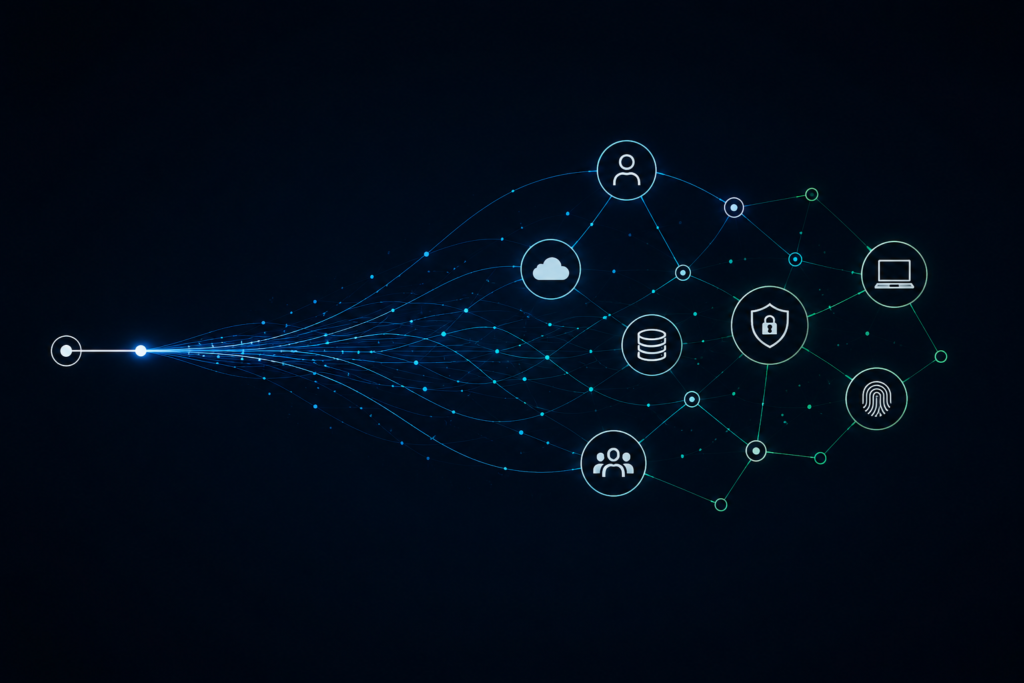
Enterprise cybersecurity has never suffered from a lack of data. Every second, organizations generate millions of security signals from endpoints, cloud platforms, identity systems, applications, firewalls, APIs, network devices, email gateways, developer tools, and countless other digital assets. Security Operations Centers (SOCs) are inundated with alerts, dashboards, vulnerability reports, and threat intelligence feeds, yet despite this abundance of information, many organizations continue to struggle with one fundamental challenge: understanding what truly matters.
The problem is not visibility. Modern enterprises are more observable than ever before. The problem is context.
Consider a seemingly ordinary security alert. An employee logs into a cloud application from an unfamiliar location. Independently, an API begins transferring larger-than-normal volumes of data. A privileged service account requests elevated permissions inside a Kubernetes cluster. A developer pushes an infrastructure change that modifies network policies. Each event appears isolated when viewed through individual security tools. Traditional monitoring platforms may classify them as medium-priority incidents or dismiss them as routine operational activity.
However, when these events are connected through business relationships, identity dependencies, application architecture, and workload interactions, they reveal something entirely different. The employee account owns the API credentials. The API supports a customer-facing financial application. The Kubernetes cluster hosts sensitive payment services. The infrastructure change unintentionally expanded access permissions across multiple production workloads. What initially appeared as unrelated operational events suddenly becomes a coordinated security risk demanding immediate attention.
This ability to understand relationships rather than individual events represents one of the most significant shifts occurring in enterprise cybersecurity. Organizations are beginning to realize that collecting more alerts will not produce better security outcomes. Instead, they need systems capable of understanding how enterprise assets, identities, applications, workloads, and business processes interact with one another.
This emerging architectural approach can be described as a Security Context Graph—an intelligent layer that transforms isolated security data into connected operational knowledge. Rather than treating every alert as an independent event, Security Context Graphs build a continuously evolving map of enterprise relationships, enabling security teams to investigate incidents with greater speed, accuracy, and business awareness.
The Limits of Alert-Centric Security
For years, cybersecurity investments have focused on improving detection. Organizations deployed endpoint protection, SIEM platforms, cloud security tools, vulnerability scanners, network monitoring solutions, identity platforms, and threat intelligence services to increase visibility across increasingly complex environments. While these investments significantly improved detection capabilities, they also introduced an unintended consequence: alert overload.
Security analysts often spend considerable time investigating events that ultimately prove harmless while genuinely critical incidents remain buried beneath thousands of routine notifications. This is not because security tools fail to detect threats, but because they typically evaluate events within the boundaries of their own data sources.
An endpoint platform understands device behavior. An identity platform understands authentication. A cloud security platform understands infrastructure. An application monitoring tool understands performance. Individually, each solution provides valuable insights. Collectively, they still struggle to explain how seemingly unrelated events influence one another.
The result is a fragmented security landscape where analysts must manually assemble evidence from multiple systems before making informed decisions. As enterprise environments continue expanding across hybrid cloud, SaaS applications, APIs, AI workloads, and distributed infrastructure, this manual correlation becomes increasingly difficult to sustain.
From Security Data to Security Relationships
Every enterprise operates as a network of interconnected relationships. Employees interact with applications. Applications depend on APIs. APIs communicate with databases. Databases support business processes. AI systems retrieve enterprise knowledge. Containers exchange information across clusters. Third-party vendors integrate directly into internal platforms. These relationships define how the organization functions every day.
A Security Context Graph captures these connections and continuously updates them as the environment evolves.
Rather than storing security information as disconnected records, it organizes enterprise assets into a living relationship model where every entity is connected through meaningful operational context. For example, a Security Context Graph may understand that:
- An employee belongs to the finance department and regularly accesses payroll systems.
- A customer portal depends on three APIs hosted across separate cloud environments.
- A privileged service account manages automated infrastructure deployments.
- Multiple AI applications retrieve information from the same enterprise knowledge repository.
- A recently discovered vulnerability affects applications supporting revenue-generating services.
- Several business-critical workloads share identical authentication dependencies.
Individually, these facts have limited value. Together, they create a comprehensive understanding of enterprise operations that dramatically improves security decision-making. Instead of asking, “Is this alert suspicious?” security teams can begin asking far more valuable questions:
- Which business services depend on this compromised workload?
- Which identities could be affected if this API is exploited?
- What customer-facing applications rely on this infrastructure component?
- Which privileged accounts interact with this database?
- Could this vulnerability disrupt critical business operations?
These questions shift cybersecurity from reactive monitoring toward operational intelligence.
Why Context Is Becoming More Valuable Than Detection
Attackers rarely operate within the boundaries of a single technology platform. Modern cyberattacks move laterally across identities, cloud environments, APIs, endpoints, applications, and infrastructure. Their success depends on exploiting relationships that traditional security tools often evaluate independently.
Imagine an attacker compromises a developer account. They authenticate successfully using valid credentials, access a source code repository, modify deployment pipelines, introduce malicious configuration changes, and ultimately gain privileged access to production workloads. Each individual action may appear legitimate because it aligns with the user’s historical permissions. Only when viewed collectively does the sequence reveal malicious intent.
A Security Context Graph provides the connective tissue that links these activities into a coherent narrative. Instead of analyzing authentication, infrastructure, application behavior, and privileged access as separate events, it understands how each action contributes to the broader operational picture.
This contextual awareness enables security teams to prioritize incidents based not only on technical severity but also on business impact. A medium-risk vulnerability affecting a mission-critical customer platform may deserve immediate attention, while a technically severe issue isolated within a non-production testing environment may require a different response.
By incorporating business relationships into security analysis, organizations improve both response quality and resource allocation, ensuring that attention is directed toward the risks that matter most.
Building a Security Context Graph
A Security Context Graph is not another security tool added to an already crowded technology stack. Instead, it acts as an intelligence layer that connects information from existing enterprise systems and continuously enriches it with operational context. Rather than replacing endpoint protection platforms, identity management solutions, cloud security tools, vulnerability scanners, or Security Information and Event Management (SIEM) platforms, it enables these technologies to work together more intelligently.
At its core, the graph represents enterprise entities as connected nodes. These nodes may include employees, service accounts, applications, APIs, cloud resources, databases, containers, devices, workloads, business units, suppliers, or AI systems. Relationships between these entities continuously evolve as applications are deployed, infrastructure changes, employees switch roles, or business processes expand.
Unlike static asset inventories that quickly become outdated, a Security Context Graph continuously reflects the operational state of the enterprise. Every authentication event, infrastructure modification, configuration update, application deployment, or workload interaction enriches the graph with additional context. As the organization grows, the graph becomes increasingly intelligent, enabling security teams to understand not only what exists within the environment but also how everything interacts.
This relationship-centric model transforms security investigations from searching across disconnected systems into exploring an interconnected enterprise ecosystem.
AI as the Intelligence Layer
Artificial intelligence significantly amplifies the value of Security Context Graphs because modern enterprises generate far more relationships than any human team can manually analyze. AI excels at identifying hidden dependencies, unusual behavioral patterns, and previously unknown attack paths across complex environments.
Instead of simply matching alerts against predefined rules, AI can evaluate the broader operational context surrounding every event. It understands how identities interact with applications, how workloads communicate across cloud environments, how APIs support customer-facing services, and how infrastructure changes influence business operations.
For example, a seemingly minor configuration change inside a development environment may appear harmless in isolation. However, AI analyzing the Security Context Graph may recognize that the same configuration indirectly affects authentication services supporting multiple production applications. It can identify downstream risks before they become operational incidents.
Similarly, AI can discover relationships that security analysts may never consider during routine investigations, including:
- Shared authentication dependencies between unrelated business applications
- Common infrastructure components supporting multiple critical services
- Machine identities with unnecessary privileged access
- Third-party integrations introducing unexpected trust relationships
- AI applications accessing sensitive enterprise knowledge without appropriate governance
By reasoning across relationships instead of isolated events, AI helps organizations prioritize the risks that are most likely to affect business continuity.
Enterprise Use Cases
The practical value of Security Context Graphs extends well beyond incident investigation. They become a foundational capability supporting multiple enterprise cybersecurity functions.
Accelerating Incident Response When analysts receive an alert, they no longer need to manually gather information from numerous security tools. The graph immediately reveals connected assets, affected identities, dependent applications, business owners, infrastructure relationships, and potential downstream impacts. This dramatically reduces investigation time while improving decision quality.
Strengthening Vulnerability Prioritization Organizations often discover thousands of vulnerabilities during routine scanning activities. Addressing every finding immediately is rarely practical. A Security Context Graph enables organizations to prioritize vulnerabilities based on business importance rather than technical severity alone. A moderate-risk vulnerability affecting a revenue-generating customer platform may deserve immediate remediation, while a critical vulnerability isolated within a disconnected testing environment may represent significantly lower business risk.
Securing Hybrid and Multi-Cloud Environments Modern enterprises operate across multiple cloud providers, on-premises infrastructure, SaaS applications, edge environments, and increasingly distributed AI platforms. Maintaining visibility across these environments can be challenging when each platform uses different security models. By connecting relationships across these environments, Security Context Graphs provide a unified understanding of enterprise security regardless of where workloads reside.
Supporting Compliance and Governance Regulatory compliance increasingly depends on demonstrating visibility, accountability, and controlled access to sensitive information. A Security Context Graph provides continuous evidence of how identities access systems, how applications exchange information, where sensitive data flows, and how governance policies are enforced across interconnected environments. This contextual visibility simplifies audits while reducing the manual effort traditionally associated with compliance reporting.
Business Benefits Beyond Cybersecurity
Although Security Context Graphs enhance threat detection and incident response, their long-term value extends far beyond the security function. They enable organizations to make more informed operational and strategic decisions by exposing relationships that were previously hidden across the enterprise. Organizations adopting this architectural approach can realize several advantages:
- Faster security investigations through automated relationship mapping
- More accurate prioritization of vulnerabilities based on business impact
- Reduced alert fatigue by correlating related security events
- Improved collaboration between security, cloud, infrastructure, and application teams
- Greater visibility across hybrid, multi-cloud, and SaaS environments
- Better governance of human, machine, and AI identities
- Enhanced resilience by identifying critical operational dependencies before failures occur
- More effective executive reporting using business-oriented risk insights rather than technical metrics
Perhaps the greatest benefit is the shift in perspective. Security teams stop asking whether individual alerts are dangerous and begin understanding how threats affect business operations as a whole.
Implementing a Security Context Graph Strategy
Organizations do not need to redesign their entire security architecture to benefit from contextual intelligence. Most successful implementations evolve gradually by enriching existing capabilities rather than replacing them. A practical implementation strategy typically includes the following steps:
- Establish a reliable inventory of enterprise assets, identities, applications, and workloads.
- Integrate existing security platforms into a common intelligence layer.
- Map operational relationships between systems, users, APIs, cloud resources, and business services.
- Continuously enrich the graph using telemetry from infrastructure, applications, identity systems, and cloud environments.
- Introduce AI-driven analysis to identify hidden dependencies and emerging attack paths.
- Align security prioritization with business-critical services instead of technical severity alone.
- Continuously refine relationship models as the enterprise evolves.
This incremental approach allows organizations to gain meaningful value while leveraging their existing cybersecurity investments.
The Future of Enterprise Cyber Defense
Enterprise technology is becoming increasingly interconnected. Artificial intelligence is introducing autonomous systems capable of making operational decisions. APIs are expanding digital ecosystems beyond organizational boundaries. Cloud-native platforms create dynamic infrastructure that changes by the minute. Machine identities now outnumber human users by a significant margin, and digital business processes rely on thousands of interconnected services working together seamlessly. In this environment, security can no longer rely solely on detecting isolated events.
The future of enterprise cyber defense depends on understanding relationships, dependencies, and operational context in real time. Organizations that can interpret these connections will respond to threats more quickly, prioritize risks more effectively, and make security decisions that support broader business objectives.
Security Context Graphs represent an important step toward this future by transforming enterprise cybersecurity from a collection of disconnected monitoring systems into an intelligent decision-making capability.
Conclusion
The modern enterprise does not operate as a collection of isolated systems, and cybersecurity should not treat it that way. Every identity, application, workload, API, cloud resource, and business process forms part of an interconnected digital ecosystem where a single event can have consequences far beyond its point of origin.
Security Context Graphs address this challenge by providing the missing intelligence layer that connects technical signals with operational meaning. Instead of overwhelming security teams with disconnected alerts, they enable organizations to understand how risks propagate across business relationships, technology dependencies, and digital workflows.
As enterprise environments continue growing in complexity, context will become just as valuable as visibility. Organizations that invest in contextual intelligence today will be better equipped to build resilient, adaptive, and business-aware cybersecurity programs capable of protecting the next generation of digital enterprises.