
Digital Transformation • 2 days ago • Neha Jamwal
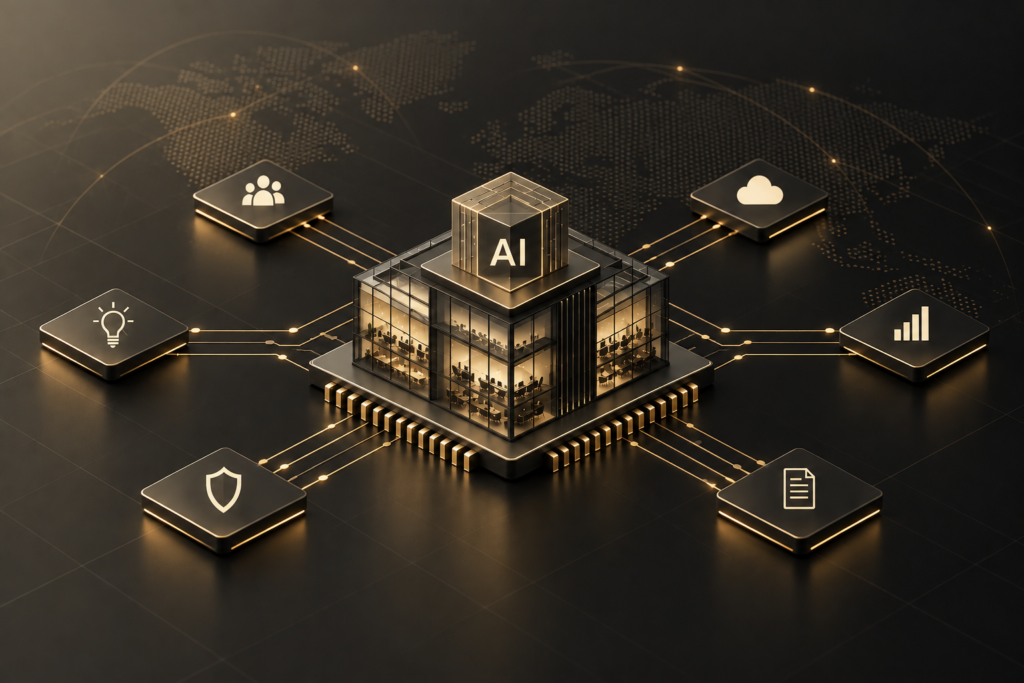
For much of the past decade, digital transformation followed a relatively familiar playbook. Enterprises moved applications to the cloud, digitized customer interactions, automated repetitive processes and replaced paper-based or disconnected workflows with software. The objective was to become digital-first: faster, more connected and less dependent on manual processes.
That model is now beginning to evolve. Artificial intelligence is pushing enterprises toward a more fundamental form of transformation, one in which AI is not simply added to existing digital systems but increasingly becomes part of how work is designed, decisions are supported and processes operate. The emerging ambition is the AI-native enterprise.
The difference may sound subtle, but it represents a significant shift in how organizations think about transformation. A digital-first enterprise uses technology to improve how people work, while an AI-native enterprise increasingly redesigns workflows around a combination of people, software, automation and AI systems.
Recent developments across the technology industry illustrate how seriously this shift is being taken. Microsoft, for example, announced a change to its financial reporting structure that groups much of its cloud and AI business under Agents and Infrastructure, reflecting how closely AI agents, cloud services and enterprise infrastructure are becoming connected in its strategy. The announcement is a useful signal of the broader direction of enterprise technology: AI is increasingly being treated not as a standalone feature but as something intertwined with the systems on which businesses operate.
The important point is not that every company is about to become fully autonomous. Most enterprises are nowhere near that stage, and many should not be. The bigger change is that AI is moving from the edges of the organization toward its operating model. Digital transformation was largely about digitizing and connecting the enterprise; the next phase is increasingly about redesigning it around intelligence.
Digital-first was about putting work into software
The digital transformation era largely focused on moving business activity into digital systems. Customer interactions shifted to websites and mobile applications, employees began collaborating through cloud-based platforms, and business processes became increasingly supported by workflow software, ERP systems and SaaS applications. These changes were significant, but the basic operating model often remained broadly the same: humans initiated processes, software processed information and automation handled predefined tasks.
Technology became faster and more capable, but people generally remained responsible for interpreting information, making decisions and moving work between different systems. AI is beginning to challenge that structure because modern AI systems can do more than process predefined instructions. Depending on the technology and permissions available, they can analyze information, interpret requests, generate outputs, interact with multiple systems and support increasingly complex workflows.
This is where the distinction between adding AI to a digital business and becoming an AI-native enterprise becomes important. Adding a chatbot to a customer service platform does not necessarily change an organization’s operating model. Using AI to redesign how customer issues are identified, prioritized, investigated and resolved potentially does. The same principle applies across the enterprise: transformation becomes more meaningful when AI is not simply layered on top of existing processes but used to reconsider whether those processes should continue operating in the same way at all.
AI-native does not mean putting AI everywhere
There is a risk that the term AI-native becomes another technology buzzword. Enterprises have already experienced enough transformation programs built around fashionable terminology rather than clear business outcomes, so being AI-native should not mean inserting an AI feature into every application or replacing every employee interaction with an agent.
A more meaningful definition is architectural and operational. An AI-native organization designs systems and workflows with the assumption that intelligence can be embedded into the process itself. AI can assist people where judgment is required, automate tasks where decisions are predictable and connect activities that previously required multiple manual handoffs.
Consider a traditional business process involving several departments. Information may move from one system to another, employees may review data at different stages, and decisions may depend on emails, spreadsheets and institutional knowledge. An AI-native approach could instead ask whether that workflow can be redesigned around a shared understanding of the information and the desired outcome. AI systems could retrieve relevant context, automate routine steps and surface exceptions to employees who are better positioned to apply judgment.
The goal is not necessarily to remove people from the process. In many cases, the more valuable objective is to remove unnecessary work from people. That distinction will become increasingly important as enterprises move beyond experimentation and begin looking for measurable returns from their AI investments.
The transformation is moving from tasks to workflows
The first wave of enterprise generative AI focused heavily on individual productivity. Employees used AI to write documents, summarize meetings, generate code, analyze information and answer questions. These applications demonstrated immediate value because they could improve the speed of individual tasks without requiring organizations to redesign their underlying technology architecture.
Improving individual tasks, however, is not the same as transforming an enterprise. The larger opportunity increasingly lies in workflows. A customer service employee may use AI to summarize a case more quickly, but the business impact remains limited if the surrounding process is fragmented. A more ambitious transformation examines the entire workflow, including how requests are received, classified, investigated, routed and resolved.
AI agents are making this conversation more relevant because they can potentially participate across multiple stages of a workflow. Rather than simply generating an answer, an agent can retrieve information from approved systems, use tools and support actions across connected applications. This is one reason recent enterprise research is increasingly focusing on process reinvention rather than AI deployment alone.
A Deloitte survey published in August 2026 found that 74% of surveyed leaders expect nearly half of their business processes to be redesigned or rebuilt around AI agents within four years. At the same time, only 5% of organizations said their processes were highly prepared for AI agents, highlighting a significant gap between enterprise ambition and operational readiness.
That gap may become one of the defining challenges of digital transformation over the next several years. Enterprises have spent years digitizing existing processes, but AI is now forcing them to ask whether those processes were designed efficiently in the first place.
The AI-native enterprise needs a different operating model
Technology transformation has traditionally been divided into separate categories. Cloud teams managed infrastructure, data teams managed information, automation teams focused on processes and software teams built applications, while business leaders focused on operations. AI increasingly connects these areas.
An AI agent needs access to reliable data, which requires governance and identity controls. It may also need infrastructure capable of supporting AI workloads while interacting with business applications and automated workflows. This means an AI strategy that operates independently from data, infrastructure and process transformation is unlikely to scale effectively.
The broader industry discussion around agentic organizations reflects this convergence. McKinsey, for example, argues that organizations moving toward agentic models will need to rethink operating models across areas including technology, data, governance, workforce and business design. Its central argument is that AI agents are likely to create more value when organizations redesign workflows around human and AI collaboration rather than simply adding agents to existing processes.
Whether enterprises adopt the language of the “agentic organization” or the “AI-native enterprise,” the underlying principle is becoming increasingly difficult to ignore: AI transformation is a systems problem, not simply a software procurement decision. A powerful AI model cannot compensate for fragmented data, and an intelligent agent cannot operate effectively if it lacks access to the systems required to complete a task. Similarly, automation cannot create meaningful business value if the underlying workflow remains poorly designed.
The AI-native enterprise is therefore likely to be defined less by the number of AI tools it owns and more by how effectively intelligence is integrated across its operating environment.
Data becomes the connective tissue
Digital transformation created enormous volumes of enterprise data. Customer interactions, transactions, applications and workflows all generated more information, but much of that information remains disconnected across cloud platforms, operational databases, SaaS applications and departmental systems.
Different teams may use different definitions for the same business concepts, while critical organizational knowledge can remain trapped in documents, emails and the experience of individual employees. This was already a challenge for analytics, but it becomes an even bigger challenge for AI.
An AI system needs more than access to large quantities of information. It needs context. It needs to understand which information is current, which source is authoritative and how different pieces of enterprise knowledge relate to one another. That is why the AI-native enterprise will depend heavily on data architecture.
The quality of an organization’s AI capabilities will increasingly be shaped by the quality of the environment surrounding them. Clean data, governance, semantic context, identity controls and integration will become essential components of transformation rather than back-office technology concerns. This may also change the relationship between CIOs, chief data officers and business leaders, because AI cannot be treated as a standalone initiative owned by a single technology team when its effectiveness depends on decisions across the entire enterprise.
AI agents could change how organizations are structured
The most significant implications may eventually be organizational rather than purely technical. Traditional companies are generally structured around functions and departments, with work moving between finance, operations, sales, customer service, IT and other specialized teams.
AI agents introduce the possibility of organizing some work more directly around outcomes. A team responsible for a particular business outcome could increasingly be supported by multiple specialized AI systems, with one agent gathering information, another analyzing it and another supporting actions within approved systems.
Humans would continue to provide expertise, judgment and accountability, particularly when decisions involve significant financial, legal, ethical or customer consequences. However, the structure of work could become more flexible as organizations rethink how responsibilities and workflows are distributed.
McKinsey’s work on the emerging agentic organization similarly suggests that enterprises may move toward more outcome-focused networks in which humans supervise and collaborate with specialized AI agents across end-to-end workflows. The firm’s analysis emphasizes that this would represent a redesign of operating models rather than simply another layer of automation.
Traditional corporate structures are unlikely to disappear overnight. Most enterprises have complex legacy systems, regulatory requirements and deeply established organizational processes, so transformation will happen gradually and unevenly. The broader direction, however, is becoming clearer: AI is creating pressure to rethink not just individual jobs but the pathways through which work moves across the organization.
Legacy technology is becoming an operating-model problem
One of the biggest obstacles to becoming AI-native will be legacy technology. Many enterprises have spent years modernizing infrastructure yet still operate with highly fragmented application environments. Critical processes may depend on systems built decades ago, while business knowledge remains distributed across multiple platforms.
Generative AI can sometimes help employees work around these limitations. AI interfaces can make older systems easier to interact with, while AI-assisted development may accelerate modernization efforts. But there is a danger in using AI simply to place a more sophisticated interface over outdated processes.
An AI-native transformation should eventually address the underlying architecture. That does not necessarily mean replacing every legacy system, which would be expensive and unrealistic for many organizations. Instead, enterprises will increasingly need to determine which systems should be modernized, which can be integrated and which processes should be redesigned entirely.
The key question is likely to change from “Where can we add AI?” to “What would this workflow look like if we designed it today with AI available from the beginning?” That question can produce uncomfortable answers because some long-established processes exist primarily because older technology required them, while other organizational handoffs may no longer make sense when systems can share information and context more effectively.
The biggest challenge will still be organizational change
There is a temptation to view AI transformation primarily as a technology challenge. In reality, many of the hardest problems will involve people and organizational behavior.
Employees need to understand where AI can be trusted and where human judgment remains essential. Managers need to redesign workflows rather than simply measuring whether employees are using AI tools, while leaders need to establish accountability when decisions involve combinations of humans, software and increasingly autonomous systems.
There are also significant cultural questions. An organization built around rigid approval structures may struggle to take advantage of intelligent automation, while a company with fragmented ownership of data may find it difficult to deploy AI across business functions. A transformation program that treats employees as passive recipients of AI technology may also encounter resistance or fail to capture valuable operational knowledge from the people who understand existing processes best.
The AI-native enterprise will therefore require new capabilities from leadership. Technology leaders will need to understand business operations more deeply, business leaders will need a better understanding of how AI changes technology and risk, and data, security and governance teams will need to become involved much earlier in transformation decisions. The next phase of digital transformation is unlikely to succeed through technology implementation alone because it will require organizations to redesign how they work.
Digital transformation is becoming intelligence transformation
The term digital transformation is not disappearing. Cloud computing, automation, data platforms and modern applications remain essential, and in many ways they provide the foundation on which enterprise AI is now being built.
What is changing is the objective. The digital-first enterprise focused on ensuring that the organization could operate through connected digital systems. The AI-native enterprise increasingly asks how intelligence can operate across those systems.
That represents a much bigger ambition. It moves transformation from digitizing information to interpreting it, from automating predefined tasks to supporting more adaptive workflows and from simply connecting applications to creating systems capable of understanding context and responding to changing conditions.
Not every enterprise will become fully AI-native at the same speed. Some industries will move faster than others, while highly regulated organizations may adopt more cautious approaches. But the direction of enterprise transformation is increasingly clear: companies that spent the last decade building digital foundations are now beginning to discover what those foundations were preparing them for.
Digital transformation made the enterprise connected. AI transformation could make it increasingly intelligent.
Key Takeaways
- Digital-first and AI-native are not the same thing. Digital transformation digitized and connected business processes, while AI-native transformation increasingly redesigns how those processes operate.
- The biggest opportunity is moving from AI-powered tasks to AI-enabled workflows. Transformation becomes more significant when organizations rethink entire processes rather than simply adding AI tools to existing work.
- AI-native transformation is a systems challenge. AI, data, automation, infrastructure, governance and business applications need to work together.
- Data architecture will become increasingly strategic. AI systems need trusted, contextualized and governed enterprise information—not simply access to large volumes of data.
- AI agents could reshape how work is organized. Organizations may increasingly structure activities around outcomes supported by combinations of people, software and specialized AI systems.
- Legacy technology remains a major obstacle. Enterprises increasingly need to ask how workflows would be designed if AI were available from the beginning.
- Organizational change will be as important as technology. Becoming AI-native requires changes in leadership, workflows, accountability and collaboration.