
Data, AI & Analytics • 3 hours ago • Shruti Das
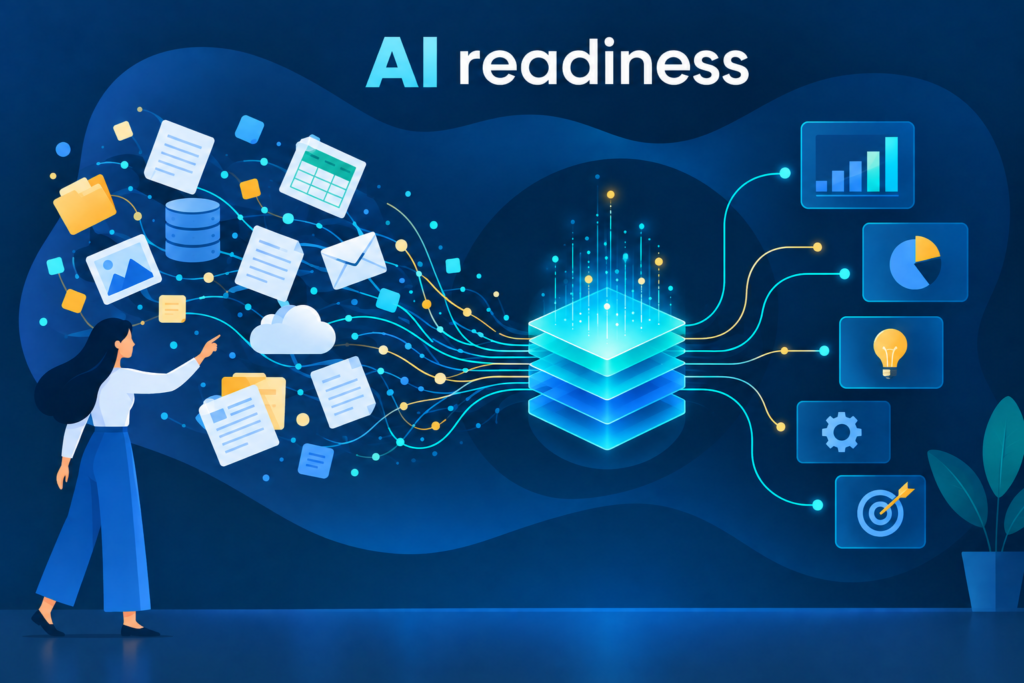
Enterprise AI has reached an interesting stage. The conversation is no longer dominated by whether organizations should experiment with generative AI, copilots or autonomous agents. Increasingly, businesses are asking a harder question: Can the data underneath these systems actually support them at enterprise scale?
That question is becoming more important as AI moves from experimentation into operational workflows. An AI assistant that summarizes documents can tolerate a certain amount of ambiguity. An AI system expected to analyze revenue, identify operational problems, recommend actions or work across enterprise applications cannot. It needs reliable information, consistent definitions, appropriate access controls and enough context to understand what the data actually represents.
This is creating a new enterprise bottleneck. The challenge for many organizations is no longer access to AI models. It is preparing the fragmented, inconsistent and often poorly governed data those models and agents need to work with. Recent developments across the enterprise data market reinforce that direction, from SAP’s focus on trusted enterprise data for agentic AI to new capabilities from Fivetran and dbt Labs designed around making enterprise data more usable by AI agents.
AI adoption is moving faster than data modernization
The traditional enterprise data modernization journey was already complicated before AI entered the picture. Companies accumulated data across ERP systems, CRM platforms, data warehouses, data lakes, SaaS applications, departmental databases and spreadsheets, often through years of acquisitions and technology changes. The resulting architecture may be functional enough for conventional reporting while still containing significant duplication, inconsistency and undocumented business logic.
AI exposes those weaknesses much more aggressively.
A dashboard can be designed around a carefully selected dataset and reviewed by an analyst who understands its limitations. An AI system operating across dozens of sources has a much broader surface area for encountering conflicting information. If two systems define an active customer differently, for example, an agent needs more than a field description to resolve the conflict. It needs business context and an authoritative definition.
This is why the distinction between having data and having AI-ready data is becoming increasingly important. Enterprise AI requires data that is discoverable, accessible, relevant, governed and sufficiently contextualized for the intended use case. IBM’s current data guidance similarly frames data quality, metadata, unified data, data integration and governance as core components of an AI-ready foundation.
The problem is that many organizations have historically optimized their data environments for human consumption. AI introduces a second consumer: software that can interpret information at machine speed and potentially use it to make recommendations or initiate actions.
That changes the standard enterprises need to meet.
The real problem is not dirty data alone
“Data quality” is often used as shorthand for the AI-readiness problem, but that description is too narrow. Poor-quality data is certainly an issue, but enterprises can also struggle with data that is technically accurate yet operationally difficult for AI systems to interpret.
Consider a customer record containing a perfectly valid revenue figure. The number itself may be correct, but an agent still needs to know whether it represents booked revenue, recognized revenue, annual recurring revenue or some internal management metric. It may also need to understand whether refunds, discounts, taxes, currency conversions or regional adjustments have already been applied.
That is a context problem, not simply a data-quality problem.
The distinction becomes even more important as AI agents work across structured and unstructured information. Contracts, emails, product documentation, support conversations, policies and internal knowledge bases can contain information that is essential to understanding a transaction or customer relationship. Leaving that context outside the analytical architecture can make an apparently intelligent system surprisingly shallow.
SAP’s latest discussion of agentic AI and enterprise data makes this point directly, arguing that fragmented and disconnected enterprise information creates a significant barrier to making AI useful in real business environments. The article focuses on Reltio’s role in creating trusted, connected enterprise data that can provide AI systems with a more coherent understanding of the business.
AI agents are raising the bar for data engineering
The rise of agentic AI is changing what data engineering teams are expected to deliver. Historically, the objective was often to move data reliably from source systems into a warehouse or lake, transform it and make it available for reporting, analytics and downstream applications.
That remains important, but it is no longer enough.
AI agents need data that can be understood in context, accessed according to policy and connected to other relevant information. They may need fresh information rather than yesterday’s batch. They may need structured business definitions rather than raw database fields. They may also need to understand relationships between entities that were never explicitly modeled because human analysts already knew how those relationships worked.
This is one reason the data stack is beginning to incorporate more explicit context and semantic capabilities. Fivetran and dbt Labs, for example, announced new capabilities this month aimed at making enterprise data more agent-ready, including a Fivetran Context Layer and dbt capabilities intended to provide richer context for AI systems.
The strategic implication is significant. Data engineering is increasingly being asked to prepare information not just for queries, dashboards and applications, but for machine reasoning. That requires a different level of attention to metadata, lineage, semantics, freshness, access and explainability.
The warehouse cannot be the entire AI strategy
For years, enterprise data strategy often revolved around centralization. Move important information into the warehouse or lakehouse, standardize the transformation process and make the resulting data available to analytics teams.
AI complicates that model because not every useful piece of information can or should be treated identically.
Some workloads require real-time operational data. Others depend on documents and unstructured content. Some information is highly sensitive and subject to strict access controls. Some workloads need analytics to happen close to where the data already resides rather than copying everything into a centralized environment.
This is reflected in EDB’s recent launch of an agentic database and converged analytics capabilities, which positions intelligence closer to enterprise data while combining database, analytics and governance functions. The company’s argument is that in an agentic environment, moving intelligence closer to where enterprise data already lives can reduce unnecessary data movement and simplify the path toward governed AI.
The important point is not whether every enterprise should adopt an agentic database. It is that AI is forcing organizations to reconsider an assumption that has shaped data architecture for years: that centralizing information is always the primary answer.
The better question is increasingly where data needs to live, how it needs to be governed and how intelligent systems will consume it.
Unstructured data is becoming part of the AI foundation
One of the biggest gaps in enterprise AI strategies is the treatment of unstructured data.
Structured databases are comparatively easy to reason about. Tables have fields, fields have types and relationships can be modeled. Enterprise documents are different. A contract can contain a critical commercial clause buried in several pages of text. A support conversation may reveal why a customer is dissatisfied. An internal policy may determine whether an AI agent is permitted to perform a particular action.
AI systems can process these sources, but simply making documents searchable does not necessarily make them reliable inputs for enterprise decision-making.
The data needs to be classified, contextualized, connected to relevant entities and governed appropriately. Otherwise, an AI agent may retrieve information without understanding its authority, currency or relationship to structured enterprise records.
This is one reason recent enterprise data announcements are increasingly emphasizing context rather than storage alone. The goal is shifting from collecting more information toward creating an environment in which AI systems can determine which information matters and how it should be interpreted.
That may become one of the defining data-management challenges of the agentic era.
Governance has to start before the model does
AI governance is often discussed as a model problem: prevent hallucinations, evaluate outputs, monitor models and establish responsible-use policies. Those are important concerns, but enterprise AI governance begins much earlier in the data pipeline.
If an agent has access to outdated customer information, governance cannot repair the underlying problem after the answer has been generated. If a user is incorrectly granted access to sensitive data, an accurate AI response can still represent a security failure. If two business systems disagree over a critical metric, model-level safeguards cannot magically establish which definition the organization considers authoritative.
Data governance therefore becomes part of AI governance.
This requires enterprises to think about data ownership, access policies, lineage, quality thresholds, semantic definitions and auditability as components of the AI architecture itself. The closer AI systems move toward autonomous execution, the less practical it becomes to treat governance as a separate committee or periodic review exercise.
The shift is already visible in enterprise data platforms, where governance, context and AI capabilities are increasingly being packaged together rather than treated as separate layers.
The cost of bad data gets higher when AI scales
Bad data has always been expensive, but its impact was often limited by the speed and scale of human decision-making. An analyst might discover an error after reviewing a report, or a manager might challenge an unusual number before acting on it.
AI changes the economics of that failure.
An agent can potentially process thousands of records, answer large numbers of questions and initiate workflows far faster than a human team. If the underlying data contains a systematic error, the problem can therefore propagate much more quickly.
This does not mean organizations should avoid automation. It means they need to distinguish between automation at scale and trusted automation at scale.
The distinction is particularly important as organizations move from generative AI assistants toward systems capable of taking actions. An incorrect recommendation can be reviewed. An incorrect automated change to a customer account, financial process or operational workflow can have consequences beyond the original analytical error.
The data foundation consequently becomes part of the organization’s risk-control architecture.
AI readiness is becoming an operating-model issue
The AI-ready data conversation is also changing who owns the problem.
It is tempting to assign responsibility to the data engineering team, but the underlying issues often span the entire organization. Finance owns definitions for important financial metrics. Sales owns customer processes. Legal owns contractual constraints. Security controls access. Data teams build the technical infrastructure. Business leaders determine which decisions can be automated.
An AI-ready enterprise therefore needs cooperation across these functions.
This is particularly important for semantic consistency. A technical team can document how a field works, but the business still has to decide what a metric means and which definition should be authoritative. Without that agreement, organizations can build highly sophisticated AI infrastructure on top of unresolved business ambiguity.
The emerging data operating model may consequently look less like a pipeline factory and more like a shared system of business context. Data teams provide the infrastructure, but business functions contribute the definitions, policies and institutional knowledge that make the data meaningful.
The next phase of AI investment may be less visible
There is a natural tendency to associate AI investment with visible products: copilots, assistants, agents, model platforms and new applications. Yet a significant part of the next enterprise AI cycle may happen underneath those interfaces.
Organizations will need to invest in data quality, metadata, integration, lineage, semantic models, identity, governance, observability and unstructured-data processing. None of these capabilities is as visually impressive as an autonomous AI agent, but they determine whether the agent can operate reliably once it leaves a controlled demonstration environment.
That creates an interesting inversion in enterprise technology strategy. The more autonomous AI becomes, the less sufficient it is to treat the data layer as plumbing.
Data becomes part of the intelligence architecture itself.
The AI-ready enterprise is not the one with the most AI
The next stage of enterprise AI may therefore be determined less by how many models or agents an organization deploys and more by whether its data environment can support them reliably.
A company can adopt the latest model, build an impressive AI interface and connect an agent to dozens of enterprise systems, but those investments will have limited value if the underlying information remains fragmented, ambiguous or poorly governed. Conversely, improvements to data quality, context and accessibility may not produce an immediately visible AI feature, yet they can create the foundation on which multiple AI applications eventually depend.
That changes how CIOs, CDOs and data leaders should think about AI readiness. It is not simply a checklist for connecting data to a model. It is an ongoing effort to make enterprise information trustworthy, contextual, accessible and actionable without losing control.
The companies that recognize this may begin treating data infrastructure as a strategic component of AI rather than a prerequisite that should have been solved before the AI project started.
And that may be the more important shift happening underneath the current AI boom. The race to deploy AI is increasingly becoming a race to make enterprise data understandable to machines.
The winners of that race will not necessarily be the organizations with the largest collection of AI tools. They will be the ones that can turn fragmented information into trusted enterprise context—and make that context available to intelligent systems at the moment it is needed.
Key Takeaways
- AI adoption is exposing weaknesses in enterprise data foundations. Fragmented systems, inconsistent definitions, poor metadata and disconnected information become more consequential as AI systems operate across multiple sources.
- AI-ready data is about more than data quality. Enterprises also need context, semantics, lineage, accessibility, freshness and clear business definitions so AI systems can understand what information actually means.
- Agentic AI raises the standard for data engineering. Data teams increasingly need to prepare information for machine reasoning, not just traditional dashboards, reporting and analytics workloads.
- Unstructured data is becoming part of the AI foundation. Contracts, documents, support conversations and internal knowledge can contain critical business context that structured databases alone cannot provide.
- Data governance is becoming part of AI governance. Access controls, ownership, lineage, quality and authoritative definitions need to be established before an AI system produces or acts on an answer.
- Centralization is no longer the only architectural question. Enterprises increasingly need to consider where data should live, where intelligence should operate and how information can be governed across distributed environments.
- The cost of poor data increases as AI becomes more autonomous. Errors that once affected an individual report can potentially propagate across automated analytical and operational workflows.
- AI readiness is ultimately an operating-model challenge. Data, IT, security and business teams all contribute essential context, policies and definitions that determine whether enterprise AI can operate reliably.