
Enterprise Software (SaaS) • 9 days ago • Jessica Mahone
For decades, enterprise software has been designed around stability.
Business processes were configured once, workflows were standardized, and applications were expected to support operations for years with only periodic updates. While this model worked in relatively predictable business environments, modern enterprises operate in a world where customer expectations, regulations, market conditions, and technology capabilities change continuously.
Ironically, organizations have become agile while their software remains rigid.
Every business change often requires configuration updates, workflow redesign, custom development, integration modifications, and user retraining. The software that was intended to increase agility frequently becomes the very constraint limiting organizational responsiveness.
A new software philosophy is emerging to solve this challenge.
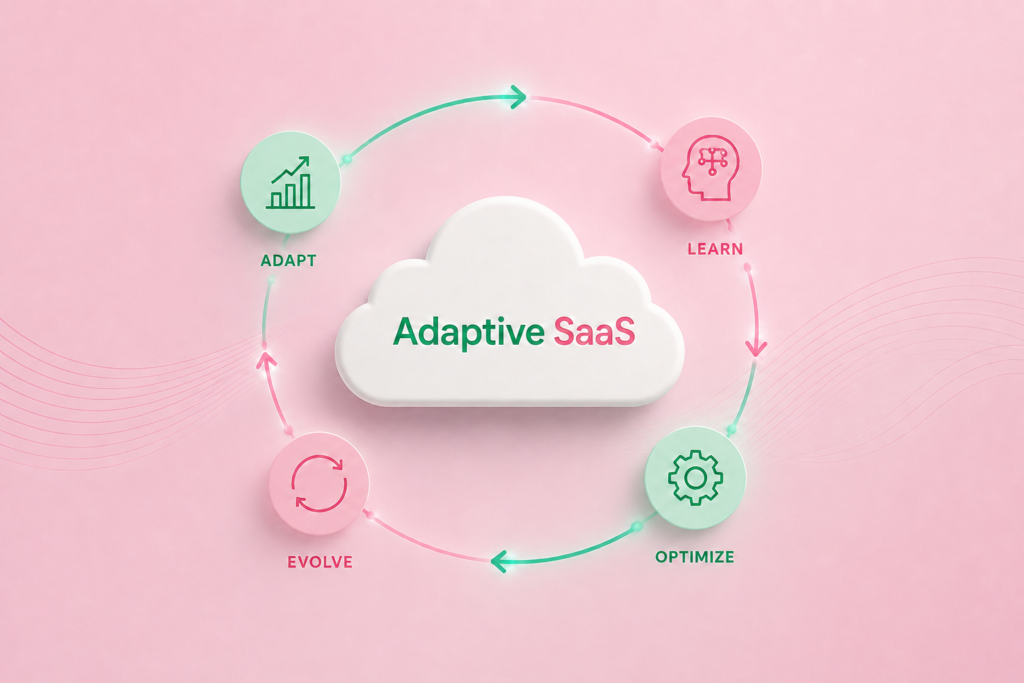
Known as Adaptive SaaS, this approach enables enterprise applications to continuously adjust their behavior based on changing business conditions, enterprise context, operational data, and organizational priorities.
Instead of forcing businesses to adapt to software, software begins adapting to the business.
The next evolution of enterprise applications may not be more features.
It may be continuous adaptation.
What Is Adaptive SaaS?
Adaptive SaaS refers to enterprise software capable of dynamically modifying workflows, recommendations, user experiences, automation rules, and operational logic without requiring extensive manual redesign.
The platform continuously learns from enterprise activity. It detects changing patterns. It adjusts execution strategies. It recommends new operational models. It evolves alongside the organization.
The application becomes a living system rather than a static product.
Why Traditional SaaS Is Becoming a Limitation
Most enterprise software assumes business processes remain relatively constant. However, organizations experience continuous change. New regulations emerge. Supply chains shift. Customer expectations evolve.
Artificial intelligence creates new opportunities. Business models transform.
Traditional SaaS platforms often require lengthy implementation projects every time operational changes occur. Adaptive SaaS minimizes this friction by allowing software behavior to evolve automatically within governed enterprise boundaries.
Configuration Is No Longer Enough
Historically, software flexibility has been achieved through configuration. Administrators modify fields, workflows, permissions, and rules. While useful, configuration remains reactive.
Adaptive SaaS introduces intelligence. The platform identifies opportunities for optimization before users request changes. It proposes process improvements. It reorganizes dashboards. It adjusts automation priorities. The software actively participates in enterprise evolution.
Context-Aware Enterprise Applications
Adaptive behavior depends on context. An approval workflow suitable during normal operations may become inefficient during supply chain disruptions. Customer engagement strategies may vary depending on market conditions. Resource allocation may require different priorities during rapid growth.
Adaptive SaaS continuously evaluates enterprise context before determining execution behavior. The same platform behaves differently according to organizational needs. Business flexibility becomes embedded within software architecture.
Artificial Intelligence as the Adaptation Engine
AI plays a central role in Adaptive SaaS. Rather than generating isolated insights, AI continuously observes enterprise operations and recommends operational improvements.
Potential adaptations include:
- Workflow optimization
- Dashboard personalization
- Automation refinement
- Resource prioritization
- Policy adjustment suggestions
- Intelligent routing
- User interface simplification
- Knowledge recommendations
- Capacity optimization
- Process redesign opportunities
Artificial intelligence transforms software from a passive tool into an active optimization partner.
Characteristics of Adaptive SaaS Platforms
Next-generation enterprise applications will increasingly demonstrate the following capabilities:
- Self-optimizing workflows
- Context-aware interfaces
- Dynamic automation
- AI-assisted personalization
- Intelligent process recommendations
- Event-driven adaptation
- Continuous learning
- Embedded governance
- Cross-functional orchestration
- Business capability awareness
These capabilities reduce operational complexity while improving organizational responsiveness.
The Shift from Features to Intelligence
For years, SaaS competition focused on feature count. Organizations compared applications based on functionality. The future competitive differentiator may instead be adaptability.
The software that understands enterprise context, anticipates operational change, and evolves automatically will deliver greater long-term value than software with static capabilities. Intelligence becomes the new feature.
Adaptation becomes the new product roadmap.
Building Adaptive SaaS Architecture
Adaptive enterprise software depends on several advanced technologies working together.
Key architectural components include:
- Semantic data models
- Enterprise knowledge graphs
- Agentic AI
- Event-driven architecture
- Decision intelligence engines
- Business capability mapping
- Process intelligence
- Metadata management
- Machine reasoning
- Autonomous orchestration
Together, these technologies enable software to continuously align itself with enterprise strategy.
Business Benefits Beyond Efficiency
Adaptive SaaS delivers benefits extending far beyond automation.
Organizations gain:
- Faster response to market changes
- Lower implementation costs
- Improved user adoption
- Reduced operational complexity
- Better AI utilization
- Stronger governance alignment
- Enhanced customer experiences
- Increased organizational resilience
- Continuous process improvement
- Greater return on software investment
The enterprise becomes more adaptable because its software becomes adaptable.
Why Adaptive SaaS Will Shape the Future of Enterprise Software
The pace of business change will continue accelerating. Organizations cannot afford enterprise platforms that require months of redesign whenever priorities shift.
Adaptive SaaS enables software to evolve continuously through intelligence rather than implementation projects. Applications become living ecosystems that learn, optimize, and improve alongside the enterprise. The relationship between business and software fundamentally changes. Software stops being infrastructure. It becomes an adaptive business capability.
Conclusion
Adaptive SaaS represents the next major evolution in enterprise software. By combining artificial intelligence, semantic understanding, process intelligence, and contextual awareness, applications gain the ability to evolve continuously with organizational needs.
Rather than serving as static repositories of business logic, they become intelligent operational partners capable of optimizing execution in real time. The future of enterprise software will not be defined by how many features it offers. It will be defined by how effectively it adapts.
Organizations that embrace adaptive software architectures today will build enterprises capable of responding to tomorrow’s uncertainty with speed, intelligence, and confidence.