
Digital Transformation • 4 days ago • Neha Jamwal
Most digital transformation initiatives begin with technology. Organizations invest in cloud platforms, enterprise applications, artificial intelligence, automation tools, and customer experience solutions with the expectation that these technologies will accelerate growth.
However, many transformation programs encounter a familiar obstacle. Technology changes. Business complexity remains.
Departments continue operating independently, duplicated processes persist, and investments become fragmented because organizations lack a clear understanding of what the business actually does at its core.
This is where the Business Capability Map becomes indispensable.
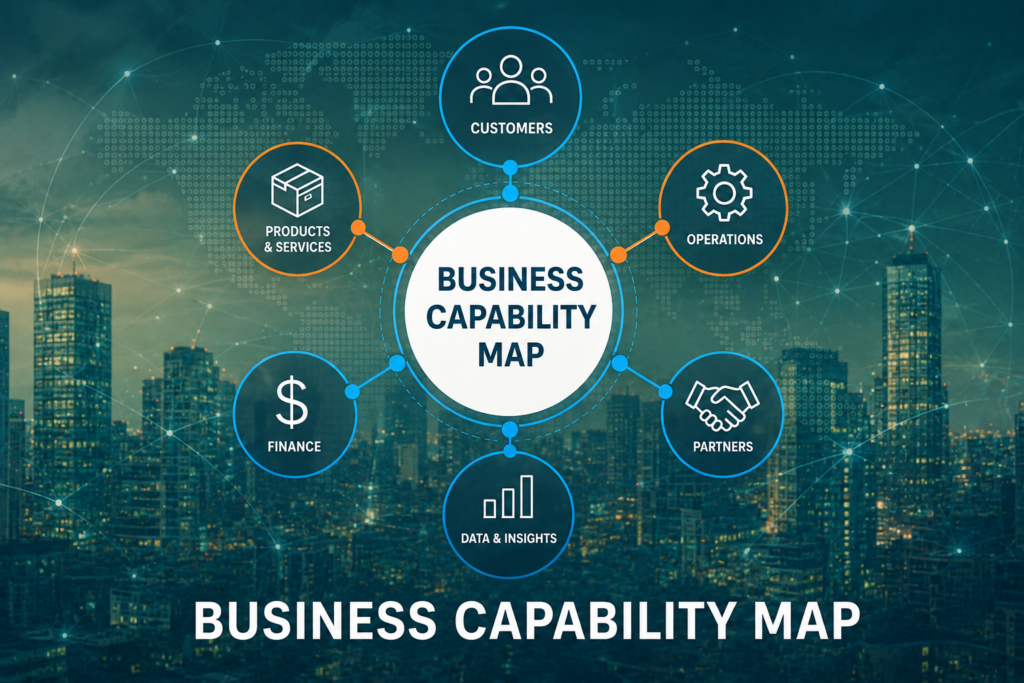
Unlike an organizational chart that reflects reporting structures or a process map that illustrates workflows, a Business Capability Map defines what an organization must be able to do to deliver value. It creates a stable blueprint that survives leadership changes, technology upgrades, and market shifts. Increasingly, leading enterprises are using capability mapping as the foundation for digital transformation, ensuring every investment strengthens a strategic business capability rather than solving an isolated problem. Digital transformation succeeds when technology aligns with capabilities—not departments.
What Is a Business Capability Map?
A Business Capability Map is a visual representation of the core abilities required for an organization to operate and compete effectively. Capabilities describe what the business performs, independent of how it is performed or who performs it. Examples include:
- Customer onboarding
- Product management
- Pricing strategy
- Order fulfillment
- Financial planning
- Risk management
- Contract lifecycle management
- Supplier collaboration
- Workforce management
- Decision support
Capabilities remain relatively stable even when processes and technologies evolve. They provide a long-term architectural foundation for transformation.
Why Digital Transformation Needs Capability Thinking
Many organizations prioritize technology projects based on immediate business requests. As a result, multiple systems emerge to solve similar problems. Teams purchase overlapping software. Processes become inconsistent. Integration complexity grows. Capability-based planning changes the conversation. Instead of asking, “Which software should we buy?” organizations ask, “Which business capability should we strengthen?” Technology becomes an enabler rather than the starting point. Transformation investments become more strategic and measurable.
Breaking Down Organizational Silos
Departments often optimize their own objectives while unintentionally creating friction for the enterprise. Sales seeks faster conversions. Finance prioritizes governance. Operations focuses on efficiency. Customer service values responsiveness. A Business Capability Map provides a common enterprise language that transcends organizational boundaries. Capabilities span multiple functions and encourage cross-functional collaboration. Transformation becomes enterprise-wide rather than department-specific.
Creating a Roadmap for Technology Investment
Without capability mapping, digital transformation often resembles a collection of disconnected projects. Organizations modernize applications independently without understanding strategic priorities. Capability maps help identify where technology investments generate the greatest business value. High-impact capabilities receive modernization first. Low-priority capabilities remain stable until business conditions require change. Investment decisions become aligned with enterprise objectives rather than short-term demands.
Data Gains Strategic Context
Enterprise data is frequently organized around applications instead of business capabilities. This makes it difficult to generate holistic insights. Capability mapping introduces business context to enterprise data.
Customer information connects to customer management capabilities. Operational metrics align with fulfillment capabilities. Financial information supports planning capabilities. Data becomes easier to govern, analyze, and share across the organization. The result is stronger analytics and more consistent decision-making.
Artificial Intelligence Performs Better with Capability Alignment
AI initiatives often struggle because they are introduced without understanding where they create the greatest business value. Capability maps identify the functions where AI can deliver measurable improvements. Examples include:
- Intelligent customer onboarding
- Automated document processing
- Predictive maintenance
- Demand forecasting
- Dynamic pricing
- Procurement optimization
- Workforce planning
- Fraud detection
- Decision support
- Contract analysis
AI becomes embedded within business capabilities rather than existing as isolated experiments.
Capability Mapping Supports Enterprise Agility
Markets evolve continuously. Customer expectations change. Regulations shift. Organizations that understand their capabilities can respond faster because they know precisely which business functions require enhancement. Instead of redesigning the entire enterprise, they strengthen individual capabilities while preserving overall stability. Adaptability becomes structured rather than reactive. Business agility emerges from architectural clarity.
Governance Becomes More Effective
Transformation initiatives often fail because accountability is unclear. Capability mapping establishes ownership for strategic business functions. Governance includes:
- Capability owners
- Performance metrics
- Data stewardship
- Technology alignment
- Investment priorities
- AI governance
- Continuous improvement
- Business outcomes
- Risk management
- Operational maturity
This governance model ensures every capability evolves intentionally and consistently.
Measuring Capability Maturity
Organizations should regularly evaluate the maturity of each business capability. Assessment dimensions include:
- Process standardization
- Technology enablement
- Data quality
- Automation level
- Customer impact
- Operational efficiency
- AI readiness
- Integration maturity
- Governance effectiveness
- Business resilience
Capability maturity provides a practical framework for prioritizing transformation initiatives and tracking long-term progress.
From Projects to Enterprise Evolution
Traditional digital transformation often consists of isolated implementation projects. Capability-driven transformation creates a continuous improvement model. Each enhancement strengthens a strategic business function. Each investment contributes to enterprise architecture. Each technology decision supports long-term organizational goals. Transformation becomes cumulative rather than fragmented. The enterprise evolves systematically instead of incrementally.
Conclusion
The success of digital transformation depends less on technology selection and more on organizational understanding. Business Capability Maps provide a stable blueprint that aligns technology investments with strategic business objectives, creating a foundation for agility, governance, innovation, and operational excellence. Organizations that adopt capability-driven transformation avoid fragmented modernization and build enterprises designed for continuous evolution.
In the next generation of B2B digital transformation, competitive advantage will belong not only to organizations with advanced technology, but to those with a clear understanding of the capabilities that truly drive business value.