
Emerging tech & Deep tech • 7 days ago • Jessica Mahone
Organizations have spent decades investing in technologies that help them collect, analyze, and visualize data. Dashboards summarize operational performance, predictive models estimate future outcomes, and artificial intelligence identifies patterns that would be difficult for humans to detect. These capabilities have significantly improved business intelligence, yet one critical question often remains unanswered: Why did something happen, and what will happen if we change it?
Most analytics platforms excel at identifying correlations. They can reveal that customer churn increases after delivery delays, that equipment failures become more frequent under certain operating conditions, or that specific marketing campaigns generate higher sales. While these observations are valuable, they do not necessarily explain the underlying causes. Acting on correlations alone can lead organizations toward ineffective strategies because two events occurring together does not always mean one causes the other.
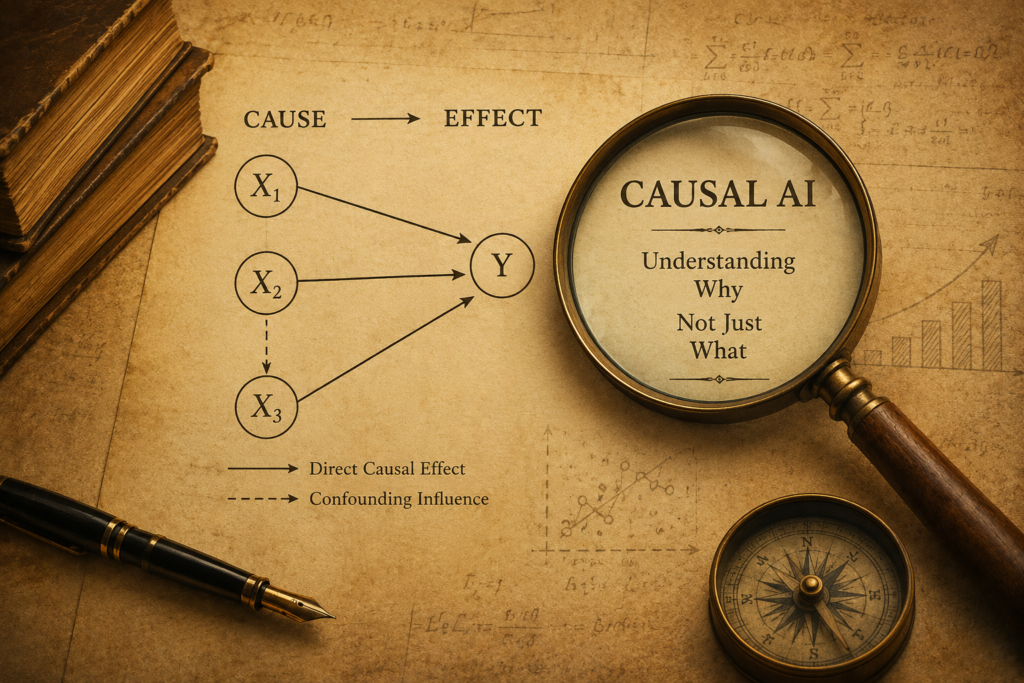
This limitation has created growing interest in Causal AI, an emerging field of deep technology that enables intelligent systems to reason about cause-and-effect relationships instead of relying solely on statistical associations. By combining machine learning, causal inference, probabilistic reasoning, graph-based modeling, and domain expertise, Causal AI helps organizations understand not only what is happening but also why it is happening and how different actions may influence future outcomes.
For enterprise leaders, this represents an important advancement. Decisions involving investments, pricing, operations, supply chains, healthcare, manufacturing, and customer experience rarely depend on isolated variables. They involve interconnected systems where one action often produces multiple downstream effects. Causal AI provides a framework for understanding those relationships before decisions are implemented, allowing organizations to move beyond prediction toward informed intervention.
Understanding Causal AI
Causal AI is an approach to artificial intelligence that focuses on identifying cause-and-effect relationships within complex systems. Its objective is not simply to recognize patterns in historical data but to determine how changes in one variable influence another while accounting for uncertainty, dependencies, and external factors.
Traditional machine learning answers questions such as:
- What is likely to happen next?
- Which customers may leave?
- Which machine is most likely to fail?
- Which products are likely to sell well?
Causal AI expands these capabilities by addressing questions such as:
- Why are customers leaving?
- Which operational changes will reduce equipment failures?
- What factors truly influence customer satisfaction?
- Which intervention is most likely to improve business performance?
This distinction is significant because enterprises rarely succeed by predicting events alone. Competitive advantage often comes from understanding which actions create measurable improvements.
Why Correlation Is Not Enough
Modern businesses generate enormous volumes of operational data, making it relatively easy to identify statistical relationships. However, correlation can be misleading when interpreted without context. Imagine an online retailer observes that customers who purchase premium accessories also tend to buy extended warranties. A predictive model may recommend promoting warranties whenever premium accessories are viewed. Yet the actual driver of both purchases could be something entirely different, such as customer income, purchase intent, or product complexity. If the underlying cause is misunderstood, marketing investments may produce disappointing results despite apparently strong statistical evidence. The same challenge appears across many industries:
- Higher production output may coincide with lower product quality, but workforce fatigue could be the actual cause.
- Customer complaints may increase after software updates, while the true cause is inadequate employee training.
- Rising logistics costs may appear related to transportation routes, even though supplier delays are creating the disruption.
Causal AI helps organizations distinguish genuine business drivers from coincidental relationships, reducing the likelihood of decisions based on incomplete evidence.
The Enterprise Causality Pyramid
One useful way to understand Causal AI is through what can be viewed as the Enterprise Causality Pyramid. This conceptual framework illustrates how organizations gradually develop deeper business understanding as analytical maturity increases.
Level 1: Observation The first level focuses on identifying what happened. Dashboards, reports, and business intelligence platforms summarize operational performance using historical data. Organizations gain visibility into trends but have limited understanding of the mechanisms producing those outcomes.
Level 2: Prediction Machine learning introduces the ability to estimate future events based on historical patterns. Businesses can forecast demand, anticipate equipment failures, estimate customer churn, and predict financial performance. Although prediction improves planning, it still does not explain why specific outcomes occur.
Level 3: Causal Understanding At this level, AI begins identifying relationships that explain how one variable influences another. Organizations gain the ability to evaluate root causes, understand business dependencies, and distinguish meaningful drivers from misleading correlations.
Level 4: Intelligent Intervention The highest level focuses on action. Causal AI evaluates potential interventions before implementation, estimating how proposed changes are likely to influence business outcomes. This transforms analytics from a reporting function into an active decision-support capability.
The Enterprise Causality Pyramid illustrates an important shift. Business intelligence evolves from describing events to understanding systems, enabling organizations to make decisions with greater confidence and precision.
How Causal AI Works
Although implementations vary across industries, most Causal AI systems follow a structured process that combines data analysis with domain knowledge and reasoning. The workflow generally includes:
- Collecting information from enterprise systems and operational data sources
- Identifying variables that influence business outcomes
- Building causal models that represent relationships between variables
- Testing assumptions using statistical inference and simulation
- Evaluating alternative interventions
- Estimating the impact of potential decisions
- Updating causal models as new information becomes available
Unlike traditional predictive models that primarily learn from patterns, Causal AI continuously refines its understanding of how business systems behave under changing conditions.
Core Technologies Supporting Causal AI
Several advanced technologies contribute to modern causal reasoning systems.
Causal Graphs represent relationships between variables using interconnected nodes and directional links. These structures allow AI to distinguish direct influences from indirect effects while modeling complex business systems.
Probabilistic Reasoning involves uncertainty. Probabilistic reasoning enables AI to estimate the likelihood of different outcomes while accounting for incomplete or imperfect information.
Counterfactual Analysis explores questions such as, “What would have happened if a different decision had been made?” This capability helps organizations evaluate alternative strategies without introducing unnecessary operational risk.
Simulation Models allow enterprises to test business scenarios before implementing changes. By modeling possible interventions in a virtual environment, organizations can estimate consequences while reducing uncertainty.
Enterprise Applications
Causal AI has broad applicability because nearly every industry depends on understanding why outcomes occur instead of merely observing them.
Healthcare Healthcare providers can distinguish factors that genuinely improve patient outcomes from variables that simply appear related. This supports better treatment planning, resource allocation, and operational decision-making.
Manufacturing Manufacturers can identify the true causes of quality issues, production delays, or equipment failures. Understanding causal relationships allows operational improvements to target root causes instead of treating symptoms.
Financial Services Financial institutions can evaluate how lending policies, pricing strategies, customer behavior, and economic variables influence long-term performance, leading to better risk management and investment decisions.
Retail and Customer Experience Retailers can analyze the factors that genuinely influence customer loyalty, purchasing behavior, and product demand. This enables more effective pricing strategies, marketing initiatives, and customer engagement programs based on causal understanding instead of statistical coincidence.
Business Benefits of Causal AI
Understanding cause-and-effect relationships gives organizations a significant advantage over relying solely on predictions. While predictive models estimate what is likely to happen, causal reasoning provides guidance on which actions are most likely to produce better outcomes. This distinction allows business leaders to move from reactive decision-making to purposeful intervention. Organizations adopting Causal AI can unlock several long-term benefits:
- Better strategic decision-making based on validated business drivers
- Improved resource allocation by focusing investments on activities with measurable impact
- More accurate root cause analysis for operational challenges
- Reduced business risk through scenario evaluation before implementation
- Higher confidence in AI-assisted recommendations
- Better policy development supported by evidence instead of assumptions
- More effective optimization across supply chains, manufacturing, finance, and customer experience
- Improved collaboration between business experts and data science teams
- Stronger governance by making decision logic more transparent
- Continuous refinement of enterprise knowledge as causal models evolve
Over time, these improvements strengthen an organization’s ability to adapt to changing market conditions while reducing costly trial-and-error decision-making.
Causal AI Versus Predictive AI
Predictive AI and Causal AI complement each other, but they serve different purposes within an enterprise. Predictive AI analyzes historical data to estimate future outcomes. It can forecast sales, identify customers who may cancel a subscription, estimate equipment failures, or detect unusual activity. These predictions are valuable for planning and operational efficiency.
Causal AI extends this capability by examining why those outcomes occur and how different actions may influence them. It helps organizations evaluate alternative strategies before implementing changes, making it particularly valuable for complex business decisions where multiple variables interact.
Consider a manufacturer experiencing declining production efficiency. A predictive model may correctly forecast further declines if current conditions continue. A causal model investigates the underlying drivers, such as maintenance schedules, equipment utilization, workforce allocation, supplier quality, or environmental conditions. By identifying the actual causes, the organization can implement targeted improvements instead of responding only to the predicted outcome.
Many enterprises achieve the greatest value by combining both approaches. Predictive models provide early warning, while causal models guide the actions most likely to improve results.
Common Misconceptions About Causal AI
As Causal AI receives more attention, several misconceptions have emerged that can create unrealistic expectations or limit adoption.
Misconception 1: Causal AI Replaces Machine Learning Causal AI builds upon machine learning rather than replacing it. Machine learning remains essential for identifying patterns, generating predictions, and processing large volumes of data. Causal reasoning adds another layer of intelligence by explaining relationships and evaluating interventions.
Misconception 2: Correlation Is Close Enough Strong statistical relationships are valuable, but they should not automatically be interpreted as causal evidence. Decisions based only on correlation can produce unintended consequences if hidden variables or external influences are overlooked.
Misconception 3: Causal Models Eliminate Uncertainty Business environments remain dynamic and uncertain. Causal AI improves understanding of relationships, but it cannot guarantee specific outcomes. Human judgment, market conditions, and unforeseen events continue to influence enterprise decisions.
Misconception 4: Causal AI Is Only for Researchers Although causal inference has academic roots, practical business applications continue to expand. Organizations across manufacturing, healthcare, finance, logistics, retail, and energy are beginning to apply causal reasoning to improve operational and strategic decisions.
Challenges and Adoption Considerations
Implementing Causal AI requires more than selecting a new analytical platform. Success depends on combining technology with deep business knowledge. One of the primary challenges involves defining meaningful causal relationships. Enterprise data often contains thousands of variables, many of which influence one another in complex ways. Domain experts play an essential role in identifying which relationships should be represented within causal models.
Data quality also remains a critical factor. Missing, inconsistent, or biased information can reduce the reliability of causal analysis. Strong governance, standardized data definitions, and continuous validation help improve model performance.
Another challenge involves organizational trust. Decision-makers are more likely to adopt causal recommendations when models provide clear explanations of how conclusions were reached. Transparency encourages collaboration between business leaders, analysts, and data scientists while strengthening confidence in AI-assisted decision support.
Computational complexity should also be considered. Building accurate causal models often requires greater effort than developing conventional predictive systems because relationships must be tested, validated, and refined as business conditions evolve. Organizations that approach implementation as a long-term capability instead of a one-time technology project are more likely to realize sustainable value.
Building a Culture of Causal Thinking
Technology alone cannot transform enterprise decision-making. Organizations also benefit from encouraging a mindset that consistently asks deeper questions before acting. Instead of stopping at observations such as “sales declined” or “customer complaints increased,” teams begin asking:
- What factors contributed to this outcome?
- Which variables have the strongest influence?
- Which interventions are likely to produce meaningful improvements?
- What unintended consequences could emerge?
- How can we validate our assumptions before implementation?
This habit of causal thinking strengthens strategic planning, operational improvement, and innovation. It encourages decisions based on evidence and reasoning instead of intuition alone. As more departments adopt this approach, organizations develop a richer understanding of how their systems behave, making future decisions more informed and more resilient.
The Future of Enterprise Causal Intelligence
As artificial intelligence continues to mature, enterprises will increasingly expect systems to explain recommendations instead of simply generating them. Understanding relationships between actions and outcomes will become as important as predicting future events.
Future causal platforms are expected to integrate with digital twins, simulation engines, optimization systems, and decision intelligence platforms. Together, these technologies will enable organizations to evaluate multiple scenarios, estimate business impact, and recommend interventions before changes are introduced into live operations.
This evolution also supports greater accountability. Executives, regulators, customers, and employees increasingly expect AI-driven decisions to be transparent and justifiable. Causal reasoning provides an important foundation for explainability by revealing the factors that influence recommendations and the assumptions behind them. As enterprise systems become more interconnected, causal intelligence is likely to become an essential capability supporting strategy, operations, risk management, and innovation.
Conclusion
Predicting the future has long been a central objective of business analytics, but prediction alone is no longer sufficient for organizations operating in increasingly complex environments. Sustainable competitive advantage comes from understanding how decisions influence outcomes and identifying the actions most likely to produce meaningful improvements. Causal AI represents an important advancement in enterprise intelligence by moving beyond pattern recognition toward genuine understanding of business systems. It helps organizations uncover root causes, evaluate interventions, reduce uncertainty, and make decisions supported by deeper analytical reasoning.
The organizations that benefit most from artificial intelligence will not be those that simply generate more predictions. They will be the ones that understand the relationships shaping their operations and use that knowledge to make better decisions with greater confidence. Causal AI provides the foundation for that next stage of enterprise intelligence, transforming data into actionable understanding and helping businesses navigate complexity with greater clarity.