
Emerging tech & Deep tech • 2 days ago • Shruti Das
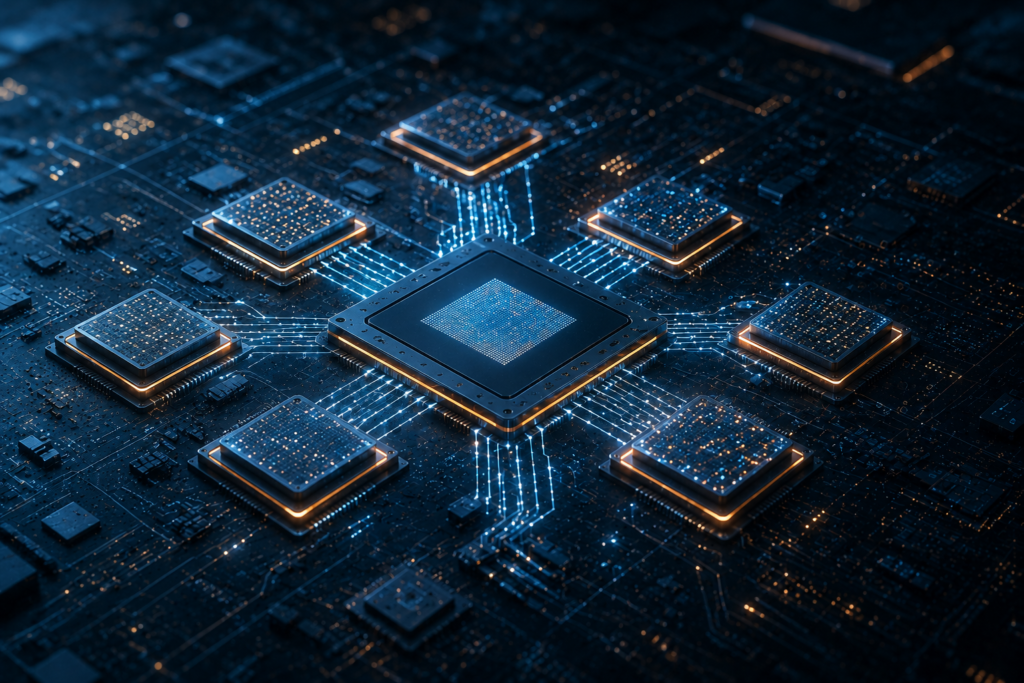
For decades, advances in computing have largely followed a predictable path. Semiconductor manufacturers packed more transistors onto increasingly powerful processors, delivering faster performance with each new generation of chips. This relentless pace of innovation transformed enterprise computing, enabling everything from cloud platforms and high-performance databases to artificial intelligence and advanced analytics. However, as chip manufacturers approach the physical and economic limits of monolithic processor design, the industry is embracing an entirely different architectural philosophy. Rather than building increasingly larger processors on a single piece of silicon, engineers are beginning to construct processors from multiple smaller specialized components known as chiplets. While this change may appear subtle, it represents one of the most significant shifts in semiconductor engineering and has the potential to reshape enterprise computing for decades to come.
Unlike traditional processors that integrate every function into one large chip, chiplet-based architectures divide different computing functions into smaller modular components that work together as a unified system. Processing cores, memory controllers, AI accelerators, networking engines, security modules, and input-output interfaces can all exist as individual chiplets connected through ultra-high-speed interconnect technologies. This modular approach allows manufacturers to optimize each component independently while dramatically improving scalability, manufacturing efficiency, and overall system performance.
Although largely invisible to end users, chiplets are rapidly becoming one of the foundational technologies behind modern data centers, AI infrastructure, cloud platforms, and high-performance enterprise computing.
Why Traditional Chip Design Is Becoming Unsustainable
For many years, improving processor performance primarily involved making transistors smaller and increasing their density within a single silicon die. While this strategy produced remarkable gains, manufacturing increasingly complex chips has become significantly more difficult. Larger processors experience lower manufacturing yields because even small defects can render an entire chip unusable. Development costs continue rising while engineering complexity grows with every new generation of semiconductor technology.
At the same time, enterprise workloads are becoming far more diverse. Artificial intelligence requires specialized matrix processors. Cloud infrastructure demands high-bandwidth networking. Cybersecurity benefits from dedicated encryption engines. High-performance analytics depend on massive memory bandwidth. Attempting to integrate every capability into one enormous processor creates both technical and economic challenges. Chiplets offer a more flexible alternative by allowing different functional blocks to be designed, manufactured, and optimized independently before being combined into complete processors.
Understanding the Chiplet Architecture
A chiplet is essentially a smaller semiconductor component designed to perform a specific function within a larger processor package. Instead of manufacturing one extremely large processor containing every feature, multiple chiplets are assembled together using advanced packaging technologies that allow them to communicate almost as efficiently as components on a single chip.
This modular design resembles constructing a building using specialized prefabricated components rather than pouring every element from scratch. Individual chiplets can be improved, replaced, or customized without redesigning the entire processor. Manufacturers gain greater flexibility while enterprises benefit from faster innovation and increasingly specialized computing platforms.
Why Enterprises Should Care
Although chiplet technology originates within semiconductor engineering, its enterprise impact extends throughout modern digital infrastructure. Every cloud service, enterprise application, AI model, cybersecurity platform, and business analytics solution ultimately depends upon the capabilities of underlying processors.
Chiplet-based architectures are expected to improve several areas of enterprise computing:
- Artificial intelligence acceleration.
- High-performance cloud infrastructure.
- Data center efficiency.
- Enterprise networking.
- Advanced cybersecurity processing.
- Scientific computing.
- Edge computing platforms.
- High-bandwidth memory integration.
As enterprise workloads become increasingly specialized, modular processor architectures enable hardware to evolve alongside changing business requirements rather than forcing every application to rely on generalized computing resources.
Accelerating Artificial Intelligence
Artificial intelligence has become one of the strongest drivers behind chiplet innovation. Modern AI systems require enormous computational resources while continuously transferring data between processors, memory, and storage. Traditional processor designs often struggle to balance these competing demands efficiently.
Chiplets allow manufacturers to integrate dedicated AI accelerators alongside general-purpose processing cores, creating heterogeneous computing environments optimized for machine learning workloads. Memory bandwidth can be expanded independently, networking chiplets can improve distributed AI training, and specialized security modules can protect sensitive AI models without redesigning the entire processor architecture. This flexibility enables enterprises to deploy infrastructure specifically optimized for AI rather than adapting conventional hardware to increasingly demanding workloads.
A New Era of Custom Enterprise Hardware
One of the most exciting aspects of chiplet technology is the possibility of customized processors built for specific industries or enterprise workloads. Instead of purchasing identical processors regardless of application, organizations may increasingly deploy hardware assembled from different combinations of chiplets.
Financial institutions could prioritize encryption and low-latency processing. Healthcare organizations may emphasize AI acceleration for medical imaging. Telecommunications providers might integrate specialized networking components. Cloud service providers could optimize processors for virtualization, storage, or distributed computing. This level of hardware customization has historically been prohibitively expensive. Chiplets make specialized processor design significantly more practical by allowing manufacturers to reuse standardized components across multiple product families.
Sustainability Through Smarter Semiconductor Design
Chiplets also introduce meaningful environmental advantages. Manufacturing smaller semiconductor components generally produces higher yields because defects affect only individual chiplets rather than entire processors. Functional components can often be reused across multiple processor generations, reducing development waste while extending product lifecycles.
Improved energy efficiency represents another important benefit. Specialized chiplets frequently perform dedicated tasks more efficiently than general-purpose processors, reducing power consumption across enterprise infrastructure. As organizations pursue ambitious sustainability objectives, modular processor architectures could play an increasingly important role in lowering the environmental impact of large-scale computing environments.
Challenges on the Path Forward
Despite their promise, chiplet ecosystems are still evolving. One of the industry’s largest priorities involves establishing common standards that allow chiplets from different manufacturers to communicate seamlessly. Greater interoperability will encourage broader innovation while preventing vendor-specific architectures from limiting enterprise flexibility.
Packaging technology also remains a critical area of advancement. Connecting multiple chiplets at extremely high speeds requires sophisticated manufacturing techniques capable of maintaining reliability, thermal efficiency, and performance comparable to traditional monolithic processors. Software optimization presents another opportunity. Operating systems, compilers, and enterprise applications must increasingly recognize heterogeneous processor architectures to fully utilize specialized computing resources. These challenges are significant but reflect a technology moving rapidly toward broader commercial adoption.
Small Components, Massive Transformation
Throughout the history of computing, transformative breakthroughs have often occurred beneath the surface, invisible to most users yet foundational to every technological advancement that followed. Chiplets represent exactly this type of innovation. Although enterprises may never see the modular components powering future processors, they will experience faster AI systems, more efficient cloud platforms, lower operational costs, improved sustainability, and infrastructure capable of adapting to increasingly specialized workloads.
Rather than attempting to build ever-larger processors, the semiconductor industry is embracing modularity as the next phase of computing evolution. This architectural shift promises greater flexibility, faster innovation, and more resilient hardware platforms capable of supporting the expanding demands of artificial intelligence, cloud computing, edge infrastructure, cybersecurity, and advanced enterprise applications. The next revolution in enterprise computing may not come from building bigger chips. It may come from building smarter ones—one chiplet at a time.