
Cloud & Infrastructure • 2 days ago • Shruti Das
Cloud computing transformed enterprise infrastructure by replacing static hardware with scalable, on-demand digital resources. Organizations gained unprecedented flexibility, allowing applications, data, and workloads to operate across multiple environments without the limitations of traditional infrastructure.
As cloud adoption matured, however, enterprises encountered a new challenge.
Infrastructure became fragmented.
Applications spread across public clouds, private clouds, edge environments, regional data centers, and specialized platforms. Every business unit optimized its own infrastructure strategy, creating an ecosystem that was powerful but increasingly difficult to govern.
Visibility declined.
Operational complexity increased.
Cost management became unpredictable.
Security policies varied between environments.
This growing challenge is driving the emergence of a new architectural concept known as the Cloud Control Tower.
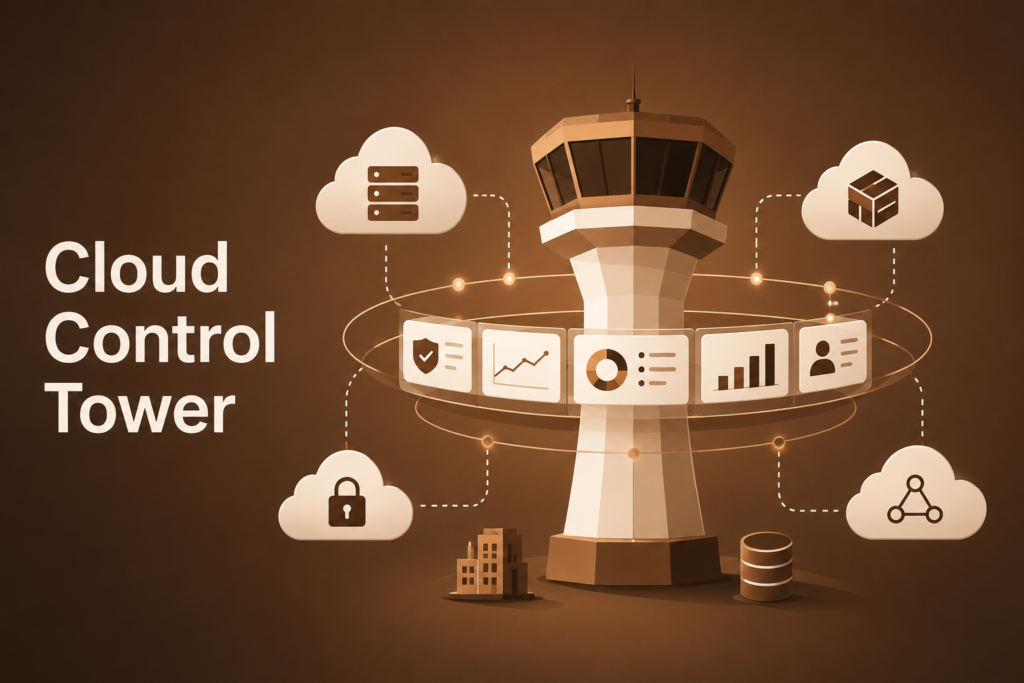
Rather than functioning as another management dashboard, a Cloud Control Tower serves as an intelligent command layer that continuously monitors, governs, optimizes, and orchestrates enterprise infrastructure across every cloud environment from a single operational perspective.
For modern B2B organizations, this invisible layer may become the foundation of truly autonomous cloud operations.
What Is a Cloud Control Tower?
A Cloud Control Tower is a centralized intelligence platform that provides unified governance, policy management, observability, automation, security, and cost optimization across distributed cloud infrastructure.
Instead of managing every cloud independently, organizations create one strategic control layer capable of coordinating resources across the entire infrastructure landscape.
Applications remain distributed. Governance becomes centralized.
Infrastructure behaves as one connected ecosystem rather than isolated environments.
Why Multi-Cloud Complexity Continues to Grow
Enterprises rarely depend on a single cloud platform.
- Different workloads have different requirements.
- Customer-facing applications prioritize scalability.
- Analytics platforms require specialized processing.
- Compliance-sensitive systems may remain within private infrastructure.
- Edge computing supports localized processing.
While each environment delivers value, operational coordination becomes increasingly difficult. Infrastructure teams spend significant effort maintaining visibility rather than creating innovation.Cloud complexity evolves faster than governance capabilities.
Moving Beyond Infrastructure Monitoring
Traditional monitoring platforms answer one question:
Is the infrastructure healthy?
Cloud Control Towers answer a more strategic question:
Is the infrastructure operating optimally for business objectives?
They evaluate utilization patterns, security posture, operational efficiency, compliance status, workload placement, resource allocation, and business priorities simultaneously.
Infrastructure management evolves from observation to intelligent decision-making.
Creating a Unified Infrastructure View
One of the greatest challenges in cloud operations is fragmented visibility.
Operations teams often rely on multiple dashboards to understand application performance, network activity, security events, storage consumption, and financial utilization. A Cloud Control Tower consolidates these perspectives into a single operational model. Infrastructure becomes easier to understand because relationships between systems become visible.
Business leaders gain strategic insights instead of isolated metrics.
Continuous Policy Enforcement Across Clouds
Infrastructure governance often varies between environments. Access controls differ.
Resource provisioning standards evolve independently. Security configurations drift over time.
Compliance policies become inconsistent.
A Cloud Control Tower continuously validates infrastructure against centralized organizational policies.
Configuration drift is detected automatically. Governance becomes continuous rather than periodic.
Operational consistency strengthens without slowing innovation.
Artificial Intelligence as an Infrastructure Advisor
Artificial intelligence enhances Cloud Control Towers by analyzing enormous volumes of operational telemetry.
Instead of waiting for administrators to investigate issues, intelligent systems proactively identify optimization opportunities.
Capabilities include:
- Workload placement recommendations
- Capacity forecasting
- Infrastructure rightsizing
- Resource utilization analysis
- Security anomaly detection
- Cost optimization insights
- Performance bottleneck prediction
- Compliance deviation alerts
- Automated remediation suggestions
- Infrastructure risk scoring
AI transforms cloud operations from reactive administration into predictive management.
Optimizing Cost Without Sacrificing Performance
Cloud spending often increases silently as organizations scale.
Unused resources remain active. Duplicate environments persist.
Storage grows continuously. Compute workloads become oversized.
Cloud Control Towers continuously analyze infrastructure consumption and recommend efficiency improvements based on actual utilization patterns.
Optimization becomes an ongoing operational capability instead of an occasional cost reduction exercise. Technology investments align more closely with business value.
Enabling Infrastructure Self-Healing
Modern infrastructure should not simply detect problems. It should respond intelligently.
Cloud Control Towers integrate automation engines capable of initiating predefined corrective actions when operational conditions change.
Applications can rebalance workloads. Resources can scale dynamically.
Policies can isolate risks. Infrastructure can recover without manual intervention.
Self-healing operations improve resilience while reducing operational burden.
The cloud becomes increasingly autonomous.
Supporting Sustainable Infrastructure Strategies
Infrastructure efficiency is no longer measured solely by performance. Resource optimization also contributes to environmental sustainability.
Cloud Control Towers identify inefficient utilization patterns, idle resources, excessive storage growth, and unnecessary compute consumption.
Organizations improve operational efficiency while reducing infrastructure waste. Sustainability becomes an outcome of intelligent infrastructure governance rather than a separate initiative.
Building the Autonomous Cloud Enterprise
The future of enterprise infrastructure lies in intelligent coordination rather than manual administration.
Cloud Control Towers establish the foundation for infrastructure ecosystems capable of governing themselves through centralized intelligence, continuous learning, and adaptive automation.
Applications become more resilient. Operations become more predictable.
Costs become more transparent. Security becomes more consistent.
Business innovation accelerates because infrastructure management shifts from operational maintenance to strategic optimization.
The next generation of cloud infrastructure will not be defined by where workloads run. It will be defined by how intelligently those workloads are governed, optimized, and orchestrated across the enterprise.
Cloud Control Towers represent that next evolution.
Invisible to users but essential to enterprise success, they transform distributed infrastructure into a unified digital command center capable of supporting the increasingly complex demands of modern business.