
Cloud & Infrastructure • 5 days ago • Shruti Das
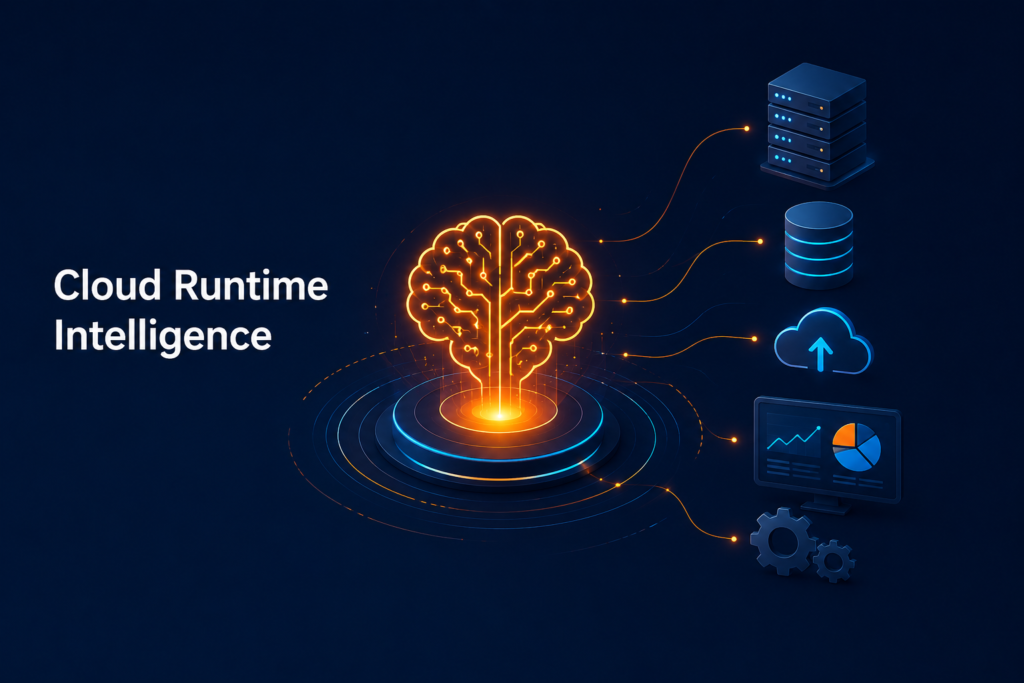
Cloud infrastructure has evolved far beyond virtual machines and storage services. Modern enterprises now operate distributed applications across public clouds, private environments, edge platforms, containers, serverless functions, and specialized AI infrastructure.
Despite this evolution, one challenge continues to grow.
Infrastructure can provision resources.
Monitoring platforms can observe systems.
Automation tools can execute predefined actions.
But very few technologies truly understand how applications behave while they are running.
As organizations become increasingly dependent on dynamic workloads, static infrastructure management is no longer sufficient.
Businesses need infrastructure that continuously learns, predicts, adapts, and optimizes itself based on live operational conditions.
This emerging architectural capability is known as Cloud Runtime Intelligence.
Rather than serving as another monitoring platform, Cloud Runtime Intelligence creates a continuous decision-making layer that analyzes application behavior, infrastructure health, workload dependencies, and business priorities in real time to optimize execution automatically.
For B2B enterprises pursuing resilient, adaptive, and autonomous operations, runtime intelligence represents one of the most significant evolutions in cloud infrastructure.
What Is Cloud Runtime Intelligence?
Cloud Runtime Intelligence is an operational intelligence framework that continuously evaluates how applications interact with infrastructure while they are actively executing.
Instead of relying solely on historical metrics or predefined automation rules, the platform observes live behavior across compute, networking, storage, containers, APIs, databases, and distributed services.
It creates a real-time understanding of infrastructure dynamics.
Every operational signal contributes to continuous optimization.
Infrastructure becomes aware of itself.
Why Traditional Infrastructure Monitoring Is No Longer Enough
Conventional monitoring systems answer questions after an event occurs.
Which server experienced high utilization?
Which application generated an error?
Which service exceeded latency thresholds?
Although valuable, these insights are reactive.
Cloud Runtime Intelligence shifts attention toward prediction and adaptation. Rather than waiting for performance degradation, the platform identifies behavioral patterns that indicate future instability. Infrastructure begins responding before users experience disruption. Operations become proactive instead of corrective.
Understanding Workload Behavior Instead of Resource Consumption
Most infrastructure platforms measure technical resources.
CPU usage. Memory utilization. Storage capacity. Network throughput.
Runtime intelligence focuses on application behavior.
How do workloads interact?
Which dependencies create cascading delays?
What operational patterns repeat under increasing demand?
Which microservices create hidden bottlenecks?
Understanding behavioral relationships provides far richer insights than isolated infrastructure metrics. The enterprise gains visibility into operational dynamics rather than individual components.
Creating an Adaptive Infrastructure Layer
Enterprise workloads rarely remain static.
Customer demand fluctuates. Business priorities change.
Application architectures evolve. Infrastructure should adapt accordingly.
Cloud Runtime Intelligence continuously evaluates execution environments and adjusts resource allocation based on actual operational conditions.
Applications receive infrastructure that matches live business requirements instead of fixed configurations. Adaptability becomes an architectural capability.
Artificial Intelligence Becomes an Infrastructure Partner
Cloud Runtime Intelligence relies heavily on machine learning and predictive analytics.
Operational data is transformed into actionable intelligence.
The platform can identify:
- Emerging performance bottlenecks
- Resource contention
- Hidden application dependencies
- Capacity risks
- Infrastructure anomalies
- Service degradation patterns
- Unbalanced workloads
- Inefficient resource allocation
- Latency propagation
- Operational drift
Artificial intelligence enables infrastructure teams to focus on strategic optimization rather than routine operational intervention.
Accelerating Platform Engineering
Platform engineering aims to provide development teams with standardized infrastructure experiences. Cloud Runtime Intelligence strengthens this objective by supplying platforms with continuous operational awareness.
Developers receive intelligent deployment recommendations.
Infrastructure automatically adjusts to application characteristics.
Operational complexity becomes abstracted behind adaptive services.
Software teams innovate faster because infrastructure behaves predictably even as underlying environments become increasingly sophisticated.
Reducing Operational Waste
Cloud environments frequently contain idle resources, oversized workloads, duplicate services, and underutilized infrastructure. Traditional optimization projects often occur periodically. Runtime intelligence performs optimization continuously.
Resource allocation evolves based on live demand rather than estimated requirements.
Organizations reduce unnecessary infrastructure consumption while maintaining application performance. Efficiency becomes embedded within operations rather than managed through separate cost initiatives.
Strengthening Enterprise Resilience
Infrastructure resilience depends on understanding relationships between services.
A single dependency failure may impact dozens of downstream applications.
Runtime intelligence continuously maps these interactions.
When anomalies emerge, the platform evaluates their potential impact across the ecosystem.
Corrective actions can be initiated before failures propagate throughout the enterprise.
Business continuity improves because infrastructure understands both technical dependencies and operational consequences.
Enabling Autonomous Cloud Operations
The long-term vision for cloud infrastructure extends beyond automation.
Automation follows predefined instructions. Autonomy requires continuous interpretation and intelligent adaptation.
Cloud Runtime Intelligence establishes the operational awareness necessary for autonomous infrastructure.
Systems observe. They learn. They optimize.
They recover. They improve.
Human teams increasingly supervise strategy while infrastructure manages execution.
This evolution fundamentally changes the relationship between enterprises and cloud technology.
The Future of Intelligent Infrastructure
Cloud infrastructure is entering an era where operational awareness becomes as important as computational capacity.
Organizations will no longer compete based solely on the scale of their cloud environments.
They will compete based on how intelligently those environments respond to changing business conditions.
Cloud Runtime Intelligence introduces an invisible decision layer capable of transforming infrastructure into an adaptive digital ecosystem.
Applications become more resilient. Operations become more efficient.
Resources become more intelligent. Innovation accelerates because infrastructure continuously optimizes itself in alignment with enterprise objectives.
The future of cloud infrastructure is not simply programmable. It is perceptive.
And Cloud Runtime Intelligence will become the foundation that enables infrastructure to think, adapt, and evolve alongside the businesses it supports.