
Commercial space technology is entering a period of accelerated expansion, driven by falling launch costs, private-sector investment, and growing demand for satellite-enabled services. What was once dominated by national space agencies is now a competitive ecosystem of private companies building orbital infrastructure for communications, Earth observation, and research.
Reusable rocket technology has significantly reduced the cost barrier to space access. Companies such as SpaceX have demonstrated the economic viability of reusable launch systems, reshaping global launch economics. Meanwhile, providers like Blue Origin continue developing heavy-lift and orbital launch capabilities.
Lower launch costs have catalyzed growth in satellite constellations. Enterprises across telecommunications, agriculture, defense, and climate monitoring are deploying satellites to collect high-resolution data.
Key areas driving commercial space expansion include:
- Low Earth Orbit (LEO) satellite networks
- Earth observation analytics
- Space-based broadband connectivity
- In-orbit servicing technologies
- Microgravity research platforms
LEO satellite constellations are transforming global connectivity. Satellite-based broadband networks are extending internet access to remote and underserved regions, creating new enterprise opportunities in logistics and field operations.
Earth observation technology is also advancing rapidly. High-resolution imaging combined with AI analytics enables real-time monitoring of climate patterns, infrastructure development, and supply chain movement.
Companies such as Planet Labs specialize in satellite imaging services, providing data that supports agriculture optimization and environmental analysis.
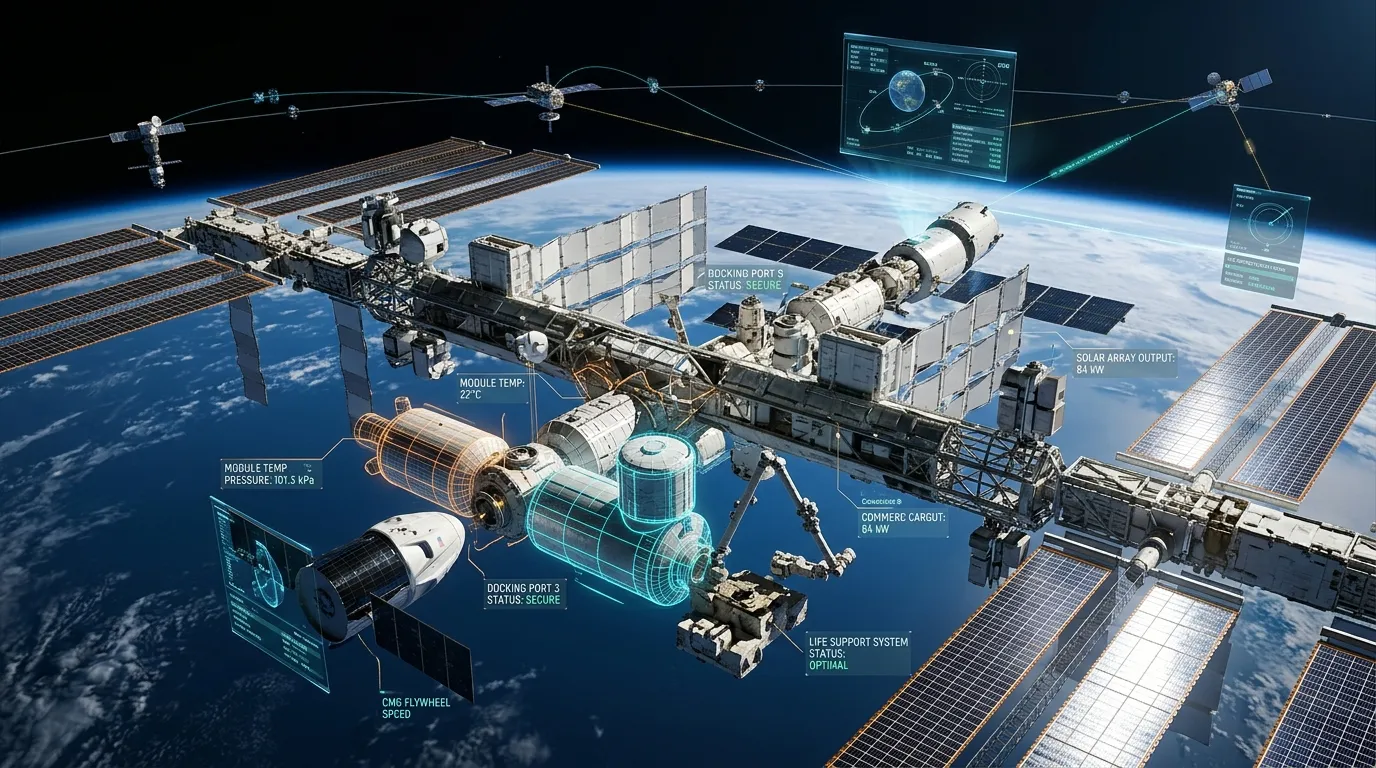
Space infrastructure development extends beyond satellites. In-orbit servicing — including refueling and satellite repair — is emerging as a new deep tech frontier.
However, commercialization brings new challenges.
Orbital congestion is increasing as satellite numbers grow. Space debris management and collision avoidance systems are becoming critical engineering priorities.
Regulatory frameworks must evolve to address space traffic management and spectrum allocation.
Insurance models for commercial launches and satellite operations are also adapting to changing risk profiles.
From a technological perspective, advances in propulsion systems, lightweight materials, and miniaturized electronics are enabling more cost-effective missions.
Government partnerships remain central to funding large-scale projects, but private capital is increasingly driving innovation cycles.
National security considerations further shape the sector. Satellite infrastructure now plays a strategic role in communications resilience and global surveillance.
As deep tech investment expands, space technology is transitioning from niche exploration to foundational infrastructure supporting digital economies.
The integration of AI, advanced materials science, and autonomous systems within space platforms underscores the interdisciplinary nature of this emerging field.
Commercial space infrastructure represents a long-horizon investment category with transformative potential across telecommunications, logistics, climate monitoring, and defense.
As launch economics improve and regulatory clarity increases, orbital technology is expected to become an increasingly embedded component of global digital infrastructure.