
Digital Transformation • 3 days ago • Melvin Hall
Digital transformation is no longer about replacing paper with software or moving infrastructure to the cloud. Those initiatives have become standard business practices. The next wave of transformation is happening much deeper—inside the architecture, processes, and decision-making capabilities of modern B2B organizations.
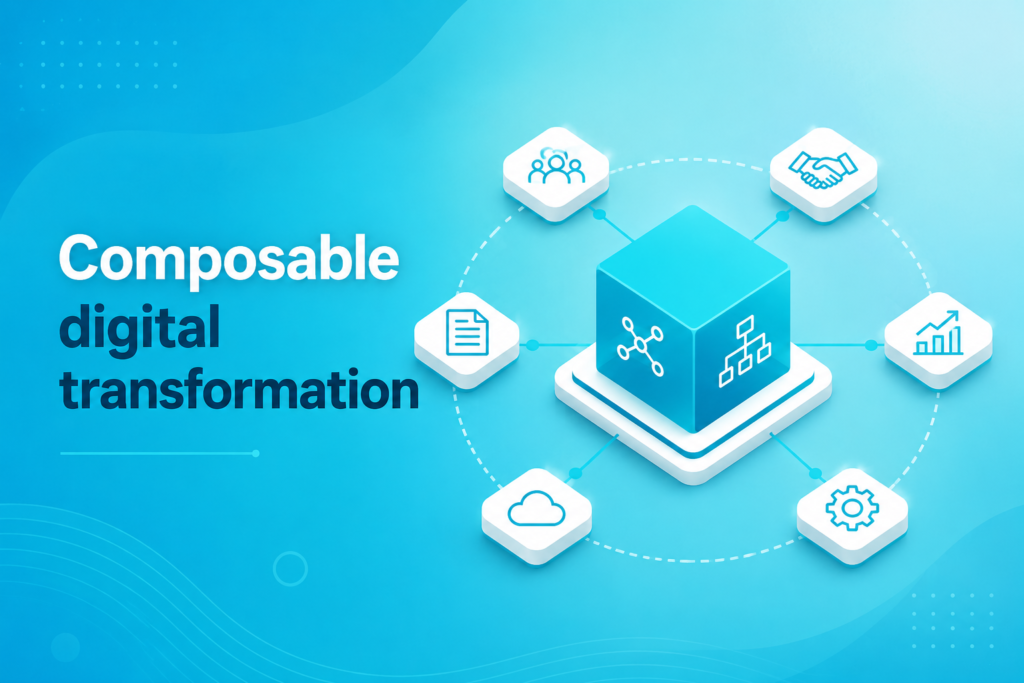
Leading enterprises are embracing a composable approach to digital transformation, where business capabilities are assembled like building blocks instead of relying on rigid, monolithic systems. This shift is enabling organizations to adapt faster, innovate continuously, and respond to customer demands without overhauling their entire technology ecosystem.
For B2B companies competing in increasingly complex markets, composability is becoming a strategic advantage rather than just an IT initiative.
What Is Composable Digital Transformation?
Composable digital transformation is the practice of designing business operations as modular components that can be connected, replaced, or expanded independently. Instead of depending on one massive enterprise platform for every business function, organizations create specialized services that work together through APIs, integrations, and automation. This creates an ecosystem where technology evolves with business needs rather than limiting them.
Imagine replacing only the engine of a car when it needs improvement instead of buying an entirely new vehicle. That is the philosophy behind composable business architecture.
Why Traditional Digital Transformation Reaches a Plateau
Many organizations successfully digitized operations but still struggle with innovation. The reason is simple. They digitized existing processes without redesigning them.
Large ERP systems, legacy CRM platforms, and disconnected business applications often create operational silos. Every new requirement becomes a costly development project involving multiple teams and lengthy approval cycles. The result is a business that appears digital on the surface but remains slow underneath. Composable transformation removes these bottlenecks by making every business capability independently scalable and reusable.
The Rise of Business Capability Thinking
Forward-looking B2B enterprises are shifting their focus away from applications and toward business capabilities. Instead of asking: “Which software should we buy?” They ask: “Which capability do we need to deliver?”
Examples include:
- Customer onboarding
- Vendor qualification
- Contract management
- Dynamic pricing
- Inventory visibility
- Order orchestration
- Partner collaboration
- Compliance validation
Each capability operates independently while seamlessly connecting with others. This modular approach dramatically reduces implementation complexity while improving organizational agility.
How Composable Enterprises Respond Faster to Market Changes
Business conditions rarely stay constant. Supply chains fluctuate. Customer expectations evolve. Regulatory requirements change. Competitive landscapes shift rapidly.
Companies operating on tightly coupled systems often require months to implement process changes. Composable organizations can introduce new workflows, connect additional platforms, or automate new business functions with minimal disruption. The competitive advantage comes from adaptability rather than size.
APIs Become the New Business Language
In modern B2B ecosystems, APIs are more than technical connectors. They become business enablers. Every department generates valuable data:
- Sales
- Procurement
- Logistics
- Finance
- Manufacturing
- Customer Success
- Marketing
When APIs securely expose these capabilities, organizations create intelligent digital ecosystems where information flows automatically between systems and stakeholders. Partners receive real-time updates. Customers experience faster service. Employees make quicker decisions. The organization operates as a connected enterprise instead of isolated departments.
AI Delivers Maximum Value Only on Modern Architectures
Artificial intelligence often receives the spotlight in digital transformation discussions. However, AI cannot create value when data remains fragmented across disconnected systems. Composable architectures establish standardized, accessible, and reusable data layers that enable AI to function effectively. This allows businesses to:
- Predict customer churn
- Automate proposal generation
- Detect operational anomalies
- Forecast demand fluctuations
- Recommend optimal inventory levels
- Prioritize sales opportunities
- Improve supplier risk management
Without a connected digital foundation, AI becomes an isolated experiment rather than a business accelerator.
Customer Experience Is Becoming the Primary Transformation Metric
Historically, digital transformation focused on internal efficiency. Today, successful B2B organizations measure transformation by customer outcomes. Every delay, manual approval, duplicate data entry, or disconnected process directly impacts customer satisfaction. Composable enterprises eliminate these friction points by enabling continuous process optimization.
Customers experience:
- Faster quotations
- Transparent order tracking
- Personalized interactions
- Shorter onboarding cycles
- Consistent communication
- Self-service capabilities
- Improved issue resolution
The operational improvements become visible through stronger customer relationships and higher retention.
The Hidden Financial Benefit: Lower Transformation Costs
Many organizations assume modular architectures increase complexity. The opposite is often true. When capabilities are reusable, businesses avoid rebuilding similar functionality across multiple projects. Technology investments generate long-term value because components can support future initiatives with minimal modification.
This reduces:
- Development effort
- Maintenance costs
- Technical debt
- Vendor dependency
- Integration expenses
- Project risk
Instead of funding repeated system replacements, organizations continuously evolve their digital ecosystem.
Organizational Culture Determines Success
Technology alone cannot create transformation. Organizations must encourage experimentation, cross-functional collaboration, and continuous improvement. Successful digital transformation programs often demonstrate several cultural characteristics:
- Business and IT teams collaborate from project inception.
- Data-driven decision making replaces assumptions.
- Employees embrace automation as support rather than replacement.
- Innovation becomes an ongoing process instead of a one-time initiative.
- Teams focus on customer value instead of departmental boundaries.
When culture and architecture evolve together, transformation becomes sustainable.
The Future Belongs to Adaptive Enterprises
The next generation of B2B leaders will not necessarily own the biggest technology stacks. They will own the most adaptable ones. Composable digital transformation enables businesses to innovate continuously without disrupting existing operations. It allows organizations to integrate emerging technologies, respond to changing customer expectations, and create scalable business models that evolve naturally over time.
Rather than viewing digital transformation as a destination, forward-thinking enterprises treat it as an ongoing capability. The businesses that thrive will be those designed for constant evolution—where every process, system, and workflow can be improved without rebuilding the enterprise from scratch.
In a world where change has become the only constant, composability may prove to be the defining competitive advantage for modern B2B organizations.