
Digital Transformation • 8 days ago • Neha Jamwal
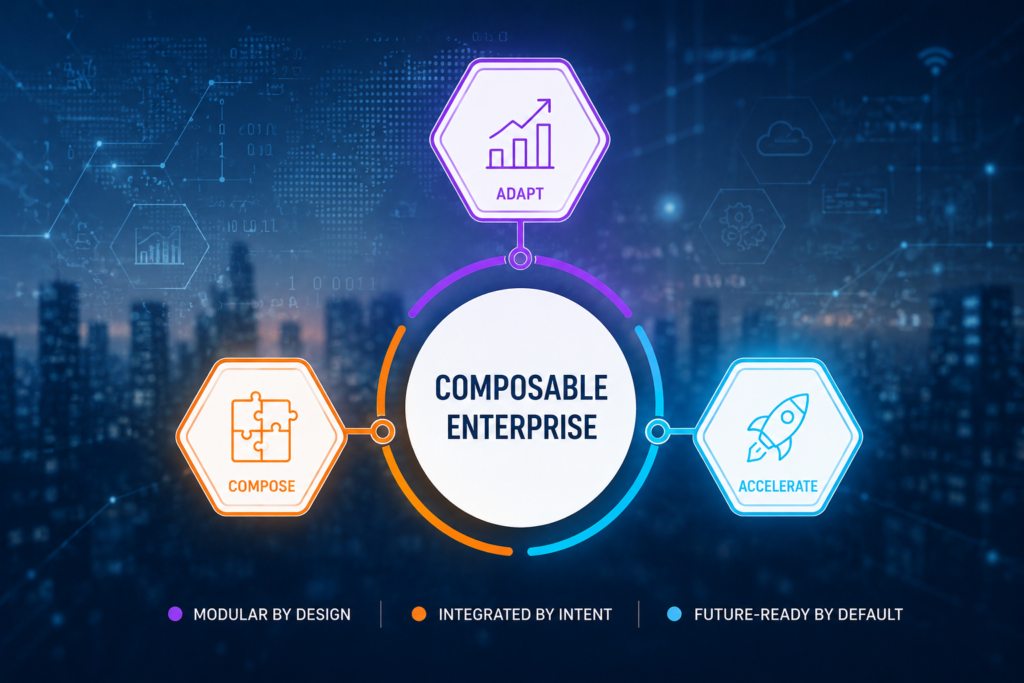
For decades, enterprises have pursued digital transformation by replacing legacy systems with newer technologies. Large-scale ERP implementations, CRM modernization, cloud migration, and automation initiatives promised agility and innovation. Yet many organizations discovered that despite significant investments, they remained slow to adapt to changing market conditions.
The problem was never technology alone. It was architecture.
Traditional enterprises were designed as tightly connected ecosystems where changing one process often required modifying multiple systems, departments, and workflows. Innovation became expensive, risky, and time-consuming.
This challenge has led to the rise of the Composable Enterprise—a business model where organizations are built from modular capabilities that can be assembled, replaced, or enhanced without disrupting the entire ecosystem. Rather than viewing digital transformation as a one-time modernization project, composability treats transformation as an ongoing capability. Organizations become flexible by design rather than by exception.
As competitive environments become increasingly unpredictable, composable architecture is emerging as one of the most important foundations of sustainable digital transformation.
What Is a Composable Enterprise?
A Composable Enterprise is an organization built from independent yet connected business capabilities that can evolve individually while continuing to operate as part of a unified ecosystem.
Instead of relying on rigid monolithic structures, enterprises create modular services for customer management, payments, analytics, supply chain operations, approvals, pricing, and decision-making. Each capability functions independently while communicating through standardized interfaces. The result is an organization capable of adapting rapidly without requiring large-scale redesign. Business agility becomes an architectural characteristic.
Why Traditional Enterprise Architecture Slows Innovation
Many organizations struggle to launch new products or enter new markets because every change affects multiple interconnected systems. Updating a pricing model may require changes across finance, sales, ERP platforms, reporting systems, and customer applications. Complex dependencies increase project duration and operational risk. Composable architecture minimizes these dependencies by isolating business capabilities. Changes remain localized. Innovation becomes faster. Transformation becomes continuous.
Business Capabilities Become Strategic Assets
Technology platforms change frequently. Business capabilities endure. Capabilities such as customer onboarding, order management, contract approval, inventory visibility, or partner integration can be designed as reusable enterprise building blocks. These modules support multiple products, business units, and digital channels simultaneously.
Instead of rebuilding functionality repeatedly, organizations assemble new business solutions using proven capabilities. Development shifts from construction to composition.
Data Connects the Enterprise
Composability does not imply fragmentation. Independent capabilities require unified information to operate effectively. Shared enterprise data ensures every capability works with consistent business context. Customer information remains synchronized. Operational metrics remain aligned. Decision-making remains coordinated. Data becomes the connective tissue that links modular business services into a cohesive enterprise.
Without strong data governance, composability creates complexity. With governed data, it creates extraordinary agility.
Artificial Intelligence Thrives in Modular Environments
AI systems perform best when integrated into clearly defined business processes. Composable enterprises provide natural insertion points for intelligent automation. AI can enhance customer onboarding without affecting finance. Predictive maintenance can improve operations without modifying sales processes. Recommendation engines can optimize commerce independently from logistics.
Modularity allows organizations to experiment with AI incrementally while minimizing enterprise-wide disruption. Innovation becomes scalable rather than risky.
Accelerating Business Transformation
Traditional transformation programs often span multiple years because organizations attempt enterprise-wide change simultaneously. Composable enterprises adopt a different philosophy. Transformation occurs one capability at a time. Business value is delivered incrementally. Lessons learned improve subsequent initiatives. Risk decreases because failures remain isolated rather than enterprise-wide. The organization evolves continuously instead of waiting for large implementation milestones.
Governance Remains Critical
Modularity without governance creates operational chaos. Successful composable enterprises establish clear standards for capability ownership, integration, security, metadata, and lifecycle management. Governance should define:
- Capability ownership
- Data standards
- API consistency
- Security policies
- Integration principles
- Performance monitoring
- Version management
- Business accountability
- Operational resilience
- Continuous optimization
Strong governance ensures flexibility does not compromise stability.
Customer Experience Improves Through Composition
Customers rarely interact with internal departments. They experience complete business journeys. Composable capabilities enable organizations to assemble personalized customer experiences by combining services dynamically. Ordering, payments, support, recommendations, and fulfillment operate as connected experiences rather than isolated functions. This flexibility allows enterprises to launch new digital services rapidly while maintaining consistent quality across every interaction.
Future-Proofing Enterprise Transformation
Technology will continue to evolve. Artificial intelligence will mature. Business models will change. Customer expectations will rise. Organizations built around fixed architectures may struggle to keep pace.
Composable enterprises are designed for evolution. Individual capabilities can be replaced, upgraded, or enhanced without disrupting surrounding operations. Transformation becomes an inherent organizational capability rather than an occasional initiative. This adaptability creates long-term competitive resilience.
Building a Composable Enterprise Strategy
Organizations pursuing composability should prioritize:
- Modular business capabilities
- API-first architecture
- Shared enterprise data
- AI-ready services
- Event-driven integration
- Standardized governance
- Reusable business functions
- Cross-functional ownership
- Continuous delivery
- Business capability mapping
The objective is not merely modular technology. It is modular business execution.
Conclusion
Digital transformation is evolving beyond technology modernization into organizational redesign. The Composable Enterprise provides a framework for creating businesses that are agile, resilient, and capable of continuous innovation. By organizing around reusable business capabilities rather than rigid systems, enterprises reduce complexity while increasing adaptability.
In an environment where change is constant, composability enables organizations to respond faster, integrate new technologies more effectively, and create sustainable competitive advantage. The future of B2B digital transformation will belong to organizations that are not simply digital. It will belong to organizations that are designed to evolve.