
Data, AI & Analytics • 1 day ago • Shruti Das
Artificial Intelligence is only as reliable as the data that powers it. Enterprises invest millions in cloud platforms, data lakes, machine learning models, and business intelligence tools, expecting faster decisions and deeper insights. Yet a simple question continues to challenge even the most mature organizations: “Where did this data actually come from?”
When executives cannot trace the origin of a KPI, when analysts cannot explain why two dashboards show different numbers, or when AI models generate unexpected predictions, trust begins to erode. This growing challenge has elevated Data Lineage Intelligence from a governance feature to a strategic enterprise capability.
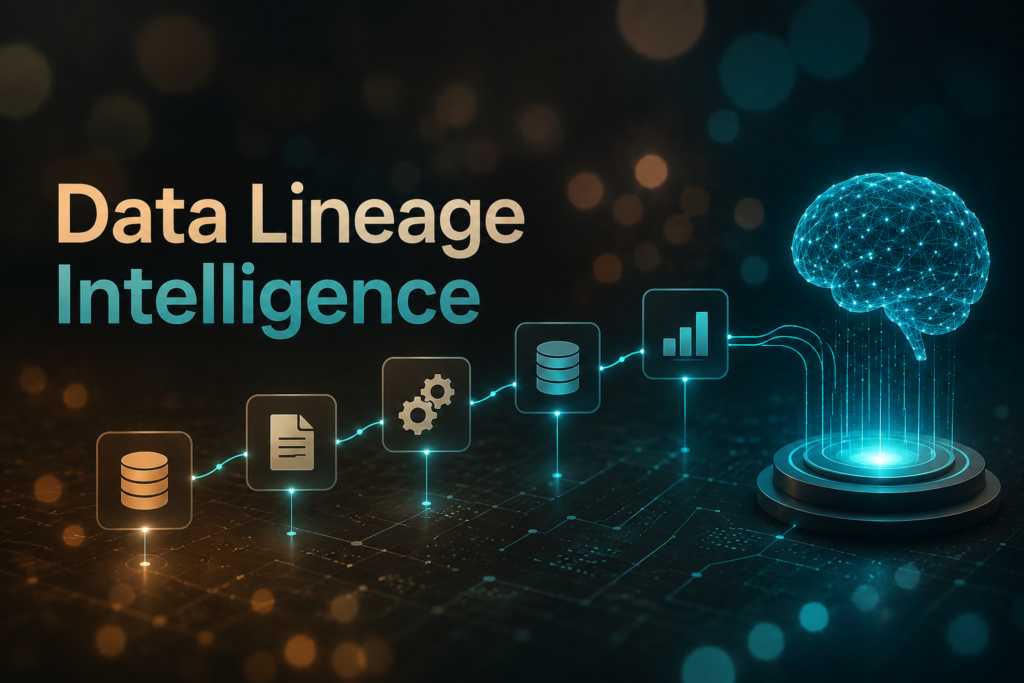
Traditional lineage simply maps data movement. Data Lineage Intelligence goes much further by combining metadata, AI, business context, and impact analysis to create a living map of how information flows across an organization. As enterprises become increasingly dependent on AI-driven decisions, understanding data journeys may become just as important as collecting the data itself.
What Is Data Lineage Intelligence?
Data Lineage Intelligence is the ability to automatically discover, visualize, analyze, and interpret how data moves through enterprise systems while understanding the business impact of every transformation. Instead of showing only technical connections, intelligent lineage explains business relationships.
A sales metric can be traced back through transformation pipelines, source applications, validation rules, enrichment processes, and operational systems. This creates transparency across the entire data lifecycle. Organizations gain confidence because every insight becomes explainable.
Why Traditional Data Lineage Is No Longer Enough
Many lineage tools simply display technical diagrams that only engineers can understand. Modern enterprises require something far more valuable. Business users need to know:
- Which reports depend on this dataset?
- Which AI models consume this information?
- Which departments will be affected by a schema change?
- Which executive dashboards could become inaccurate?
- Which regulatory reports depend on this field?
Data Lineage Intelligence answers these questions automatically by connecting technical metadata with business meaning.
AI Requires Explainable Data Journeys
Enterprise AI cannot operate as a black box. Business leaders increasingly expect AI recommendations to be explainable and auditable. If an AI model predicts customer churn or operational risk, stakeholders need to understand which information influenced that conclusion. Data Lineage Intelligence provides this transparency. Every prediction can be traced back through data sources, transformation logic, and business definitions. Explainability creates trust. Trust accelerates AI adoption.
Eliminating Hidden Dependencies
Large enterprises operate thousands of interconnected data pipelines. A seemingly minor schema modification may affect dozens of downstream applications. Without visibility, teams discover problems only after dashboards fail or AI models begin producing inaccurate results. Data Lineage Intelligence identifies hidden dependencies before changes occur. Organizations can evaluate potential impacts, notify stakeholders, and reduce operational risk. Instead of reacting to failures, they proactively prevent them.
Building Confidence in Enterprise Analytics
Analytics platforms often struggle with inconsistent metrics. Different departments calculate the same KPI differently. Business leaders question reports instead of acting on them. Lineage Intelligence strengthens confidence by documenting every calculation and transformation. Users no longer see only a number. They understand how that number was created. Transparency transforms analytics into trusted decision support.
Metadata Becomes Business Intelligence
Metadata is often viewed as technical documentation. In reality, metadata describes how an organization operates. When enriched with AI, metadata evolves into enterprise intelligence. Relationships between datasets, business terms, policies, owners, and applications become visible. This allows organizations to understand not only where data resides but how knowledge flows throughout the business. Metadata shifts from passive documentation to active intelligence.
Supporting AI Governance at Scale
Governance becomes increasingly complex as organizations deploy multiple AI models across business functions. Each model depends on numerous datasets. Each dataset has owners, quality standards, and transformation rules. Data Lineage Intelligence simplifies governance by providing centralized visibility. Organizations can monitor:
- Data origins
- Quality checkpoints
- Transformation history
- Ownership changes
- Compliance dependencies
- AI model inputs
- Business rule applications
- Cross-platform integrations
- Metadata evolution
- Risk exposure
This creates stronger governance without slowing innovation.
Accelerating Root Cause Analysis
When business reports become inaccurate, identifying the underlying issue can consume valuable time. Teams manually inspect pipelines, compare datasets, and investigate transformations. Data Lineage Intelligence significantly reduces investigation effort. AI-assisted lineage can identify upstream changes, highlight anomalies, and recommend probable causes. Operational disruptions become easier to diagnose and resolve. Recovery times improve. Business continuity strengthens.
Data Lineage as a Competitive Advantage
Organizations with mature lineage capabilities move faster because they trust their information. Analytics teams spend less time validating reports. Engineers spend less time troubleshooting pipelines. Executives spend less time debating metrics. AI teams deploy models with greater confidence. Over time, trusted information creates faster decisions, better collaboration, and stronger organizational alignment. Transparency becomes a strategic asset.
Building a Data Lineage Intelligence Strategy
Enterprises preparing for AI-driven operations should invest in:
- Automated metadata discovery
- Business glossary integration
- AI-powered impact analysis
- Cross-platform lineage mapping
- Real-time monitoring
- Data quality integration
- Governance automation
- Semantic relationships
- Ownership management
- Change intelligence
The objective is not simply documenting data movement. It is creating enterprise-wide understanding.
Conclusion
The next generation of enterprise AI will depend on more than sophisticated algorithms and scalable infrastructure. It will depend on trust. Data Lineage Intelligence provides the visibility required to understand how information flows, transforms, and influences business outcomes.
By connecting technical architecture with business meaning, organizations create analytics that are explainable, AI that is accountable, and decisions that are defensible. In the future of B2B Data and AI, the organizations that understand the journey of their data will gain greater value from every destination it reaches.