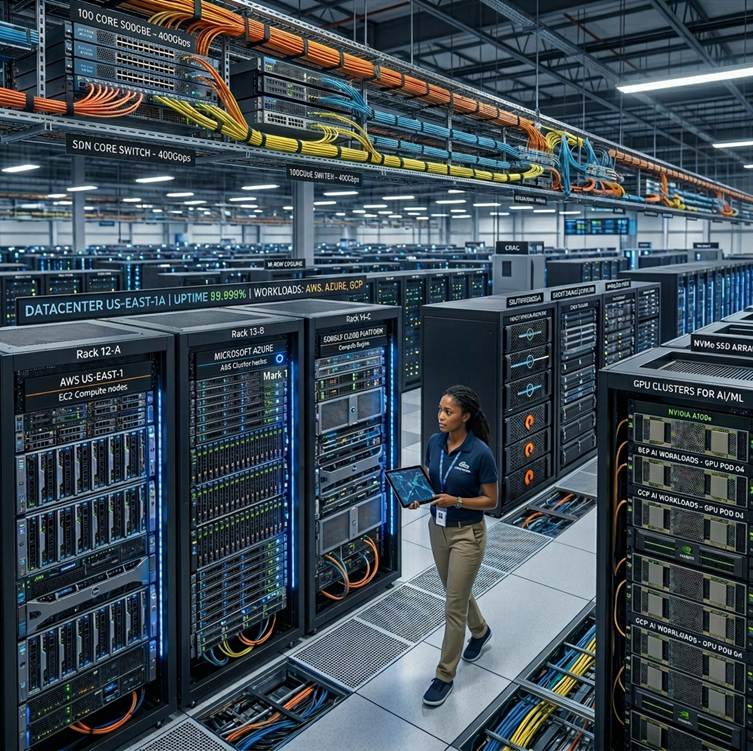


As digital services demand faster response times and real-time data processing, enterprises are extending infrastructure beyond centralized cloud data centers. Edge computing is emerging as a critical component of modern infrastructure strategy, enabling organizations to process data closer to where it is generated.
Traditional cloud models rely on centralized data centers to handle processing and storage. While highly scalable, this model can introduce latency when data must travel long distances. For applications such as industrial automation, autonomous systems, financial transactions, and healthcare monitoring, even milliseconds of delay can affect performance and outcomes.
Edge computing addresses this challenge by decentralizing processing power. Instead of sending all data to the cloud, edge systems analyze information locally — at the “edge” of the network — and transmit only necessary insights to centralized platforms.
The rise of Internet of Things (IoT) devices has accelerated edge adoption. Manufacturing plants deploy sensors to monitor equipment health in real time. Retailers use smart cameras to analyze in-store traffic. Logistics companies track fleet performance through connected devices. These systems generate vast amounts of data that require immediate analysis.
Cloud providers are integrating edge capabilities into their broader infrastructure ecosystems. Platforms such as Amazon Web Services and Microsoft Azure offer distributed edge services that synchronize with central cloud environments. This hybrid approach enables centralized control while maintaining low-latency local processing.
Key drivers behind edge computing adoption include:
- Reduced latency for real-time applications
- Lower bandwidth consumption
- Improved reliability in remote locations
- Enhanced data privacy control
- Operational resilience
In industrial environments, edge systems support predictive maintenance by analyzing sensor data instantly. This allows organizations to detect anomalies before equipment failures occur. In healthcare, edge-enabled devices monitor patient vitals continuously, transmitting alerts when thresholds are exceeded.
Security considerations are central to edge expansion. Distributed infrastructure increases the number of endpoints that must be secured. Identity management, encrypted communication, and secure firmware updates are critical safeguards.
Managing edge infrastructure introduces new operational complexity. IT teams must monitor distributed devices across multiple locations while maintaining consistent policies. Observability tools provide visibility into device performance and network health.
Edge computing does not replace cloud infrastructure; rather, it complements it. Data requiring large-scale analysis or archival storage continues to reside in centralized environments. Edge systems filter and preprocess data before forwarding relevant information to the cloud.
Hybrid edge-cloud architectures are becoming standard practice. Organizations design systems where latency-sensitive tasks run locally, while heavy analytics workloads operate centrally.
Regulatory compliance also influences edge adoption. Certain industries require that sensitive data remain within specific geographic boundaries. Edge systems allow localized data processing that aligns with regulatory requirements.
Cost optimization is another factor. By reducing data transmission volumes, enterprises can lower bandwidth expenses and improve operational efficiency.
Telecommunications providers play an important role in enabling edge infrastructure. The expansion of 5G networks enhances connectivity and supports distributed computing environments.
Key challenges associated with edge computing include:
- Device lifecycle management
- Consistent software updates
- Network reliability in remote areas
- Standardization across vendors
Despite these challenges, industry momentum continues building. As real-time analytics becomes increasingly essential, enterprises view edge computing as a strategic enabler of digital responsiveness.
Edge infrastructure expands the enterprise footprint beyond centralized data centers, creating a distributed digital ecosystem.
Organizations that integrate edge capabilities into broader cloud strategies gain greater agility, improved performance, and enhanced operational resilience.
The evolution toward distributed infrastructure signals a broader transformation in how enterprises design and manage digital systems — prioritizing speed, proximity, and intelligent responsiveness.