
Digital Transformation • 7 days ago • Jessica Mahone
Digital transformation is often measured by technology investments. Organizations celebrate cloud migrations, AI adoption, automation initiatives, and platform modernization projects as milestones of progress.
Yet many enterprises equipped with world-class technology continue to struggle with slow decision-making, lengthy product launches, and operational rigidity.
The underlying challenge is not technology.
It is the adaptability.
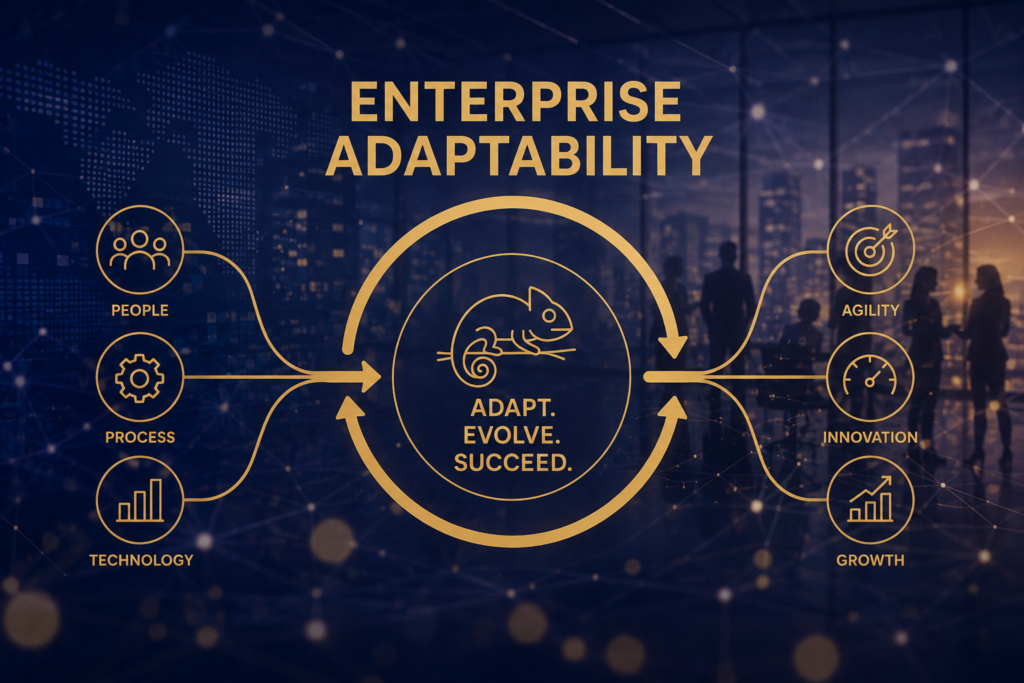
Enterprise Adaptability refers to an organization’s ability to continuously respond to market changes, customer expectations, technological disruption, and operational challenges without requiring large-scale restructuring. It is rapidly becoming one of the most valuable competitive capabilities in modern business. Unlike traditional transformation programs that focus on replacing systems, adaptability focuses on creating an enterprise that can evolve continuously. Technology enables adaptability. But organizational design, data maturity, governance, and culture determine whether adaptability becomes reality.
In the next generation of digital transformation, the organizations that adapt fastest will outperform those that simply digitize faster.
What Is Enterprise Adaptability?
Enterprise Adaptability is the capability to rapidly adjust business processes, operating models, customer experiences, and technology services while maintaining operational stability. Rather than treating change as an exceptional event, adaptable organizations treat change as a normal operating condition.
Every business capability is designed to evolve. Every process can improve. Every technology component supports continuous innovation. Adaptability transforms transformation from a project into an organizational competency.
Why Digital Transformation Often Stalls
Many transformation programs succeed technically but fail operationally. New systems are implemented. Dashboards are modernized. Applications move to the cloud. Yet employees continue following legacy workflows. Departments remain siloed. Decision-making remains hierarchical. Innovation slows because organizational structures cannot evolve at the same pace as technology. Digital maturity requires operational flexibility. Without adaptability, transformation eventually reaches a plateau.
The Four Pillars of Enterprise Adaptability
Organizations that adapt successfully build capabilities across four interconnected dimensions.
Process Adaptability – Business processes should evolve through continuous optimization rather than periodic redesign. Automation, analytics, and operational feedback enable organizations to improve workflows without disrupting daily operations.
Technology Adaptability – Modern platforms should support integration, scalability, and modular enhancement rather than rigid implementation cycles. Technology should enable experimentation rather than restrict it.
Data Adaptability – Enterprise data should flow seamlessly across business functions, providing real-time visibility that supports rapid decision-making. Adaptable organizations treat data as a shared enterprise asset rather than a departmental resource.
Organizational Adaptability – Leadership structures, governance models, and workforce capabilities should encourage collaboration, experimentation, and learning. People become active participants in transformation instead of passive recipients.
Adaptability Creates Business Resilience
Unexpected disruptions expose operational weaknesses. Rigid enterprises struggle because processes depend on predefined assumptions. Adaptable enterprises respond by reconfiguring workflows, reallocating resources, and introducing new business models with minimal delay. Resilience is no longer defined by resistance to change. It is defined by the ability to change successfully. Adaptability transforms uncertainty into opportunity.
Artificial Intelligence Accelerates Adaptability
AI enables organizations to identify patterns that humans may overlook. Predictive insights support faster planning. Automation reduces repetitive activities. Intelligent recommendations improve operational decisions. However, AI creates value only when organizations possess the flexibility to act upon its recommendations.
Adaptability converts intelligence into execution. Technology and organizational agility become mutually reinforcing capabilities.
Customer Expectations Demand Continuous Evolution
Modern customers expect businesses to improve continuously. Products evolve. Services become personalized. Experiences become connected across channels. Organizations unable to adapt rapidly risk losing relevance despite significant technology investments. Adaptable enterprises continuously refine customer journeys based on operational data and behavioral insights. Transformation shifts from reactive improvement to proactive innovation. Customer experience becomes a living capability.
Building Adaptability Through Governance
Adaptability should not create operational inconsistency. Strong governance provides the structure necessary for sustainable change. Key governance capabilities include:
- Standardized business principles
- Outcome-based performance metrics
- Enterprise-wide data standards
- Cross-functional collaboration
- Agile funding models
- Continuous risk assessment
- AI governance
- Change enablement frameworks
- Operational transparency
- Business capability ownership
Governance enables controlled evolution rather than uncontrolled experimentation.
Measuring Adaptability
Traditional transformation metrics focus on implementation milestones. Adaptability should be measured through business outcomes. Organizations should evaluate:
- Speed of process improvement
- Time required to launch new services
- Cross-functional collaboration
- Decision velocity
- Customer responsiveness
- Technology integration speed
- Operational resilience
- Innovation frequency
- Workforce agility
- Business capability reuse
These indicators reveal whether adaptability has become embedded within enterprise operations.
Adaptability as a Strategic Differentiator
Technology platforms are increasingly available to every competitor. Artificial Intelligence is becoming democratized. Automation tools continue to mature. The differentiator will not be access to technology. It will be the organizational capability to leverage technology faster than competitors. Adaptable enterprises continuously redesign themselves while maintaining operational excellence. They create strategic advantage through evolution rather than scale alone.
Creating an Adaptability-First Enterprise
Organizations seeking sustainable transformation should prioritize:
- Business capability mapping
- Agile governance
- Modular technology architecture
- Data-driven operations
- Continuous process optimization
- AI-enabled decision support
- Workforce empowerment
- Customer-centric innovation
- Enterprise collaboration
- Continuous learning frameworks
The objective is not simply becoming digital. It is becoming continuously adaptable.
Conclusion
Digital transformation is entering a new era where technology implementation alone is no longer sufficient. Organizations must develop the capability to evolve continuously across people, processes, technology, and governance. Enterprise Adaptability provides this foundation. It enables businesses to respond confidently to disruption, accelerate innovation, and create lasting competitive advantage.
In the future of B2B digital transformation, the most successful organizations will not necessarily be those with the largest technology investments. They will be the ones that adapt the fastest while maintaining strategic clarity and operational excellence.