
Enterprise Software (SaaS) • 7 days ago • Jessica Mahone
For decades, enterprise software has been organized around applications. Organizations purchased separate systems for finance, human resources, customer relationship management, procurement, project management, supply chain operations, customer support, and countless other business functions. Each application solved a specific operational problem, creating an ecosystem of specialized tools that collectively supported the enterprise.
This application-centric approach has served businesses remarkably well. Modern SaaS platforms have improved accessibility, reduced infrastructure complexity, accelerated deployment, and enabled organizations to adopt best-of-breed solutions for individual departments. Yet as enterprises become increasingly digital, a new challenge has emerged: business outcomes rarely align with application boundaries. Winning a new customer requires collaboration between marketing, sales, legal, finance, customer success, implementation teams, and support organizations. Launching a new product involves engineering, procurement, manufacturing, compliance, operations, logistics, and executive leadership. Managing enterprise risk requires continuous coordination across virtually every department.
Applications may execute individual tasks efficiently, but businesses compete through capabilities that span multiple systems. This realization is driving a significant architectural shift. Instead of organizing enterprise technology around software applications, leading organizations are beginning to organize it around business capabilities. These Enterprise Capability Platforms bring together data, workflows, AI, governance, automation, and decision intelligence required to deliver an entire business capability, regardless of which applications participate behind the scenes. The future of enterprise SaaS will be defined less by the applications organizations purchase and more by the capabilities they continuously deliver.
Why Application-Centric Architecture Is Becoming a Limitation
Enterprise applications have traditionally reflected organizational structures, where finance owns financial software, sales owns CRM platforms, human resources manages workforce applications, and operations oversees supply chain systems. While this separation simplifies software ownership, it often introduces unnecessary complexity into business execution.
Consider the process of onboarding a new enterprise customer. Although the customer experiences a single business interaction, the organization coordinates activities across numerous applications. Sales finalizes commercial agreements, legal validates contracts, finance establishes billing, IT provisions access, customer success prepares onboarding plans, operations configure services, and support activates service channels. Each department performs its responsibilities effectively, but the challenge lies in coordinating work across applications that were never designed to function as one unified business capability. Employees frequently become the integration layer, monitoring progress, exchanging information, resolving exceptions, and manually ensuring every participating application remains synchronized. As organizations adopt more SaaS platforms, this coordination burden increases. Enterprise Capability Platforms reduce this complexity by shifting attention away from individual applications and toward the complete business capability those applications collectively support.
Understanding Enterprise Capability Platforms
An Enterprise Capability Platform provides everything required to deliver a specific business capability regardless of the underlying technology landscape. Instead of exposing multiple software products to employees, the platform presents a unified operational capability.
For example, a customer onboarding capability may include CRM data, contract management, identity provisioning, billing, project planning, customer communications, compliance validation, AI recommendations, workflow automation, and executive reporting. Employees interact with a single business capability while, behind the scenes, numerous enterprise applications collaborate to deliver that experience.
This architectural approach fundamentally changes software design. Applications continue managing specialized responsibilities, but capabilities become the primary interface through which organizations execute business operations. The emphasis shifts from owning software products to delivering measurable business outcomes.
From Departments to Business Capabilities
Business capabilities differ from organizational departments: departments describe how companies are structured, while capabilities describe what businesses are able to accomplish.
For example, “Customer Acquisition” is a business capability that depends on marketing, sales, pricing, legal, finance, customer data, analytics, AI, and workflow automation. Similarly, “Procurement Excellence” extends beyond procurement software to incorporate supplier management, financial approvals, inventory planning, compliance validation, logistics coordination, contract management, and operational analytics. Each capability represents a collection of people, processes, technology, governance, and business knowledge working together toward a shared objective. This perspective encourages organizations to optimize complete business outcomes instead of improving individual applications independently. As AI becomes increasingly responsible for coordinating work across enterprise systems, capability-centric architecture provides a far more natural operating model than isolated departmental software.
Building Capability Platforms Instead of Software Silos
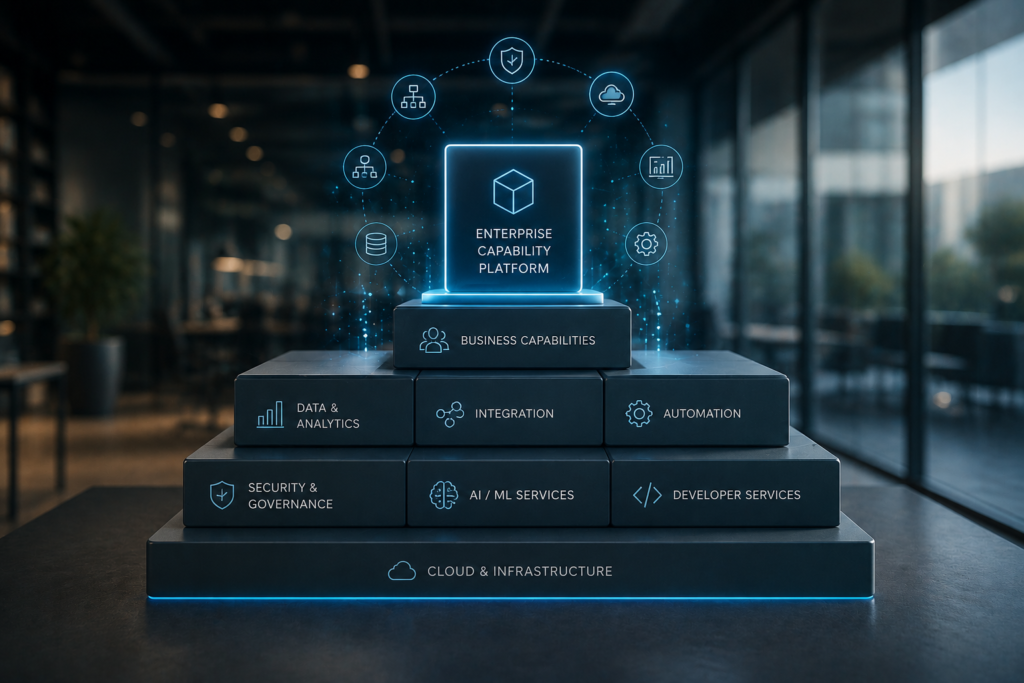
Enterprise Capability Platforms combine multiple architectural elements into reusable business capabilities. Typical components include:
- Shared enterprise data spanning multiple applications.
- Workflow orchestration across business functions.
- AI-powered recommendations and operational assistance.
- Business rules and policy enforcement.
- Identity and access management.
- Operational analytics and business observability.
- Integration services connecting enterprise systems.
- Continuous governance and compliance controls.
Rather than implementing these capabilities separately inside every application, organizations establish reusable enterprise services supporting multiple business functions simultaneously. This reduces duplication while improving consistency across the technology landscape. More importantly, it enables business capabilities to evolve independently from the applications supporting them. As organizations replace individual SaaS products, the business capability remains stable because the capability platform abstracts underlying implementation details.
Why AI Naturally Aligns with Capability Platforms
Artificial intelligence rarely thinks in terms of applications. Employees do not ask AI to update a CRM record, modify an ERP transaction, and initiate a procurement workflow individually; they ask AI to accomplish business objectives such as onboarding a customer, preparing next quarter’s budget, resolving a supplier issue, or accelerating product delivery.
Each objective spans multiple enterprise applications, and Capability Platforms provide AI with an operating model that matches how businesses actually function. Instead of coordinating isolated software products, AI interacts with complete business capabilities that already combine the necessary data, workflows, governance, and operational intelligence.
This significantly simplifies intelligent automation. AI focuses on achieving business outcomes while the capability platform manages application complexity behind the scenes. As enterprise software continues evolving toward autonomous operations, capability-centric architecture will become one of the most important foundations supporting scalable enterprise AI.
Capability Platforms in Action Across the Enterprise
The value of Enterprise Capability Platforms becomes most apparent when organizations stop thinking in terms of software ownership and begin focusing on end-to-end business outcomes.
Consider employee onboarding. In many enterprises, this seemingly straightforward process involves Human Resources, IT, security, payroll, facilities, identity management, collaboration platforms, compliance systems, and learning applications. Although every department completes its individual responsibilities, employees often experience delays because coordination occurs across disconnected applications. A capability platform transforms this experience by presenting onboarding as a single business capability rather than a collection of independent systems. AI coordinates activities, workflows orchestrate approvals, identity services provision user access, compliance policies validate mandatory requirements, and analytics monitor overall progress. Employees interact with one unified process while the platform manages application complexity behind the scenes.
The same principle applies across customer onboarding, procurement, financial planning, product launches, supplier management, contract administration, incident response, and countless other enterprise capabilities. Instead of asking which application should perform each task, organizations begin asking how the capability itself can continuously improve, shifting optimization from individual tools to overall business outcomes. This subtle change significantly reshapes enterprise software architecture because optimization occurs at the business outcome level rather than the application level.
Agility Improves When Capabilities Become Independent
One of the greatest limitations of application-centric architecture is that business change often depends on modifying multiple systems simultaneously. Introducing a new approval process may require updates to workflow engines, ERP platforms, collaboration tools, reporting systems, identity management, compliance controls, and customer-facing applications. Coordinating these changes across numerous technology teams slows innovation and increases implementation risk. Capability Platforms reduce this dependency by abstracting the underlying technology landscape. Organizations can improve business processes without redesigning every participating application, even as individual SaaS platforms evolve, integrations change, or new technologies are introduced.
This architectural flexibility allows enterprises to respond more quickly to changing market conditions, regulatory requirements, customer expectations, and operational priorities. Instead of rebuilding technology around every new business initiative, organizations extend existing capabilities that already incorporate reusable enterprise services, creating a more adaptive and manageable technology landscape over time.
Enterprise AI Becomes More Effective
Artificial intelligence performs best when it can operate across complete business processes rather than isolated software applications, and Capability Platforms provide precisely this environment. Instead of interacting independently with CRM systems, ERP platforms, procurement software, HR applications, and collaboration tools, AI works within capabilities that already combine enterprise context, workflows, governance, operational policies, and business knowledge.
Imagine an executive asking AI to accelerate enterprise customer onboarding. Rather than generating generic recommendations, AI evaluates every participating capability, identifies approval bottlenecks, predicts resource constraints, recommends workflow adjustments, prioritizes high-value customers, coordinates supporting departments, and continuously measures operational improvements after implementation. The employee communicates a business objective, and the capability platform translates that objective into coordinated enterprise execution. This dramatically reduces operational complexity while improving the quality and consistency of AI-supported decision-making.
Governance Becomes a Shared Enterprise Capability
Another advantage of capability-centric architecture is the ability to centralize governance rather than duplicating policies across dozens of applications.
Traditional enterprise environments often implement similar approval rules, security controls, compliance policies, audit requirements, and business validations independently inside multiple software platforms, making consistency increasingly difficult as the application portfolio expands. Capability Platforms establish governance as a reusable enterprise service. Identity management, policy enforcement, approval workflows, regulatory compliance, audit logging, AI oversight, and operational monitoring become standardized capabilities supporting every business function, simplifying governance while improving organizational consistency. When compliance requirements change or new policies are introduced, organizations update shared capability services rather than modifying every participating application individually, resulting in stronger governance with significantly lower operational complexity.
Challenges Organizations Must Overcome
Transitioning toward capability-centric architecture requires more than introducing another technology platform. The first challenge involves identifying the capabilities that truly differentiate the business. Many organizations remain organized around applications and departments, making it difficult to define cross-functional capabilities that span multiple operational areas. The second challenge concerns ownership. Capability Platforms frequently require collaboration between business leaders, enterprise architects, product teams, platform engineering groups, and application owners, making shared accountability essential for long-term success.
Integration also remains an important consideration. Although capability platforms reduce application complexity for end users, they depend on reliable communication between enterprise systems, making strong integration architecture fundamental to delivering consistent business capabilities. Organizations must also avoid simply creating another layer of technical complexity. Capability Platforms should simplify business execution rather than introducing additional abstraction without measurable business value, ensuring that implementations remain focused on improving enterprise outcomes rather than adding unnecessary architectural sophistication.
The Future of Enterprise Architecture Is Capability-Driven
Enterprise software is steadily moving beyond collections of independent applications toward integrated business capabilities. Future SaaS platforms will increasingly expose capabilities instead of software modules. Employees will request outcomes such as onboarding customers, resolving supplier issues, launching products, or planning budgets, and the platform will coordinate every participating application automatically while AI continuously optimizes execution behind the scenes. Business capabilities will become reusable enterprise building blocks that evolve independently from the technology supporting them. This architectural model also creates greater resilience, allowing organizations to replace applications, adopt new AI technologies, modernize infrastructure, or expand digital services without disrupting the capabilities that drive business performance. Competitive advantage will shift away from owning more software and instead depend on delivering superior business capabilities.
Conclusion
Enterprise software has reached a point where application boundaries no longer reflect the way modern businesses operate. Customers, employees, suppliers, and partners experience organizations through complete business capabilities rather than individual applications, yet many enterprises continue organizing technology around disconnected software products.
Enterprise Capability Platforms address this disconnect by bringing together data, workflows, AI, governance, automation, and enterprise services into unified operational capabilities. Instead of asking employees to coordinate dozens of applications manually, these platforms orchestrate business outcomes through reusable enterprise capabilities that remain consistent even as underlying technologies evolve.
As artificial intelligence, autonomous operations, and enterprise automation continue reshaping business execution, capability-centric architecture provides a more natural foundation for the next generation of SaaS. The future of enterprise software will not be defined by how many applications an organization owns, but by how effectively its business capabilities operate.