
Digital Transformation • 1 day ago • Jessica Mahone
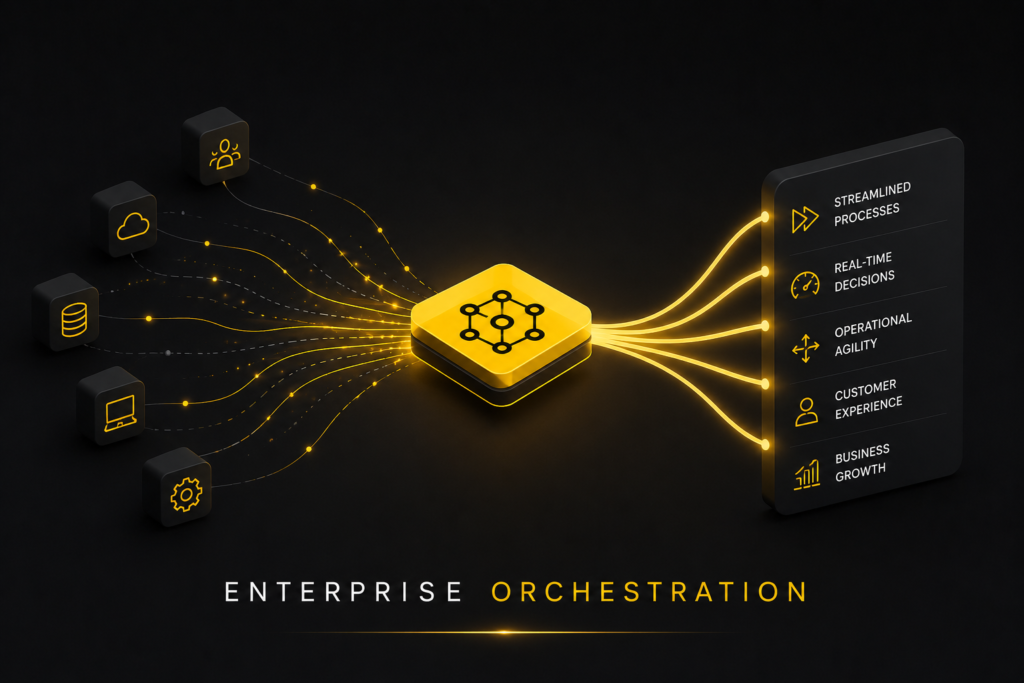
Digital transformation has evolved far beyond migrating applications to the cloud or implementing automation platforms. Organizations now operate across dozens of enterprise applications, AI services, analytics engines, workflow tools, customer platforms, and external partner ecosystems.
Yet despite unprecedented technological advancement, a common problem persists.
The technology works. The business doesn’t always flow. Departments execute independently. Applications exchange data but fail to coordinate actions. Artificial intelligence generates recommendations that remain disconnected from operational execution.
The missing ingredient is Enterprise Orchestration.
Enterprise Orchestration is the strategic capability that coordinates people, processes, applications, data, automation, and AI into a unified operational ecosystem. Rather than viewing digital transformation as isolated modernization projects, orchestration creates an enterprise where every capability works together toward shared business outcomes. It transforms complexity into coordination. As organizations continue expanding their digital ecosystems, orchestration is becoming one of the most important foundations of sustainable transformation.
What Is Enterprise Orchestration?
Enterprise Orchestration is the coordinated management of business capabilities across multiple systems, technologies, and operational functions. Unlike integration, which simply connects applications, orchestration governs how activities occur across the enterprise.
It determines:
- What should happen
- When it should happen
- Which system should respond
- Which team should participate
- Which AI recommendation should be applied
- Which business rule should take precedence
The result is a synchronized enterprise rather than a collection of disconnected technologies.
Integration Connects Systems. Orchestration Connects Business
Many organizations believe APIs and integrations are enough to achieve digital transformation. Integration moves information. Orchestration manages execution. A customer order may trigger inventory validation, fraud analysis, pricing verification, logistics planning, payment authorization, compliance review, and customer communication. Each capability may operate within different systems. Orchestration coordinates the entire business journey as one intelligent workflow. The enterprise behaves as a single operating system instead of isolated applications.
Why Complexity Is the Biggest Transformation Challenge
Every new technology introduces additional dependencies. Cloud platforms, AI services, automation tools, CRM solutions, ERP systems, and analytics platforms all contribute value individually. Collectively, they increase operational complexity.
Without orchestration, organizations spend significant effort managing exceptions rather than delivering innovation. Enterprise Orchestration creates visibility across these interactions, reducing operational friction while improving scalability. Complexity becomes manageable through intelligent coordination.
AI Requires Orchestration to Deliver Business Value
Artificial Intelligence is increasingly embedded within enterprise operations. However, AI recommendations alone do not create business outcomes. Recommendations must initiate workflows, notify stakeholders, trigger approvals, update systems, and measure results.
Enterprise Orchestration transforms AI insights into coordinated enterprise action. Instead of generating isolated predictions, AI becomes an active participant in business execution. This alignment significantly increases the practical value of enterprise AI investments.
Customer Journeys Depend on Orchestration
Customers interact with organizations across multiple channels – Websites, Mobile applications, Sales representatives, Support teams, Partner ecosystems.
Customers expect these interactions to feel unified. Enterprise Orchestration synchronizes every touchpoint through coordinated workflows and shared business context. The experience becomes seamless because the enterprise operates as one connected ecosystem. Customer satisfaction improves through operational consistency rather than isolated excellence.
Data Flows Become Business Flows
Organizations often focus on moving data efficiently. Equally important is moving decisions efficiently. Enterprise Orchestration connects information with action. Operational events automatically initiate business responses. Approvals become dynamic. Processes adapt based on real-time conditions. Business execution accelerates because information immediately drives coordinated action. Transformation extends beyond digital information into digital operations.
Governance Without Bottlenecks
Highly regulated organizations often struggle to balance agility with governance. Enterprise Orchestration embeds governance directly into workflows. Business rules execute automatically. Compliance checks occur continuously. Approvals become contextual. Audit trails are generated by default. Governance shifts from manual oversight to intelligent operational control. Innovation accelerates without sacrificing accountability.
Measuring Enterprise Orchestration Maturity
Organizations should evaluate orchestration capabilities through metrics such as:
- Process synchronization
- Cross-system automation
- Decision execution speed
- AI workflow integration
- Customer journey continuity
- Operational visibility
- Exception management
- Process adaptability
- Governance automation
- Enterprise responsiveness
These indicators reveal how effectively business capabilities operate together. Transformation success increasingly depends on orchestration maturity rather than technology maturity alone.
Building an Orchestrated Enterprise
Organizations seeking long-term digital leadership should invest in:
- Enterprise workflow architecture
- Event-driven operations
- AI-enabled automation
- Unified business rules
- Shared operational data
- Cross-platform orchestration
- Process observability
- Decision automation
- Governance integration
- Business capability coordination
The objective is not merely connecting technology. It is coordinating enterprise behavior.
Why Enterprise Orchestration Will Define the Next Generation of Digital Transformation
Technology ecosystems will continue expanding. Artificial intelligence will become embedded across every business function. Automation will become increasingly autonomous. Organizations that simply accumulate technology will struggle with growing complexity. Organizations that orchestrate technology will create agility. Enterprise Orchestration enables businesses to operate intelligently across distributed systems while maintaining strategic alignment. It becomes the invisible layer that transforms digital investments into measurable business outcomes.
Conclusion
The future of digital transformation is not about implementing more technology. It is about ensuring technology works together as a unified enterprise capability. Enterprise Orchestration provides the coordination layer that aligns people, processes, AI, data, and applications around shared business objectives. It reduces operational complexity, improves customer experiences, strengthens governance, and enables continuous innovation.
As digital ecosystems continue to expand, the organizations that succeed will not necessarily own the most advanced technologies. They will be the ones that orchestrate them most effectively.