
Enterprise Software (SaaS) • 8 days ago • Melvin Hall
Enterprise software has evolved dramatically over the past decade. Organizations have adopted cloud-native platforms for customer relationship management, finance, procurement, human resources, project management, collaboration, and analytics. These applications have digitized business operations and improved efficiency across every department.
Yet despite these advancements, most SaaS platforms still suffer from a fundamental limitation.
They remember transactions but rarely remember context.
Every interaction often begins as a new event, forcing employees to repeatedly search for historical information, reconnect fragmented records, and rebuild business context before making decisions.
This challenge is giving rise to a new architectural concept within enterprise software: the Enterprise SaaS Memory Layer.
Rather than serving as another application, a memory layer functions as an intelligent contextual engine that continuously captures relationships, decisions, conversations, workflows, and operational history across the enterprise.
Instead of isolated software systems, organizations gain software that remembers.
For modern B2B enterprises, this capability could redefine productivity and decision-making.
What Is an Enterprise SaaS Memory Layer?
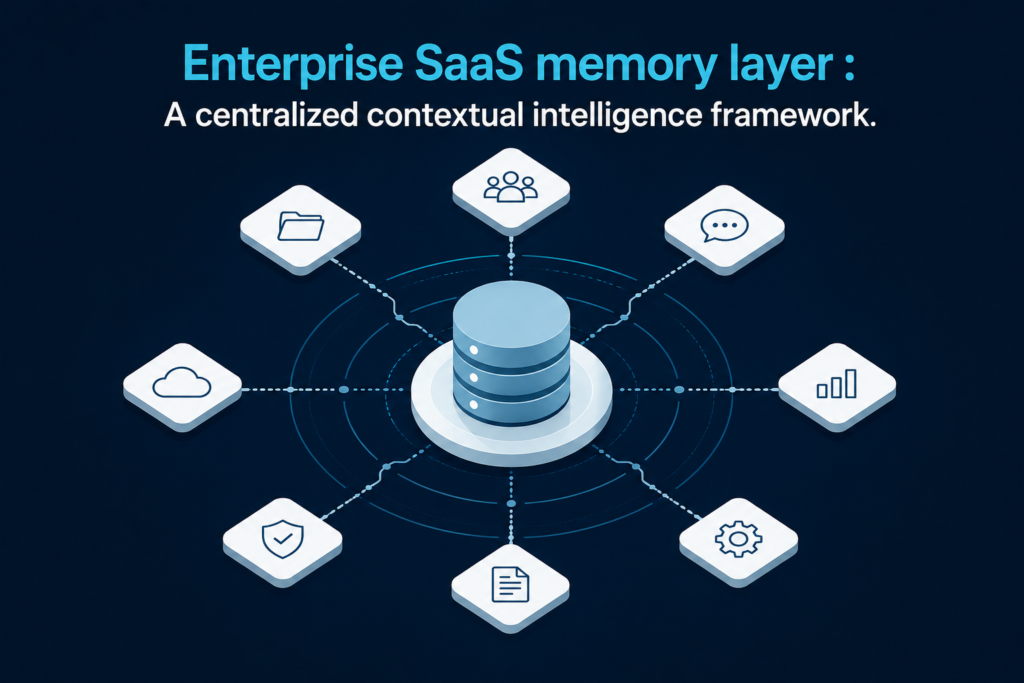
An Enterprise SaaS Memory Layer is a centralized contextual intelligence framework that sits across multiple business applications and continuously captures organizational knowledge. It records not only data but also relationships between events, workflows, approvals, customer interactions, projects, and business decisions.
The platform creates persistent organizational memory that can be reused across departments and software ecosystems. Information evolves into institutional intelligence rather than remaining isolated within individual applications.
Why Enterprise Knowledge Continues to Disappear
Organizations generate enormous amounts of valuable knowledge every day. Customer meetings. Procurement discussions. Implementation notes. Project decisions. Support conversations. Approval comments. Operational exceptions.
Most of this information remains scattered across emails, chat platforms, documents, tickets, and individual SaaS applications. When employees leave or teams change, much of that context disappears. The enterprise loses experience that was expensive to acquire.
A memory layer preserves this intelligence and makes it continuously accessible.
Beyond Data Storage
Traditional SaaS platforms excel at storing structured information. A CRM stores customer records. An ERP stores transactions. A project tool stores tasks.
However, very few systems understand why decisions were made. The memory layer captures business reasoning alongside business activity. Future teams can understand not only what happened but also the context behind those actions.
This significantly improves continuity across long-term initiatives.
Creating Context Across Multiple Applications
Modern enterprises rarely operate within a single software platform. Business processes span multiple systems simultaneously.
A customer opportunity may involve:
- CRM records
- Sales proposals
- Contract approvals
- Legal reviews
- Procurement workflows
- Finance systems
- Customer support platforms
- Implementation projects
The memory layer connects these interactions into one continuous business narrative. Employees no longer need to reconstruct history from disconnected applications. The software remembers for them.
Transforming Employee Productivity
One of the largest hidden costs in enterprise software is information retrieval. Employees spend valuable time searching documents, reviewing historical conversations, and locating previous decisions.
An enterprise memory layer dramatically reduces this effort. Relevant context becomes available instantly. Instead of asking colleagues for background information, employees receive intelligent summaries generated from accumulated organizational knowledge.
Work begins with understanding rather than investigation.
Supporting AI With Organizational Memory
Artificial intelligence performs best when provided with rich business context. Without organizational memory, AI models generate recommendations based only on current inputs.
A memory layer provides historical awareness. AI assistants can reference previous negotiations, project outcomes, customer preferences, operational decisions, and workflow patterns. Recommendations become more accurate because they are informed by enterprise experience rather than isolated data.
Memory transforms AI from reactive assistance into strategic guidance.
Strengthening Customer Relationships
Long-term B2B relationships depend on continuity. Customers expect organizations to remember previous interactions, commitments, preferences, and implementation history. Fragmented software environments often create inconsistent customer experiences.
An enterprise memory layer provides a unified relationship history across departments. Sales, customer success, support, finance, and operations all access the same contextual understanding. The customer experiences one coordinated organization rather than multiple disconnected teams.
Building a Learning Enterprise
Many businesses repeat the same mistakes because organizational knowledge is not systematically preserved. Lessons learned remain within individual teams. Successful strategies are forgotten after projects conclude.
The memory layer converts operational experience into reusable enterprise intelligence. Every completed project strengthens future execution. Every resolved issue contributes to organizational learning. Continuous improvement becomes embedded within enterprise software itself.
Governance and Compliance Advantages
Regulated industries often require clear documentation explaining why decisions were made. Traditional systems provide records but rarely preserve decision context. Memory layers create traceable narratives linking approvals, discussions, policies, and operational actions.
This improves:
- Audit readiness
- Regulatory reporting
- Policy compliance
- Risk management
- Decision transparency
- Knowledge retention
- Process governance
- Operational accountability
Compliance evolves from documentation to contextual evidence.
The Future of Enterprise SaaS
The next generation of enterprise software will compete not only on features but also on intelligence. Applications that understand historical context will outperform systems that simply process transactions. The Enterprise SaaS Memory Layer introduces a persistent intelligence foundation capable of connecting people, processes, and decisions across the organization.
As businesses continue investing in AI and automation, memory will become an essential capability enabling software to deliver truly informed recommendations and adaptive workflows. The future of SaaS is not merely cloud-based software.
It is software that remembers, learns, and continuously strengthens the enterprise through accumulated knowledge. Organizations that embrace this evolution will build technology ecosystems where every interaction contributes to long-term business intelligence, creating a competitive advantage that grows stronger with every decision.