
Cloud & Infrastructure • 18 hours ago • Shruti Das
Cloud infrastructure has traditionally been built around capacity.
Organizations provision servers, allocate storage, configure networks, and deploy applications based on expected demand. As business requirements evolve, infrastructure teams adjust configurations to maintain performance and reliability.
But modern digital enterprises are becoming too dynamic for static infrastructure models.
Customer behavior changes instantly. AI workloads fluctuate dramatically. Global traffic shifts continuously. Security threats evolve without warning. New services launch every week.
The infrastructure supporting these environments must do more than scale.
It must adapt.
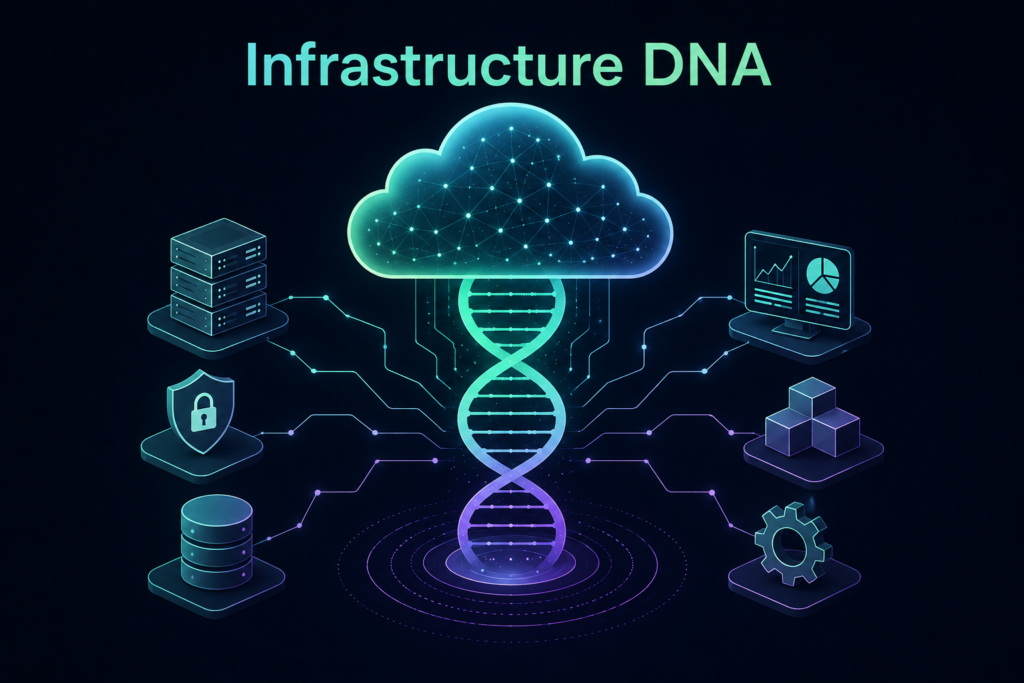
This need is giving rise to a new architectural philosophy known as Infrastructure DNA—an intelligent cloud foundation capable of understanding its own operational patterns, learning from historical behavior, and continuously modifying itself to optimize performance, resilience, security, and cost.
Instead of treating infrastructure as a collection of hardware and software components, enterprises are beginning to view it as a living digital ecosystem.
The organizations that embrace adaptive infrastructure will build cloud platforms that evolve alongside their business instead of limiting it.
Beyond Elasticity: The Next Stage of Cloud Evolution
Elasticity has long been one of cloud computing’s greatest strengths.
Applications automatically add or remove resources based on demand, improving efficiency compared to traditional infrastructure. Adaptive infrastructure extends this concept far beyond simple scaling. It evaluates operational conditions across the entire technology landscape and determines how infrastructure should evolve in response.
Rather than simply adding servers, it may redistribute workloads, optimize storage placement, adjust network paths, strengthen security policies, or modify application dependencies. Infrastructure becomes capable of intelligent evolution instead of mechanical expansion.
Every Enterprise Has Its Own Infrastructure DNA
No two organizations operate the same way. Financial institutions experience predictable transaction peaks. Healthcare platforms prioritize availability and compliance. Manufacturing systems depend on edge computing. Media platforms encounter unpredictable traffic surges.
Adaptive cloud environments recognize these operational signatures over time.
They develop unique behavioral profiles that influence future infrastructure decisions. Instead of applying generic optimization rules, the platform learns what “normal” looks like for that specific business and continuously adjusts itself accordingly. Infrastructure begins reflecting the organization’s operational identity.
Data Is Becoming the Primary Infrastructure Resource
Servers and storage remain essential, but data now drives infrastructure intelligence.
Every workload generates telemetry that reveals:
- Application performance
- Resource utilization
- Network behavior
- User interaction patterns
- Security events
- Capacity trends
- Service dependencies
- Geographic demand distribution
Adaptive platforms transform these signals into operational knowledge. Infrastructure decisions become increasingly data-driven rather than manually configured. The cloud environment effectively learns from its own experience.
Infrastructure That Understands Business Priorities
Traditional infrastructure treats all workloads similarly. Adaptive platforms recognize that different applications create different business value.
For example:
- Customer payment systems require maximum availability.
- Internal reporting workloads can tolerate delayed execution.
- AI training jobs can shift to lower-cost compute resources.
- Analytics processing can be scheduled dynamically.
Infrastructure DNA enables platforms to allocate resources according to business importance rather than technical assumptions. Technology becomes aligned with strategic objectives instead of isolated operational metrics.
The Rise of Continuous Infrastructure Optimization
Infrastructure optimization has historically occurred during scheduled reviews. Teams analyzed reports, identified inefficiencies, and implemented improvements weeks or months later.
Adaptive infrastructure eliminates this delay. Optimization becomes continuous.
The platform constantly evaluates:
- Compute efficiency
- Storage allocation
- Network latency
- Service communication
- Security posture
- Resource placement
- Cost distribution
- Workload performance
Minor improvements occurring thousands of times each day generate substantial long-term business value. Optimization becomes part of infrastructure behavior rather than an occasional project.
Resilience Through Intelligent Adaptation
Enterprise resilience is no longer measured solely by disaster recovery plans. Modern cloud platforms must respond instantly to changing conditions.
Adaptive infrastructure continuously identifies operational risks before they become outages.
Potential actions include:
- Rerouting application traffic
- Relocating workloads
- Replicating critical datasets
- Isolating unhealthy services
- Increasing redundancy
- Adjusting edge routing
- Prioritizing business-critical applications
- Redistributing processing capacity
Recovery shifts from reactive incident management to proactive infrastructure adaptation. Customers experience uninterrupted digital services even as conditions change behind the scenes.
Security Evolves Alongside Infrastructure
Cybersecurity strategies often struggle because infrastructure changes faster than security policies. Adaptive cloud platforms integrate security directly into operational intelligence. The infrastructure continuously evaluates trust relationships and modifies protection mechanisms in real time.
Examples include:
- Dynamic network segmentation
- Identity-aware communication
- Automated policy updates
- Intelligent threat isolation
- Behavioral anomaly detection
- Risk-based resource access
- Continuous encryption validation
- Self-adjusting compliance controls
Security becomes an adaptive capability rather than a static configuration.
Platform Engineering Enables Adaptive Infrastructure
The emergence of platform engineering accelerates Infrastructure DNA adoption. Instead of manually building environments for every project, platform teams create standardized infrastructure capabilities that evolve automatically. Developers consume infrastructure as reusable services while adaptive intelligence continuously optimizes the underlying platform.
Benefits include:
- Faster application delivery
- Reduced operational complexity
- Consistent governance
- Improved scalability
- Better developer experience
- Simplified compliance
- Standardized infrastructure patterns
- Continuous innovation
Infrastructure becomes a product rather than a project.
Measuring Adaptive Infrastructure Maturity
Modern enterprises increasingly evaluate infrastructure quality through adaptive performance indicators.
Important metrics include:
- Autonomous optimization frequency
- Infrastructure learning accuracy
- Workload mobility efficiency
- Predictive scaling success
- Operational resilience
- Self-remediation rate
- Business alignment score
- Resource adaptation speed
These measurements reflect how effectively infrastructure responds to changing business conditions rather than simply how much capacity it provides.
The Future Belongs to Infrastructure That Learns
Enterprise cloud environments are entering a new era where intelligence becomes just as important as compute power. Infrastructure DNA represents the convergence of cloud computing, automation, observability, AI, security, and platform engineering into a single adaptive ecosystem. Rather than waiting for administrators to redesign architecture every few months, adaptive platforms continuously reshape themselves to meet evolving business needs.Organizations adopting this philosophy gain infrastructure that becomes smarter with every workload, every transaction, and every operational event.
In the future of cloud computing, competitive advantage will not come from owning more infrastructure. It will come from owning infrastructure capable of learning, adapting, and evolving faster than the business environment around it.