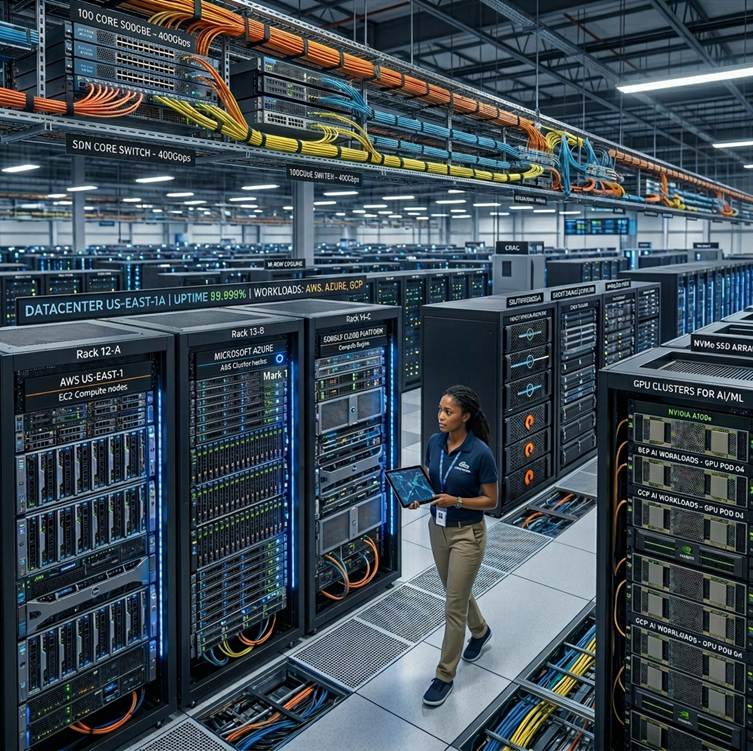


As applications evolved from monolithic systems into distributed, microservices-based architectures, infrastructure complexity increased dramatically. Instead of running a single large application on one server, organizations began deploying dozens — sometimes hundreds — of smaller services that communicate with each other across networks. Each service might scale independently. Each service might fail independently. Each service might require different resource allocations.
Managing this level of distribution manually is nearly impossible.
Containers emerged as a solution to part of this problem. Container technology allows applications and their dependencies to be packaged into lightweight, portable units that run consistently across environments. Unlike traditional virtual machines, containers share the host operating system kernel, making them more efficient and faster to start.
However, running containers at scale introduces its own challenges. If hundreds of containers are running across dozens of servers, who ensures they stay healthy? Who restarts them if they crash? Who distributes traffic evenly? Who scales them during demand spikes?
This is where orchestration becomes essential.
The most widely adopted orchestration platform is Kubernetes. Originally developed by Google and now maintained by the Cloud Native Computing Foundation, Kubernetes has become the standard platform for managing containerized workloads in cloud environments.
From Containers to Orchestration
Containers solve the “it works on my machine” problem. They package application code, runtime, libraries, and dependencies into a consistent environment. Developers can build containers locally and deploy them confidently to production without worrying about configuration inconsistencies.
But running a single container is trivial. Running thousands reliably is complex.
Containers are ephemeral by nature. They can start, stop, and restart quickly. This volatility requires automated management. Kubernetes provides that management layer.
Instead of thinking about individual servers, Kubernetes encourages thinking in terms of desired state. Engineers declare how many instances of a service should run, what resources they require, and how they should communicate. Kubernetes continuously reconciles the actual state with the desired state.
If a container crashes, Kubernetes restarts it. If a node fails, containers are rescheduled on healthy nodes. If traffic increases, replicas can scale automatically.
The Architecture of Kubernetes
At its core, Kubernetes consists of a control plane and worker nodes. The control plane manages the cluster’s overall state, while worker nodes run the containerized workloads.
The control plane includes components responsible for scheduling workloads, maintaining cluster state, and exposing APIs. The scheduler determines which node should run each container based on resource availability and constraints. The API server acts as the central communication hub.
Worker nodes host containers inside structures called pods. A pod represents the smallest deployable unit in Kubernetes. It may contain one or more tightly coupled containers that share networking and storage resources.
This architecture separates management from execution, enabling scalability and flexibility.
Declarative Deployment and Desired State
One of Kubernetes’ most powerful concepts is declarative configuration. Instead of manually starting containers, engineers define manifests that describe how applications should run. These manifests specify:
- The number of replicas
- Resource requirements
- Environment variables
- Networking rules
- Storage configurations
Kubernetes reads these definitions and ensures the system matches them.
This declarative model aligns closely with Infrastructure as Code principles. Infrastructure and application deployment become automated and version-controlled. Systems move from manual intervention to continuous reconciliation.
Self-Healing Systems
Kubernetes is designed to maintain application health automatically. Health checks are defined within deployment configurations. If a container fails its health check, Kubernetes restarts it. If a node becomes unreachable, workloads are redistributed.
This self-healing capability reduces downtime and operational burden. Instead of engineers constantly monitoring and manually restarting services, the platform handles recovery.
Self-healing does not eliminate the need for monitoring, but it reduces the frequency of manual intervention.
Scaling and Resource Optimization
Scalability in Kubernetes occurs at multiple levels. Horizontal Pod Autoscalers adjust the number of running replicas based on metrics such as CPU usage or request rate. Cluster autoscalers can add or remove worker nodes depending on workload demand.
This multi-layered scaling ensures that applications remain responsive during traffic surges. At the same time, it prevents unnecessary resource consumption during idle periods.
Efficient resource allocation is critical in cloud environments, where cost correlates directly with usage. Kubernetes scheduling optimizes container placement based on available CPU and memory resources, minimizing waste.
Networking and Service Discovery
In distributed systems, communication between services is essential. Kubernetes provides built-in service discovery mechanisms. Each service receives a stable network identity, allowing containers to communicate reliably even as individual instances scale or restart.
Ingress controllers manage external access to services. They handle routing rules, TLS termination, and traffic management.
These networking abstractions simplify complex routing requirements and reduce operational overhead.
Storage and Stateful Workloads
While containers are often associated with stateless applications, many systems require persistent storage. Kubernetes supports persistent volumes that allow stateful applications — such as databases — to store data reliably.
StatefulSets manage stateful workloads, ensuring stable network identities and ordered deployment processes.
Although running large-scale databases directly inside Kubernetes requires careful planning, the platform provides the primitives necessary for persistent workloads.
Security Considerations
Security in Kubernetes requires deliberate configuration. Role-Based Access Control (RBAC) governs permissions within the cluster. Network policies define allowed communication paths between services. Secrets management systems store sensitive credentials securely.
Container security is equally important. Images must be scanned for vulnerabilities before deployment. Runtime security tools monitor suspicious behavior.
While Kubernetes provides robust capabilities, misconfiguration can introduce risk. Operational maturity and governance practices are essential.
Core Advantages of Kubernetes
- Automated container deployment and scheduling
- Self-healing through health checks and restarts
- Horizontal and cluster-level auto scaling
- Built-in service discovery and networking
- Declarative configuration aligned with IaC
These capabilities collectively make Kubernetes the backbone of cloud-native application management.
Microservices and Cloud-Native Design
Kubernetes is often associated with microservices architecture. In this model, applications are decomposed into smaller, independent services that communicate via APIs. Each service can scale independently, deploy independently, and evolve independently.
This flexibility improves resilience and accelerates development. However, it also introduces complexity in communication, observability, and debugging.
Kubernetes provides the infrastructure foundation, but organizations must complement it with observability tools, service meshes, and robust monitoring systems.
Managed Kubernetes and Cloud Integration
Many organizations adopt managed Kubernetes services offered by cloud providers. These services abstract control plane management, reducing operational overhead. Teams focus on application deployment rather than cluster maintenance.
Managed platforms integrate with cloud-native services such as load balancers, identity systems, and storage solutions. This integration streamlines operations and enhances scalability.
The Future of Orchestration
Container orchestration continues evolving. Serverless container models abstract node management further. Service meshes enhance traffic control and observability. Policy engines enforce governance automatically.
Despite these advancements, the core value proposition remains: Kubernetes enables reliable, scalable management of distributed containerized applications.
In a world where software systems are increasingly modular, dynamic, and globally distributed, orchestration is not optional. It is essential.
Kubernetes transforms containers from isolated units into coordinated systems. It enables teams to manage complexity with automation, resilience, and scalability at the forefront.