
Emerging tech & Deep tech • 1 day ago • Neha Jamwal
Artificial intelligence is steadily evolving from a tool that responds to individual prompts into a collaborative workforce capable of handling complex business operations. Early enterprise AI applications focused on isolated tasks such as generating content, answering customer queries, summarizing documents, or analyzing data. While these capabilities delivered measurable productivity gains, they also exposed an important limitation. A single AI model, regardless of its sophistication, cannot efficiently manage every responsibility across a modern enterprise.
Large organizations operate through specialized teams. Finance professionals oversee budgets and compliance, procurement teams negotiate with suppliers, human resources manage talent, operations coordinate production, and customer service resolves issues. Each department possesses unique expertise while working toward common organizational objectives. Artificial intelligence is beginning to follow a similar model.
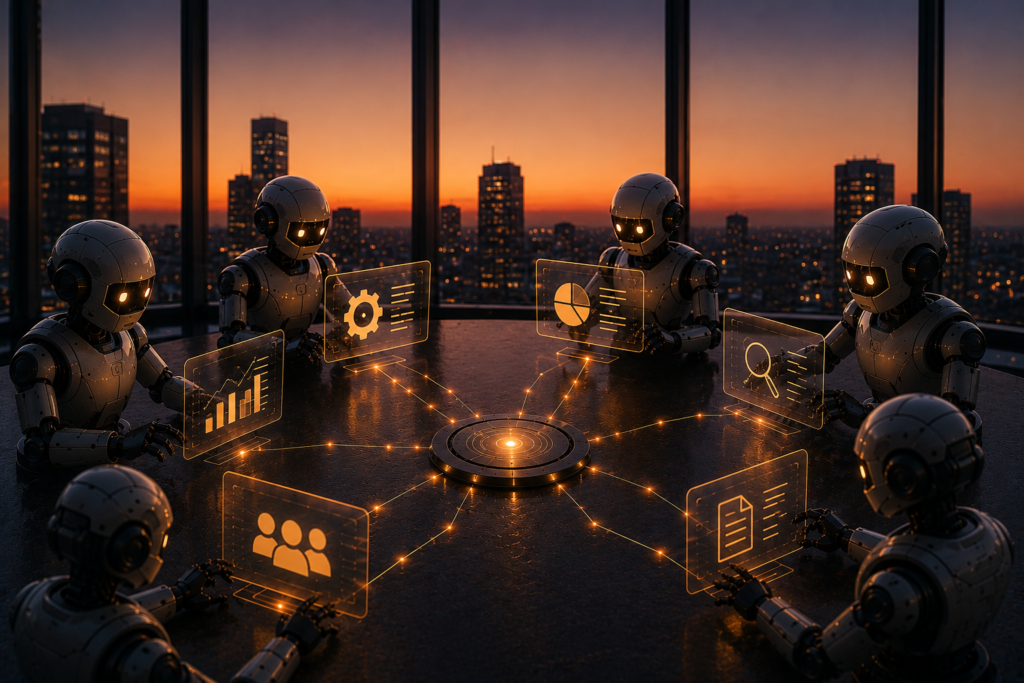
This shift has led to the emergence of Multi-Agent Enterprise Systems, a deep technology that enables multiple AI agents to work together as coordinated specialists instead of relying on one general-purpose assistant. Each agent performs a distinct role, collaborates with other agents when necessary, and contributes to broader business outcomes through shared intelligence and coordinated decision-making.
The concept represents a significant advancement in enterprise AI. Instead of deploying one intelligent system responsible for every task, organizations can build networks of specialized agents that communicate, exchange knowledge, divide responsibilities, and collectively solve problems. The result is an intelligent operational ecosystem that mirrors how successful organizations already function through collaboration between specialized teams. As enterprise environments continue to grow in complexity, Multi-Agent Enterprise Systems are expected to become a foundational component of intelligent business operations, enabling greater automation while maintaining flexibility, governance, and domain expertise.
Understanding Multi-Agent Enterprise Systems
A Multi-Agent Enterprise System consists of multiple autonomous AI agents that cooperate to achieve shared business objectives. Each agent is designed to perform a specific function, make localized decisions, and exchange information with other agents when tasks require coordination.
Unlike a traditional AI assistant that attempts to answer every request independently, a multi-agent environment distributes work across specialists. One agent may analyze financial data, another may monitor supply chain conditions, while a third evaluates regulatory requirements. Together, they produce recommendations that consider a broader range of business factors than any single system could evaluate alone.
This collaborative approach reflects how enterprises naturally operate. Complex business challenges rarely belong to one department. A pricing decision may influence manufacturing, procurement, logistics, finance, marketing, and customer support simultaneously. Multi-Agent Enterprise Systems recognize these dependencies and coordinate expertise across multiple domains before presenting a recommended course of action.
The objective is not simply automation. It is coordinated intelligence that enables organizations to solve increasingly sophisticated business problems.
Why Enterprises Are Moving Beyond Single AI Models
The rapid adoption of generative AI demonstrated that intelligent systems can significantly improve productivity. However, enterprise deployments quickly revealed several practical challenges. A single AI assistant often struggles to maintain deep expertise across every business function. It may lack visibility into specialized workflows, fail to understand departmental priorities, or produce recommendations that overlook operational constraints elsewhere in the organization. As AI responsibilities expand, organizations require systems capable of balancing competing priorities across multiple business units. Several factors are accelerating the move toward multi-agent architectures:
- Enterprise operations involve highly specialized knowledge domains.
- Business decisions frequently require collaboration between multiple departments.
- Large-scale workflows consist of interconnected tasks rather than isolated activities.
- Governance becomes easier when responsibilities are distributed among specialized agents.
- Independent agents can evolve without disrupting the entire system.
This architectural shift allows enterprises to develop intelligent systems that scale in the same way successful organizations scale—through specialization, collaboration, and clearly defined responsibilities.
The Enterprise Agent Hierarchy
One useful way to understand Multi-Agent Enterprise Systems is through what can be viewed as an Enterprise Agent Hierarchy. This conceptual framework illustrates how different categories of AI agents cooperate across organizational layers to support enterprise operations.
Executive Agents operate at the strategic level. Their responsibility is to evaluate enterprise-wide objectives, monitor organizational performance, identify emerging risks, and coordinate high-level planning activities. These agents synthesize information from multiple functional domains to support executive decision-making.
Functional Agents specialize in individual business domains such as finance, procurement, human resources, cybersecurity, sales, marketing, or manufacturing. Each develops deep expertise within its area while continuously exchanging information with other functional agents when business activities overlap.
Operational Agents manage routine workflows that support day-to-day business activities. They automate repetitive processes, monitor system performance, coordinate approvals, and ensure operational consistency across departments.
Specialist Agents focus on narrowly defined responsibilities requiring advanced expertise. Examples include contract analysis, fraud detection, predictive maintenance, inventory optimization, regulatory compliance monitoring, or demand forecasting. Their outputs often support both operational and functional agents.
This hierarchy demonstrates that enterprise AI is evolving into a collaborative ecosystem where specialized intelligence operates across multiple organizational levels instead of relying on one centralized system.
How Multi-Agent Enterprise Systems Work
Although implementations vary, most Multi-Agent Enterprise Systems follow a similar operational model. A business objective initiates the workflow. The system identifies which agents possess relevant expertise and distributes responsibilities accordingly. Individual agents analyze available information, perform specialized reasoning within their respective domains, and exchange findings with collaborating agents. Once each agent completes its analysis, the system consolidates the results into a unified recommendation. Depending on governance requirements, the recommendation may be reviewed by human decision-makers or automatically executed within predefined operational boundaries.
This collaborative workflow enables enterprises to address problems that would otherwise require multiple disconnected systems or extensive manual coordination. A typical process includes:
- Identifying the business objective
- Assigning responsibilities to specialized agents
- Collecting information from enterprise systems
- Performing domain-specific analysis
- Sharing findings across collaborating agents
- Resolving conflicts or competing priorities
- Producing coordinated recommendations
- Supporting human approval or automated execution
- Recording outcomes to improve future collaboration
Over time, each interaction strengthens the collective intelligence of the system, allowing agents to refine coordination patterns and improve operational effectiveness.
Enterprise Applications
The versatility of Multi-Agent Enterprise Systems makes them suitable for a wide range of industries and operational environments.
Supply Chain Coordination Supply chain management requires continuous coordination between procurement, inventory planning, logistics, manufacturing, supplier management, and customer demand forecasting. Specialized AI agents assigned to each function can exchange information in real time, helping organizations optimize inventory levels, reduce transportation costs, and respond more effectively to unexpected disruptions.
Financial Operations Finance departments manage budgeting, forecasting, expense monitoring, compliance, auditing, treasury operations, and financial reporting. Multi-agent systems allow these activities to operate collaboratively while maintaining clear separation of responsibilities. For example, a compliance agent can validate regulatory requirements while a forecasting agent evaluates financial scenarios and a treasury agent monitors liquidity, producing recommendations that reflect multiple financial perspectives.
Customer Experience Delivering exceptional customer experiences often requires information from sales, support, product management, logistics, and billing. Multi-agent collaboration enables AI systems to combine these perspectives, giving employees and customers more accurate, personalized, and context-aware assistance without requiring information to be gathered manually from multiple departments.
Manufacturing and Industrial Operations Manufacturing environments involve thousands of interconnected decisions every day. Production scheduling, equipment maintenance, quality assurance, inventory availability, workforce planning, and energy management all influence operational performance. Specialized agents can continuously coordinate these activities, helping organizations improve efficiency while minimizing downtime and operational risk.
Business Benefits of Multi-Agent Enterprise Systems
Organizations that adopt multi-agent architectures are not simply adding more AI systems to their technology landscape. They are creating an intelligent operating model where specialized agents collaborate in much the same way experienced teams coordinate across an enterprise. This shift improves not only automation but also the quality, consistency, and speed of business decisions. Several advantages become apparent as these systems mature:
- Faster execution of complex business workflows
- Better coordination across departments
- Reduced manual intervention in repetitive processes
- Greater scalability as business operations expand
- Improved decision quality through domain-specific expertise
- Stronger operational resilience when individual agents can continue functioning independently
- Easier governance by assigning clearly defined responsibilities to each agent
- Continuous improvement through shared learning and feedback
These benefits extend beyond operational efficiency. Multi-agent systems help organizations manage complexity without requiring every decision to pass through a single centralized AI model or human team.
Agent Orchestration: The Intelligence That Connects Everything
Specialized agents are only as effective as their ability to work together. Without coordination, even highly capable AI agents can produce conflicting recommendations, duplicate work, or overlook important dependencies. This is where agent orchestration becomes essential.
Agent orchestration provides the rules, communication mechanisms, and governance that allow multiple agents to function as a unified system. It determines which agent should perform a task, how information should be shared, when collaboration is required, and how disagreements between recommendations should be resolved. An orchestration layer typically performs several responsibilities:
- Assigns tasks to the appropriate agents
- Coordinates communication between agents
- Resolves competing recommendations
- Monitors workflow progress
- Applies enterprise governance policies
- Escalates decisions requiring human review
- Maintains audit trails for accountability
Without orchestration, enterprises risk building collections of intelligent tools that operate independently. With orchestration, they create coordinated digital teams capable of supporting complex business operations.
Common Misconceptions About Multi-Agent Enterprise Systems
As interest in agent-based AI grows, several misconceptions have emerged that can create unrealistic expectations.
Misconception 1: More Agents Always Produce Better Results Adding additional agents does not automatically improve performance. Each agent should serve a clearly defined purpose and contribute specialized expertise. An excessive number of poorly coordinated agents can increase complexity without creating additional value.
Misconception 2: Every Agent Must Be Fully Autonomous Autonomy exists on a spectrum. Some enterprise agents execute routine tasks independently, while others operate under strict human supervision. The appropriate level of autonomy depends on business risk, governance requirements, and regulatory obligations.
Misconception 3: Multi-Agent Systems Replace Employees These systems are designed to support employees, not eliminate them. Human expertise remains essential for strategic planning, ethical judgment, negotiations, relationship management, and decisions involving significant uncertainty. AI agents reduce repetitive work and provide analytical support, allowing people to focus on higher-value activities.
Misconception 4: Every Department Needs Its Own AI Agent Successful implementations focus on solving meaningful business problems instead of assigning an agent to every organizational function. In many cases, a small group of well-designed agents can support multiple departments through shared intelligence and coordinated workflows.
Challenges and Adoption Considerations
Building an effective Multi-Agent Enterprise System requires thoughtful planning. While the underlying technology has advanced significantly, organizational readiness often determines long-term success. One of the primary challenges is defining clear responsibilities. Agents with overlapping functions can produce conflicting recommendations or duplicate effort. Establishing precise boundaries helps maintain efficiency and accountability.
Data integration is another critical consideration. Agents depend on timely, reliable information from enterprise applications, operational platforms, customer systems, and external data sources. Fragmented or inconsistent data limits the effectiveness of collaborative decision-making.
Security and governance become increasingly important as the number of agents grows. Organizations need clear policies governing identity management, access permissions, communication protocols, audit logging, and approval workflows. Every recommendation should be traceable to the agents and information that contributed to the outcome.
Performance monitoring is equally essential. Enterprises should continuously evaluate how agents collaborate, identify bottlenecks, measure business impact, and refine orchestration strategies to improve overall system performance.
Finally, organizations must prepare employees to work alongside AI agents. Successful adoption depends on trust, transparency, and a clear understanding of how human expertise complements automated intelligence.
Building Trust in Collaborative AI
Trust is one of the most important factors influencing enterprise adoption. Employees are more likely to embrace AI when they understand how recommendations are generated and when they retain appropriate oversight over important decisions. Several practices strengthen confidence in multi-agent systems:
- Clearly defining the responsibilities of each agent
- Providing explanations for recommendations
- Maintaining complete audit trails
- Allowing human review for high-impact decisions
- Monitoring agent performance continuously
- Updating agents as business policies evolve
Transparency transforms AI from a black-box technology into a dependable business partner that employees can confidently incorporate into their daily work.
The Next Evolution of Enterprise Intelligence
As enterprises continue expanding their AI capabilities, isolated assistants will gradually give way to coordinated networks of specialized intelligence. Future business systems are expected to involve hundreds or even thousands of collaborating agents responsible for monitoring operations, optimizing workflows, supporting employees, and assisting leadership teams with strategic planning. These agents will not operate independently. They will exchange information continuously, coordinate activities across business functions, and adapt to changing operational conditions through shared learning. Enterprise intelligence will become increasingly distributed, with specialized expertise available wherever it is needed.
This evolution also creates opportunities for greater organizational resilience. If one agent becomes unavailable or requires updates, other agents can continue supporting business operations without disrupting the entire system. Such modular architectures provide flexibility that is difficult to achieve with monolithic AI platforms. Over time, Multi-Agent Enterprise Systems are expected to become an essential layer of enterprise infrastructure, supporting everything from customer engagement and financial planning to manufacturing, cybersecurity, supply chain optimization, and executive decision-making.
Conclusion
Enterprise AI is entering a new stage of maturity. The focus is shifting away from isolated intelligent assistants toward collaborative systems that mirror the way successful organizations already operate. Multi-Agent Enterprise Systems bring together specialized AI agents that contribute domain expertise, coordinate decisions, and support complex workflows across the business.
Their greatest strength lies in collaboration. By combining specialized knowledge with intelligent orchestration, these systems enable organizations to manage complexity more effectively while improving agility, operational efficiency, and decision quality.
The enterprises that gain the greatest advantage will not necessarily deploy the largest AI models. They will build intelligent ecosystems where specialized agents work together with employees, share knowledge across business functions, and continuously improve through experience. Multi-Agent Enterprise Systems represent an important step toward that vision, providing the architectural foundation for a more adaptive, collaborative, and intelligent enterprise.