
Emerging tech & Deep tech • 7 days ago • Jessica Mahone
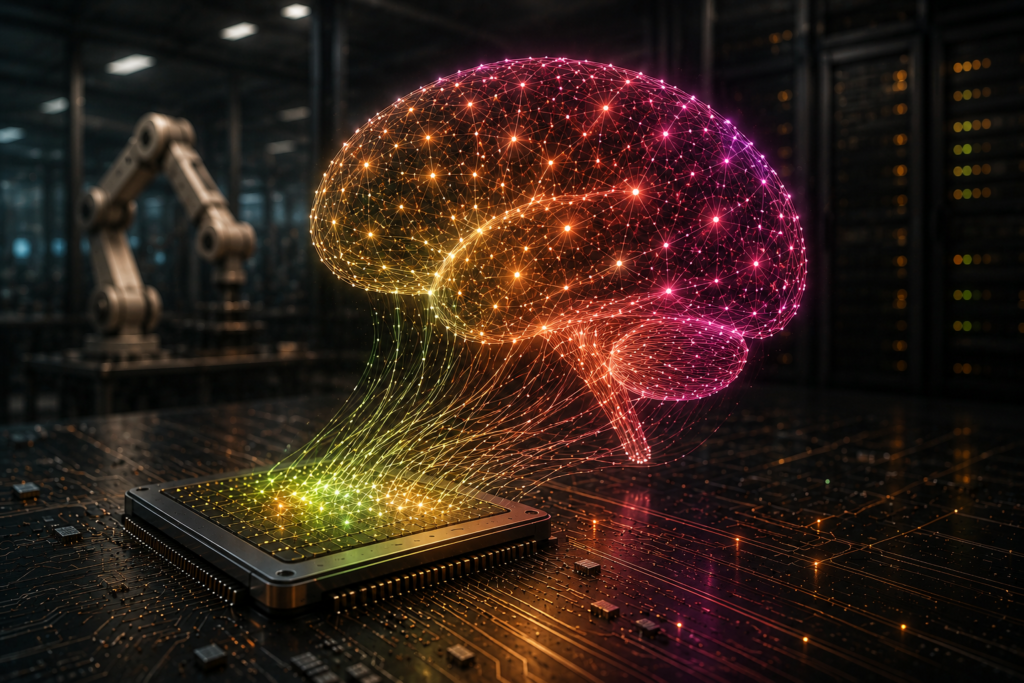
For decades, advances in enterprise computing have been driven by faster processors, larger memory capacities, and increasingly powerful cloud infrastructure. While these innovations have enabled artificial intelligence, big data analytics, and real-time business applications, they also reveal an important limitation. Traditional computers process information in a fundamentally different way from the human brain. Modern processors execute instructions sequentially or in parallel using enormous amounts of computational power, while the brain processes information through billions of interconnected neurons operating simultaneously with remarkable speed and extraordinary energy efficiency. As artificial intelligence models continue to grow in complexity, researchers are increasingly looking toward biology for inspiration. This has led to the emergence of Neuromorphic Computing—one of the most promising deep technologies capable of redefining the future of enterprise intelligence.
Neuromorphic computing is not about creating machines that imitate human consciousness. Instead, it focuses on designing computing architectures that mimic the brain’s neural structure, allowing systems to learn, adapt, recognize patterns, and make decisions while consuming only a fraction of the energy required by conventional processors. For enterprises preparing for the next generation of AI, autonomous systems, robotics, and edge computing, neuromorphic computing represents a significant shift from simply increasing computational power to fundamentally changing how machines process information.
Why Conventional Computing Is Reaching Its Limits
Artificial intelligence has become one of the most computationally demanding technologies in enterprise environments. Training sophisticated models requires massive processing clusters, specialized accelerators, and substantial energy consumption. Even after deployment, AI inference often depends on powerful cloud infrastructure capable of handling millions of simultaneous requests.
This approach has delivered impressive results, but it also creates growing challenges. Large AI systems consume enormous electrical power, generate considerable heat, require complex cooling infrastructure, and introduce latency when real-time decisions depend on cloud connectivity. These limitations become increasingly significant as enterprises deploy AI across manufacturing facilities, healthcare environments, autonomous vehicles, industrial equipment, smart cities, and connected devices where rapid decision-making is essential.
Neuromorphic computing approaches these challenges differently. Rather than increasing processor speed alone, it redesigns computing architecture to operate more like biological intelligence, enabling highly efficient processing that can occur directly where information is generated.
Understanding Neuromorphic Computing
Traditional processors separate memory and computation, requiring information to move continuously between storage and processing units. This constant movement consumes both time and energy. The human brain operates differently. Memory and computation exist together within interconnected neural networks, allowing information to flow efficiently through billions of neurons and synapses simultaneously. Neuromorphic processors adopt similar principles. Artificial neurons communicate using electrical impulses known as spikes rather than continuously exchanging digital signals. Processing occurs only when meaningful events take place, dramatically reducing unnecessary computation and energy consumption.
Instead of following rigid programming instructions, these systems learn through repeated interactions, strengthening or weakening connections based on experience. This event-driven architecture enables machines to respond dynamically to changing environments while operating with exceptional efficiency.
Why Enterprises Should Pay Attention
Although neuromorphic computing is still developing, its long-term enterprise potential extends across multiple industries. Businesses increasingly require intelligent systems capable of processing complex information in real time without depending entirely on centralized cloud infrastructure. Several enterprise applications could benefit significantly from neuromorphic architectures:
- Intelligent robotics and autonomous machines.
- Industrial automation and predictive maintenance.
- Smart manufacturing and quality inspection.
- Autonomous transportation systems.
- Healthcare diagnostics and wearable medical devices.
- Advanced cybersecurity anomaly detection.
- Intelligent surveillance and computer vision.
- Edge AI for connected infrastructure.
These workloads require rapid decision-making, continuous learning, and efficient operation in environments where traditional computing architectures often struggle.
A New Era for Edge Intelligence
One of the strongest use cases for neuromorphic computing lies at the edge of enterprise networks. Traditional artificial intelligence frequently relies on sending sensor data to centralized cloud platforms before decisions can be made. While effective for many applications, this approach introduces latency, consumes network bandwidth, and limits responsiveness in environments where immediate action is required.
Neuromorphic processors allow intelligent devices to analyze information locally using minimal energy. Industrial sensors can detect equipment failures instantly. Autonomous robots can navigate dynamic environments without waiting for cloud responses. Smart infrastructure can recognize unusual activity while processing information directly at the source. This shift enables enterprises to distribute intelligence throughout their operations instead of concentrating computational power exclusively within centralized data centers.
Energy Efficiency Could Become the Biggest Advantage
As organizations expand artificial intelligence initiatives, energy consumption has become an increasingly important business consideration. Large AI models require substantial computing resources, contributing to rising operational costs and growing sustainability concerns. Neuromorphic architectures offer a compelling alternative because they perform computations only when necessary. Instead of continuously processing every incoming signal, they respond selectively to meaningful events. This event-driven design significantly reduces power consumption while maintaining intelligent behavior. For battery-powered devices, remote industrial equipment, wearable technologies, and autonomous systems, this efficiency could dramatically extend operational life while reducing infrastructure requirements. As enterprises pursue sustainability goals alongside digital transformation, energy-efficient computing may become as strategically valuable as computational performance itself.
Complementing Artificial Intelligence Rather Than Replacing It
Neuromorphic computing is often misunderstood as a replacement for existing AI technologies. In reality, it is more likely to complement today’s computing landscape by addressing workloads where conventional architectures are less effective. Traditional cloud platforms will continue handling large-scale model training, enterprise software, and data analytics. GPUs will remain essential for computationally intensive machine learning. Quantum computing may eventually solve specialized optimization problems. Neuromorphic processors will excel in environments requiring adaptive, real-time intelligence with minimal energy consumption. This hybrid computing model allows enterprises to deploy the most appropriate architecture for each workload rather than expecting one technology to solve every computational challenge.
Challenges on the Road to Adoption
Like many emerging deep technologies, neuromorphic computing remains in an early stage of commercial maturity. Hardware platforms continue evolving, software development frameworks are still expanding, and programming models differ significantly from conventional computing environments. Developers must adopt new approaches to designing algorithms that fully leverage spiking neural networks and event-driven processing. Enterprise software ecosystems will also require greater standardization before widespread adoption becomes practical.
Another challenge involves workforce readiness. Engineers, architects, and AI specialists must develop new skills to understand neuromorphic systems, their capabilities, and their most suitable applications. Despite these challenges, continued investment by semiconductor manufacturers, research institutions, and enterprise technology providers suggests that neuromorphic computing will become increasingly important as artificial intelligence evolves.
The Future of Enterprise Intelligence May Resemble Nature
Throughout the history of computing, progress has largely depended on making existing technologies faster and more powerful. Neuromorphic computing represents a different philosophy. Instead of forcing machines to process information through increasingly complex hardware, it draws inspiration from one of nature’s most efficient computational systems—the human brain.
The long-term implications extend beyond artificial intelligence. Enterprises could build intelligent machines capable of learning continuously, responding instantly, consuming remarkably little energy, and operating independently across factories, hospitals, transportation systems, smart infrastructure, and countless connected environments.
While mainstream adoption will occur gradually, organizations that begin understanding neuromorphic computing today will be better positioned to evaluate future innovations as they emerge. Just as cloud computing, artificial intelligence, and edge computing transformed enterprise technology over successive generations, neuromorphic computing has the potential to become another defining milestone in the evolution of intelligent systems. Rather than simply creating faster computers, it introduces the possibility of building machines that process information in fundamentally new ways, bringing enterprise technology one step closer to the remarkable efficiency of the human brain.