
Emerging tech & Deep tech • 1 day ago • Neha Jamwal
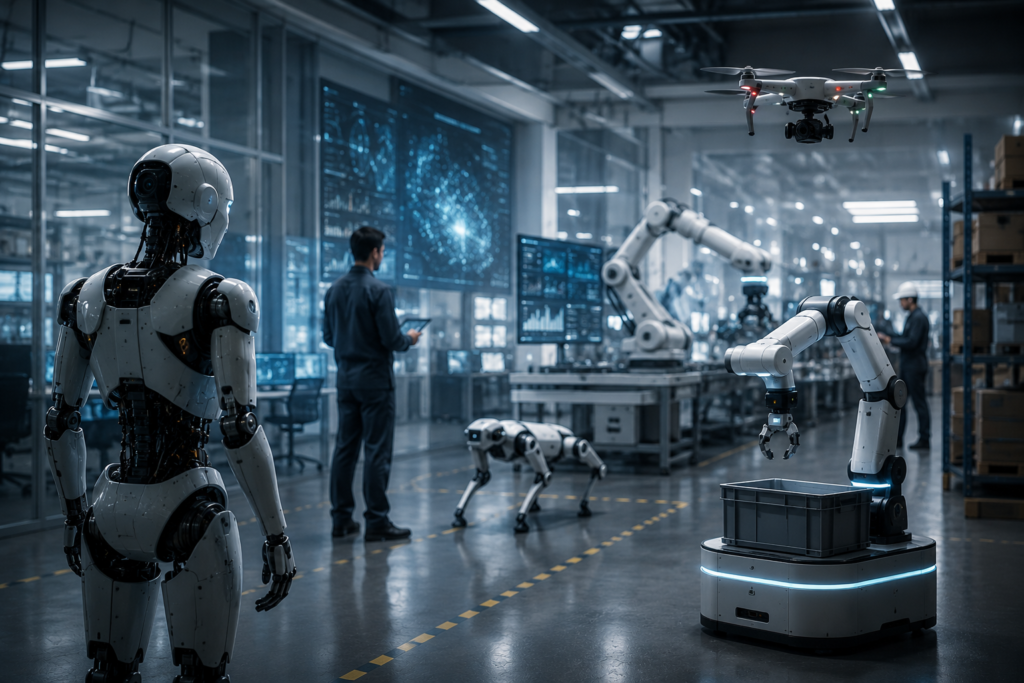
Artificial intelligence has spent years transforming the digital world. It has optimized enterprise software, enhanced cybersecurity, automated workflows, improved customer experiences, and accelerated business analytics. Yet, until recently, AI has largely remained confined to screens, servers, and cloud platforms. A new technological shift is now beginning to redefine how intelligence interacts with the physical world. Known as Physical AI, this emerging field enables intelligent systems to perceive, understand, and respond to real-world environments, allowing machines to make decisions and perform actions with minimal human intervention. Unlike traditional AI that processes digital information, Physical AI combines artificial intelligence with robotics, computer vision, sensors, autonomous systems, and edge computing to bridge the gap between software and the physical environment.
For enterprises, Physical AI represents far more than another advancement in automation. It introduces an entirely new way of operating businesses where machines can inspect infrastructure, move inventory, monitor industrial equipment, collaborate with employees, and continuously learn from real-world interactions. As organizations pursue greater efficiency, resilience, and operational intelligence, Physical AI is rapidly becoming one of the most significant Deep Tech innovations shaping the future of enterprise technology.
From Digital Intelligence to Physical Intelligence
Traditional enterprise AI excels at analyzing digital information such as documents, transactions, customer behavior, and application data. Physical AI extends these capabilities into environments where decisions must be made based on visual observation, spatial awareness, environmental conditions, and continuous interaction with the surrounding world.
Imagine a warehouse where autonomous robots identify obstacles, adjust delivery routes in real time, and coordinate with human workers without requiring manual instructions. Consider manufacturing facilities where intelligent machines inspect product quality, predict equipment failures, and optimize production continuously. Think of hospitals where autonomous systems transport medical supplies while monitoring environmental conditions to maintain safety standards.
These scenarios illustrate an important distinction. Physical AI does not simply automate repetitive tasks. It enables machines to observe, reason, adapt, and improve their performance as conditions change, making enterprise operations significantly more responsive and intelligent.
Why Physical AI Is Emerging Now
Several technological breakthroughs have converged to make Physical AI commercially viable. Advances in machine learning have dramatically improved object recognition and decision-making capabilities. Computer vision systems now interpret complex environments with remarkable accuracy. High-performance processors and specialized AI accelerators enable real-time inference directly within physical devices. At the same time, edge computing allows intelligent systems to process information locally without depending entirely on cloud connectivity.
Equally important is the rapid improvement in sensor technologies. Modern enterprises can capture detailed environmental data using cameras, lidar, radar, thermal imaging, microphones, and precision motion sensors. These inputs provide AI systems with a rich understanding of their surroundings, enabling them to react intelligently rather than following predefined instructions. Together, these technologies have transformed Physical AI from an ambitious research concept into a practical enterprise capability.
Enterprise Applications Are Expanding Rapidly
Physical AI is finding applications across industries where operational complexity, safety, and efficiency are critical. Unlike traditional automation systems that rely on predictable environments, intelligent machines can adapt to changing conditions while continuously improving performance. Some of the most promising enterprise applications include:
- Autonomous warehouse operations and inventory movement.
- Intelligent manufacturing quality inspection.
- Predictive maintenance through continuous equipment monitoring.
- Infrastructure inspection using autonomous drones and robots.
- Smart healthcare logistics and medical assistance.
- Precision agriculture with autonomous monitoring systems.
- Energy infrastructure inspection and maintenance.
- Intelligent construction site monitoring and safety management.
These deployments demonstrate that Physical AI is becoming an operational platform capable of supporting multiple business functions rather than addressing isolated automation challenges.
The Role of Edge Computing
One of the defining characteristics of Physical AI is its dependence on real-time decision-making. Many environments simply cannot tolerate delays caused by transmitting data to distant cloud servers before receiving instructions. Autonomous machines often need to respond within milliseconds to avoid safety risks or operational disruptions. Edge computing solves this challenge by bringing computational intelligence closer to where data is generated. AI models execute directly on intelligent devices or nearby infrastructure, enabling rapid decision-making while reducing network dependency. For enterprises, this architecture offers several important advantages. Operational continuity improves even when connectivity is limited. Sensitive data can remain within secure local environments. Network bandwidth requirements decrease because only relevant insights are transmitted rather than continuous streams of raw sensor data. The combination of Physical AI and edge computing creates highly responsive systems capable of operating reliably in dynamic enterprise environments.
Human and Machine Collaboration
Contrary to common misconceptions, Physical AI is not primarily about replacing human workers. Its greatest value often lies in augmenting human capabilities rather than eliminating them. Intelligent systems can perform hazardous inspections, repetitive transportation tasks, precision measurements, and continuous monitoring, allowing skilled professionals to focus on higher-value decision-making and problem-solving.
Collaborative robots, commonly known as cobots, exemplify this approach. Unlike traditional industrial robots that operate within isolated safety barriers, cobots are designed to work alongside employees while responding intelligently to human movement and changing work environments. This collaborative model improves productivity while enhancing workplace safety. As Physical AI continues evolving, enterprises are likely to see increasing collaboration between human expertise and machine intelligence rather than complete automation of complex workflows.
Challenges That Enterprises Must Address
Despite its enormous potential, deploying Physical AI requires careful planning. Intelligent machines operate within unpredictable environments where safety, reliability, and accountability become critical concerns. Enterprise systems must consistently interpret sensor data accurately while making decisions that align with operational policies and regulatory requirements. Infrastructure readiness also plays a significant role. Organizations require reliable networking, robust edge computing platforms, high-quality sensor integration, and scalable AI management systems capable of supporting thousands of intelligent devices across distributed locations.
Cybersecurity introduces another important consideration. Connected autonomous systems expand the enterprise attack surface, making secure device identity, encrypted communication, software integrity, and continuous monitoring essential components of every Physical AI deployment. Finally, organizations must invest in workforce readiness. Employees will increasingly collaborate with intelligent systems, requiring new skills that combine operational expertise with AI literacy.
Physical AI Will Transform Enterprise Operations
Every major technological revolution has extended computing into new environments. Personal computers brought digital tools to employees. Cloud computing connected global enterprises. Mobile technology enabled work from anywhere. Physical AI now extends intelligence into factories, warehouses, hospitals, transportation networks, construction sites, energy facilities, and countless other operational environments.
The long-term significance extends beyond automation. Physical AI creates organizations capable of continuously sensing their surroundings, responding to changing conditions, learning from operational experience, and improving performance with minimal manual intervention. Enterprise operations become adaptive rather than static, allowing businesses to operate with greater resilience, efficiency, and precision.
As artificial intelligence continues moving beyond software into the physical world, enterprises will increasingly compete based on how effectively they integrate intelligent machines into everyday operations. The organizations that succeed will not simply automate individual tasks—they will build environments where digital intelligence and physical execution work together seamlessly. Physical AI represents the next major evolution in enterprise technology, transforming machines from programmable tools into intelligent operational partners capable of driving the future of business.