
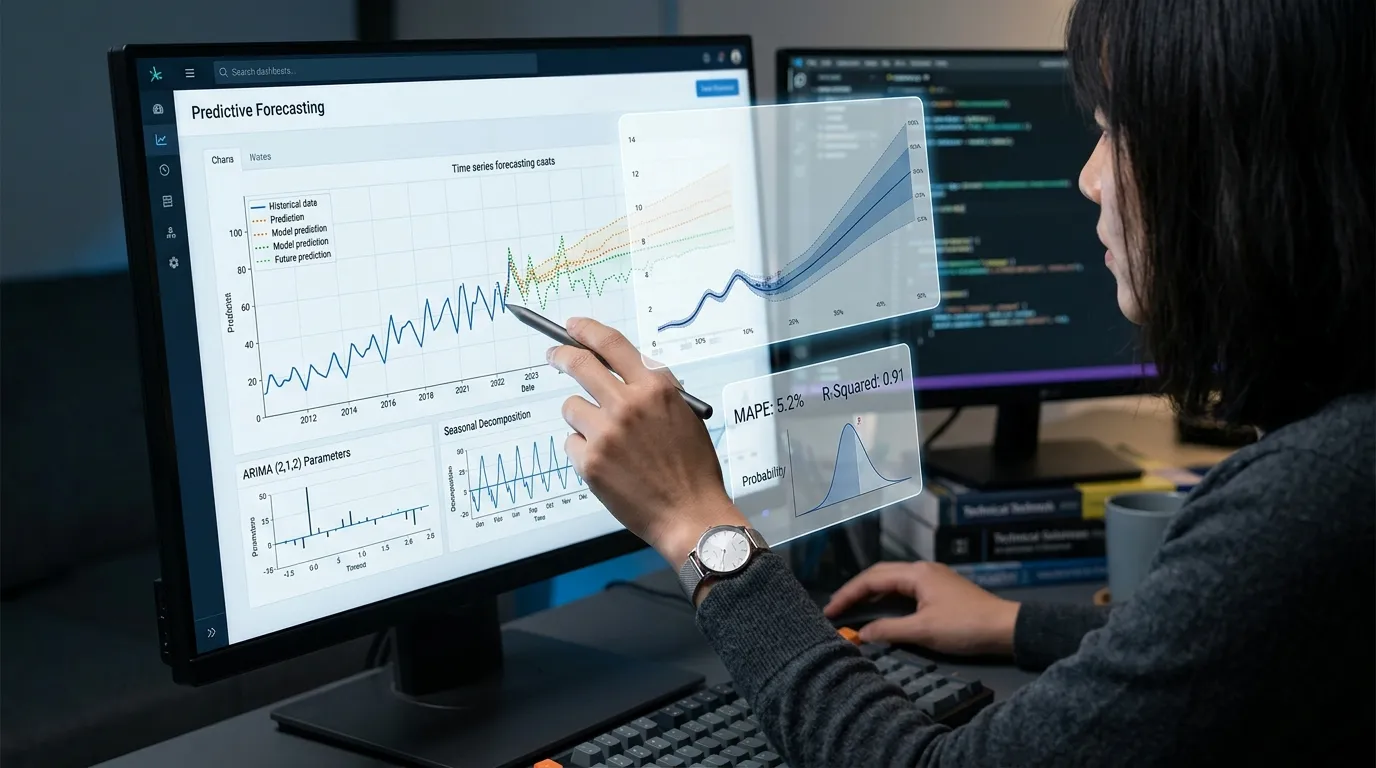

While Business Intelligence focuses primarily on understanding past performance, predictive analytics moves organizations into the future. It uses historical data, statistical modeling, and machine learning techniques to forecast likely outcomes and anticipate trends before they occur. In highly competitive markets, this forward-looking capability provides a powerful strategic advantage.
Predictive analytics answers questions such as: What is likely to happen next? Which customers are at risk of leaving? How much demand should we expect next quarter? By leveraging data science methodologies, organizations can move from reactive decision-making to proactive planning.
At the core of predictive analytics are statistical algorithms and machine learning models. These models analyze historical data to identify patterns and relationships among variables. Once trained, they apply those patterns to new data to generate forecasts.
For example, a telecommunications company might analyze usage patterns, billing history, and customer service interactions to predict customer churn. By identifying customers likely to leave, the company can intervene with retention strategies before revenue is lost.
Similarly, retailers use predictive analytics to forecast product demand. By analyzing past sales data, seasonality, and market trends, they can optimize inventory levels and reduce overstock or stockouts.
The predictive analytics process typically involves several steps:
- Data collection and preparation
- Exploratory data analysis
- Model selection and training
- Validation and performance evaluation
- Deployment and monitoring
Data preparation is often the most time-consuming phase. Raw data must be cleaned, standardized, and transformed into usable formats. Missing values, duplicates, and inconsistencies can significantly affect model accuracy.
Model selection depends on the problem type. Regression models predict continuous outcomes, such as revenue projections. Classification models categorize outcomes, such as identifying fraudulent versus legitimate transactions. Time-series models analyze trends over sequential time intervals.
Evaluation metrics vary depending on the use case. Accuracy, precision, recall, and mean squared error help determine model performance. Continuous monitoring ensures models remain reliable as new data patterns emerge.
Tools such as Python libraries for data science and platforms like Databricks simplify model development and deployment.
Predictive analytics supports numerous industries. Financial institutions detect fraudulent transactions in real time. Healthcare providers predict patient readmission risks. Manufacturing firms anticipate equipment failures through predictive maintenance models. Marketing teams personalize campaigns based on predicted customer behavior.
Key advantages of predictive analytics include:
- Improved demand forecasting
- Enhanced risk management
- Optimized resource allocation
- Increased customer retention
- Competitive strategic planning
Despite its potential, predictive analytics requires caution. Models rely heavily on historical data. If past data reflects bias or unusual circumstances, predictions may be skewed. Additionally, correlation does not guarantee causation. Business leaders must interpret predictions within proper context.
Ethical considerations are equally important. Predictive models influencing loan approvals, hiring decisions, or medical diagnoses must be transparent and fair. Explainable AI techniques help stakeholders understand how predictions are generated.
Cloud computing has made predictive analytics more accessible. Scalable infrastructure from providers like Amazon Web Services allows organizations to train complex models without maintaining expensive hardware.
Predictive analytics represents a shift from hindsight to foresight. Instead of analyzing what already happened, organizations gain the ability to anticipate and prepare for what is likely to occur.
In dynamic markets where timing is critical, forecasting trends accurately can determine success or failure. Companies that integrate predictive analytics into strategic planning respond faster to change and reduce uncertainty.
Ultimately, predictive analytics transforms data into foresight — enabling organizations not just to react to the future, but to shape it.