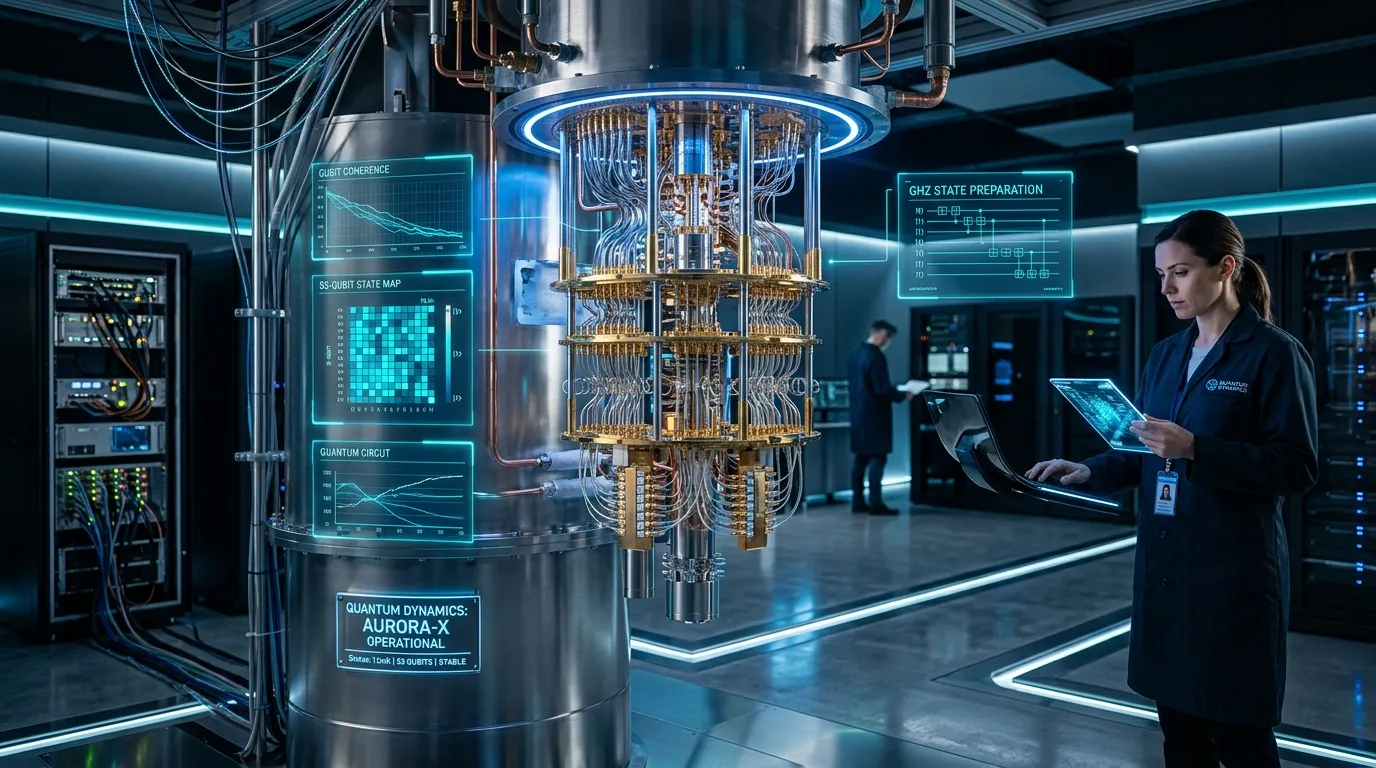

Quantum computing represents one of the most profound technological shifts on the horizon. While classical computers process information using bits that exist in states of 0 or 1, quantum computers operate using quantum bits — or qubits — which can exist in multiple states simultaneously through a property known as superposition. Combined with another quantum principle called entanglement, this enables computational capabilities far beyond traditional systems.
Unlike incremental improvements in processor speed, quantum computing introduces a fundamentally different approach to problem-solving. Certain complex problems that would take classical computers thousands of years to solve may, in theory, be addressed by quantum machines in dramatically shorter timeframes.
The implications are enormous.
Quantum computing has the potential to revolutionize cryptography. Many modern encryption standards rely on the difficulty of factoring large numbers — a task that classical computers struggle to perform efficiently. However, quantum algorithms such as Shor’s algorithm could theoretically break widely used encryption methods. This has led to urgent research into quantum-resistant cryptography.
Companies like IBM and Google are heavily investing in quantum research. Experimental quantum processors are already operational, though still limited in scale and stability. These early-stage machines demonstrate proof-of-concept but remain far from mainstream commercial deployment.
Beyond cryptography, quantum computing may transform industries such as pharmaceuticals, materials science, logistics, and finance.
In drug discovery, quantum simulations could model molecular interactions at a level of detail impossible with classical computers. This may accelerate the development of new medicines and reduce research timelines significantly.
In logistics, quantum optimization algorithms could improve route planning and supply chain management. Financial institutions may use quantum models to enhance portfolio optimization and risk modeling.
Despite its promise, quantum computing faces significant technical challenges. Qubits are highly sensitive to environmental interference, a phenomenon known as decoherence. Maintaining stable quantum states requires extremely low temperatures and precise control mechanisms.
Scalability remains another hurdle. Current quantum systems operate with relatively small numbers of qubits. To solve large-scale practical problems, systems must scale to thousands or millions of stable qubits — a goal that researchers are still pursuing.
Key characteristics of quantum computing development include:
- Experimental hardware with limited qubit stability
- Ongoing research into error correction
- Hybrid quantum-classical computing approaches
- Government and corporate research partnerships
- Long-term commercialization timelines
Governments worldwide are investing heavily in quantum research initiatives. National strategies recognize quantum computing as both an economic opportunity and a strategic security consideration.
In the near term, hybrid computing models are emerging. These systems combine classical computing infrastructure with quantum accelerators to handle specific computational tasks. This approach allows incremental integration while hardware matures.
Workforce development is also critical. Quantum computing requires expertise in physics, mathematics, and advanced engineering. Educational institutions are expanding quantum research programs to prepare future specialists.
While mainstream enterprise adoption may still be years away, organizations should begin monitoring quantum advancements closely. Preparing for post-quantum cryptography and exploring potential use cases positions companies for long-term readiness.
Quantum computing is not simply faster computing — it is different computing. Its potential to solve previously intractable problems could redefine scientific discovery and technological capability.
Although still in early stages, quantum innovation signals the beginning of a new computational era — one that may reshape industries as profoundly as the internet once did.