
Enterprise Software (SaaS) • 9 days ago • Melvin Hall
The first generation of enterprise SaaS transformed how organizations purchased and deployed software. Instead of maintaining expensive on-premise systems, businesses adopted cloud-based applications that delivered scalability, flexibility, and faster implementation.
Over time, however, a new challenge emerged.
Organizations accumulated dozens—and often hundreds—of SaaS applications across departments. Finance uses one platform, HR another, sales relies on multiple CRM tools, operations run specialized systems, while marketing, procurement, legal, and customer support each manage separate software ecosystems.
Although every application performs well independently, many struggle to operate together.
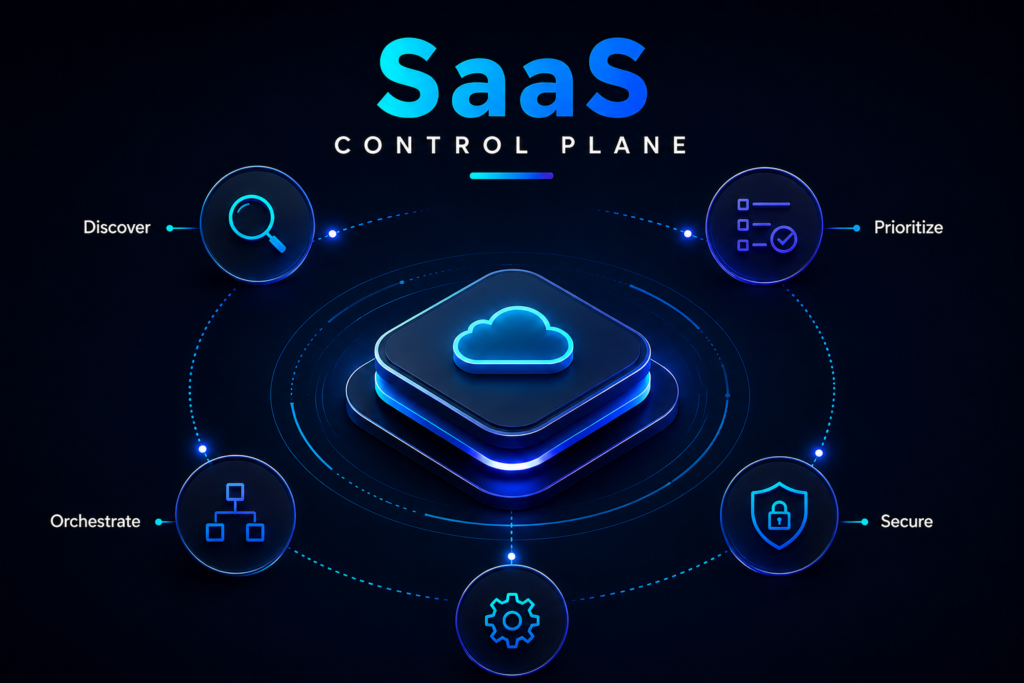
This growing complexity is driving the rise of a new enterprise software concept: the SaaS Control Plane.
Rather than replacing existing applications, a SaaS control plane acts as an intelligent orchestration layer that governs workflows, policies, integrations, permissions, automation, and data movement across the entire software ecosystem.
For enterprises seeking the next phase of digital maturity, this invisible software layer may become as important as the applications themselves.
What Is a SaaS Control Plane?
A SaaS control plane is a centralized intelligence layer that manages and coordinates multiple enterprise software platforms through unified policies, automation, and governance.
Instead of each application operating independently, the control plane creates a connected operational environment where systems communicate intelligently.
It provides visibility, consistency, and centralized management without disrupting existing investments.
The enterprise gains one operational brain instead of dozens of disconnected applications.
Why SaaS Sprawl Has Become a Strategic Challenge
Cloud adoption solved infrastructure problems but introduced operational complexity. Large organizations frequently manage hundreds of software subscriptions. Different departments purchase applications independently. Business data becomes fragmented. Workflows cross multiple systems. User permissions become difficult to govern. Integration maintenance consumes significant IT resources.
As software ecosystems expand, managing relationships between applications becomes more difficult than managing the applications themselves. The problem is no longer software deployment.
The problem is software coordination.
From Integration to Orchestration
Traditional integrations move information between two systems. SaaS control planes coordinate entire business processes across many platforms simultaneously.
For example, onboarding a new employee may involve:
- Identity management
- Human resources
- Payroll
- Security provisioning
- Device allocation
- Collaboration software
- Learning platforms
- Expense management
Instead of multiple disconnected workflows, the control plane orchestrates a single intelligent process. Business operations become seamless rather than fragmented.
Creating a Unified Governance Model
Enterprise governance often suffers because policies differ across software environments. Security rules vary. Approval workflows differ. Compliance controls become inconsistent.
A SaaS control plane introduces centralized governance that applies business policies uniformly across the software landscape. Organizations gain stronger security, simplified compliance, and improved operational consistency without reducing departmental flexibility.
Governance becomes intelligent instead of restrictive.
Enabling Adaptive Enterprise Workflows
Business processes evolve continuously. Static workflows quickly become outdated.
SaaS control planes allow organizations to modify enterprise processes dynamically without redesigning every application. A change in procurement policy can automatically influence approvals, finance systems, supplier management, reporting, and contract workflows.
Business agility increases because change occurs at the orchestration layer rather than within every individual application.
Artificial Intelligence Enhances the Control Plane
Artificial intelligence transforms the control plane from an administrative tool into an intelligent operational advisor. AI can identify redundant workflows, predict integration failures, recommend automation opportunities, and optimize software utilization.
Potential capabilities include:
- Intelligent workflow routing
- License optimization
- Permission analysis
- Compliance monitoring
- Usage forecasting
- Integration health scoring
- Process optimization
- Operational anomaly detection
- Software consolidation recommendations
- Enterprise automation insights
The control plane evolves from management software into enterprise intelligence.
Reducing Hidden SaaS Costs
Many organizations underestimate the financial impact of SaaS sprawl – duplicate licenses, inactive users, redundant applications, unnecessary integrations, manual administrative effort, disconnected workflows.
A centralized control plane provides visibility across the software portfolio, enabling organizations to identify inefficiencies and maximize technology investments. Software spending becomes measurable and strategically optimized.
Building a Better Employee Experience
Employees rarely think about enterprise architecture. They simply expect technology to work. Disconnected applications create repetitive logins, duplicate data entry, inconsistent approvals, and fragmented user experiences.
A SaaS control plane creates a unified operational environment where information flows naturally between systems. Employees spend less time navigating software and more time delivering business value. Productivity improves because complexity becomes invisible.
Preparing for Autonomous Enterprises
Future enterprises will increasingly depend on software ecosystems capable of self-management. A SaaS control plane provides the operational foundation for this evolution. Intelligent policies can automatically provision access, optimize workflows, detect anomalies, and coordinate enterprise applications without constant manual oversight. Software transitions from isolated tools into a collaborative digital workforce.
Autonomous enterprise operations become achievable because orchestration exists above individual applications.
The Future of Enterprise SaaS
The next phase of enterprise software will not be defined by acquiring more applications. Competitive advantage will come from making existing applications work together intelligently. SaaS control planes represent a shift from software ownership to software orchestration. They simplify complexity, strengthen governance, improve automation, and create connected enterprise ecosystems capable of continuous adaptation.
As organizations continue expanding their cloud portfolios, the invisible intelligence layer coordinating those applications will become one of the most valuable assets in enterprise technology. The future of SaaS is not simply smarter applications.
It is smarter coordination between every application that powers the modern enterprise.