
Cybersecurity • 10 days ago • Shruti Das
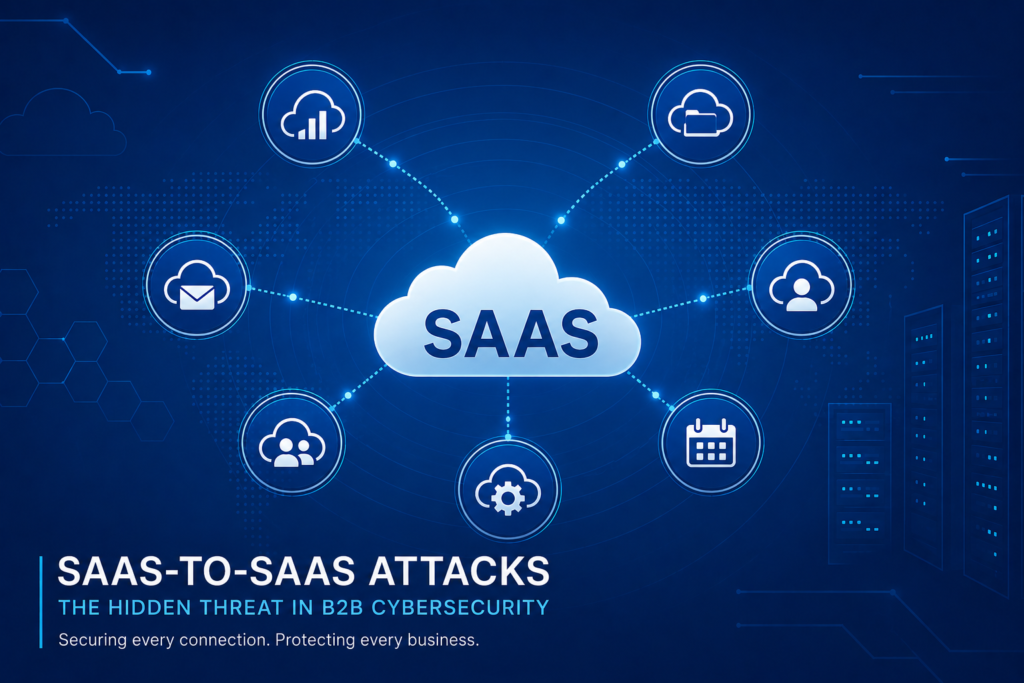
For years, enterprise cybersecurity strategies have focused on protecting endpoints, networks, cloud environments, and user identities. Yet a new category of risk is quietly expanding across the B2B landscape—one that doesn’t rely on malware, compromised laptops, or traditional network intrusions. Instead, it exploits trust between business applications.
This threat is known as the SaaS-to-SaaS Attack Surface, and it is rapidly becoming one of the most significant blind spots in modern cybersecurity.
Organizations today depend on dozens, sometimes hundreds, of Software-as-a-Service (SaaS) applications. Customer relationship management platforms communicate with marketing tools. HR systems integrate with payroll providers. Collaboration platforms connect with document repositories. Finance applications synchronize with analytics platforms. Every integration creates a digital relationship built on trust. The challenge is that attackers have begun targeting those trusted connections.
Rather than attacking a company’s infrastructure directly, they increasingly seek opportunities to compromise one application and leverage its permissions to access others. This approach allows attackers to move through interconnected business systems while appearing as legitimate software activity.
Why SaaS Ecosystems Have Changed Enterprise Security
Modern organizations no longer operate within a single technology environment. Business operations are distributed across:
- CRM platforms
- Collaboration tools
- Cloud storage systems
- Marketing automation software
- Financial applications
- HR platforms
- Project management tools
- Customer support systems
These applications exchange information continuously. To improve productivity, organizations enable integrations that allow software platforms to communicate automatically. While these integrations eliminate manual work, they also introduce security dependencies that many organizations struggle to monitor. The result is a highly connected ecosystem where trust is often granted at scale.
Understanding the SaaS-to-SaaS Attack Path
Traditional cyberattacks typically focus on users, devices, or networks. SaaS-to-SaaS attacks focus on application relationships. Imagine a scenario where an attacker compromises a lower-risk business application. On its own, that application may not contain sensitive information. However, if it possesses access permissions to multiple enterprise systems, it can become a stepping stone to far more valuable assets. The attacker doesn’t need to break through every security layer individually. Instead, they exploit existing trust relationships. This creates a situation where legitimate integrations become unintended attack pathways.
Why Security Teams Often Miss This Risk
One reason SaaS-to-SaaS attacks are gaining attention is that traditional security tools were not designed to monitor application trust relationships in depth. Organizations typically have strong visibility into:
- Employee logins
- Endpoint activity
- Network traffic
- Identity management systems
However, visibility often decreases when applications interact directly with one another. Security teams may know:
- Which applications are approved
But they may not know:
- What permissions each integration has
- Which data is being exchanged
- Whether excessive access exists
- How permissions have changed over time
- Which integrations are no longer necessary
This lack of visibility creates opportunities for attackers to operate unnoticed.
The Problem of Over-Permissioned Applications
A major contributor to SaaS security risk is excessive access. When organizations deploy new software, permissions are often granted broadly to ensure functionality. Over time, these permissions accumulate. Common examples include:
- Applications accessing entire email environments
- Collaboration tools reading sensitive documents
- Analytics platforms retrieving customer databases
- Automation tools possessing administrative privileges
- Integrations maintaining access long after they are needed
The result is an expanding ecosystem of trusted applications with powerful permissions. If even one of those applications becomes compromised, the impact can extend far beyond its original purpose.
Why Identity Security Alone Is No Longer Enough
Identity security remains one of the most important pillars of cybersecurity. However, many organizations focus almost exclusively on human identities while overlooking application identities.
Modern enterprises now have:
- Employees
- Contractors
- Vendors
- Service accounts
- APIs
- Automated workflows
- SaaS integrations
Many of these non-human entities possess significant privileges. In some environments, application identities outnumber human users by a substantial margin. This shift requires organizations to rethink how trust is established, monitored, and enforced.
Building a SaaS Security Strategy
The solution is not reducing innovation or limiting software adoption. Instead, organizations need stronger governance around application access. Key practices include:
- Maintaining an inventory of SaaS applications
- Reviewing integration permissions regularly
- Applying least-privilege access principles
- Monitoring unusual application behavior
- Removing unused integrations
- Conducting periodic access audits
- Evaluating application security before deployment
The goal is to ensure that applications only possess the access necessary to perform their intended functions.
The Role of Zero Trust in SaaS Security
The rise of Zero Trust security models has significant implications for SaaS ecosystems. Historically, organizations trusted approved applications by default. Zero Trust challenges this assumption. Instead, every access request should be validated continuously. This means:
- Verifying application identities
- Limiting permissions
- Monitoring behavior
- Detecting anomalies
- Reassessing trust continuously
By extending Zero Trust principles to SaaS environments, organizations can significantly reduce the risk associated with interconnected applications.
Why This Topic Will Define the Future of B2B Cybersecurity
As businesses continue to adopt cloud-native technologies, SaaS ecosystems will become even more interconnected. New applications, automation platforms, AI-powered tools, and digital partnerships will create thousands of new trust relationships across the enterprise. The cybersecurity challenge is no longer simply protecting networks or users. It is understanding how trust flows between applications.
Organizations that focus solely on traditional security controls may overlook one of the fastest-growing attack surfaces in modern business environments. Those that prioritize SaaS governance, application identity security, and continuous access monitoring will be better positioned to reduce risk while maintaining operational agility. In the next evolution of B2B cybersecurity, attackers will increasingly target relationships rather than systems. The organizations that succeed will be those that recognize trust itself as something that must be continuously verified, managed, and protected.