
Emerging tech & Deep tech • 7 days ago • Jessica Mahone
Enterprise technology has become the operational backbone of modern business. Customer transactions, supply chain operations, manufacturing systems, financial services, healthcare platforms, and digital workplaces all depend on software and infrastructure operating continuously. Even brief disruptions can interrupt business processes, delay critical services, reduce customer confidence, and create significant financial consequences.
For decades, organizations have invested heavily in monitoring tools designed to detect system failures. While these platforms provide valuable visibility, they are fundamentally reactive. An alert is generated after an issue has already occurred, leaving engineers responsible for identifying the root cause, coordinating a response, implementing corrective actions, and verifying system recovery. As enterprise environments continue to grow in scale and complexity, this model becomes increasingly difficult to sustain.
This challenge has accelerated the emergence of Self-Healing Enterprise Platforms, a deep technology that combines artificial intelligence, automation, predictive analytics, observability, and policy-driven orchestration to detect, diagnose, and resolve operational issues with minimal human intervention. The objective extends well beyond automated monitoring. These platforms continuously evaluate system health, anticipate failures, initiate corrective actions, and learn from every incident to strengthen future resilience.
Instead of treating downtime as an unavoidable part of enterprise operations, self-healing platforms aim to make technology environments adaptive, resilient, and capable of maintaining business continuity even when unexpected conditions arise. As organizations continue to expand digital operations across cloud environments, data centers, edge computing, and connected devices, this capability is becoming an important foundation for enterprise reliability.
Understanding Self-Healing Enterprise Platforms
A Self-Healing Enterprise Platform is an intelligent operational environment capable of monitoring its own health, identifying anomalies, determining probable causes, and executing predefined or AI-assisted remediation actions without requiring continuous manual intervention. Traditional IT operations depend on separate monitoring tools, incident management systems, automation scripts, and engineering teams. Each component contributes to operational stability, but the overall process often involves multiple handoffs before normal service is restored.
Self-healing platforms integrate these capabilities into a coordinated system. Observability tools collect operational signals, artificial intelligence evaluates system behavior, automation engines execute corrective actions, and governance policies ensure that every response aligns with organizational requirements. The result is an infrastructure that actively maintains its own operational stability instead of relying exclusively on human operators to respond after problems appear.
Why Traditional IT Operations Are Reaching Their Limits
Enterprise environments have changed dramatically over the past decade. Applications are distributed across multiple cloud providers, on-premises infrastructure, container platforms, edge locations, and third-party services. Every layer introduces new dependencies that increase operational complexity.
When an issue occurs, identifying its true source often requires analyzing logs, metrics, traces, configuration changes, infrastructure dependencies, security events, and application behavior across multiple systems. Even experienced engineering teams can spend considerable time determining which event triggered the disruption. Several factors make traditional operational models increasingly difficult to manage:
- Distributed cloud-native architectures
- Rapid software release cycles
- Large-scale microservices environments
- Hybrid infrastructure deployments
- Growing cybersecurity threats
- Increasing customer expectations for uninterrupted service
- Rising operational costs associated with manual incident response
Self-healing platforms address these challenges by combining continuous observation with automated decision-making and intelligent remediation.
The Autonomous Resilience Cycle
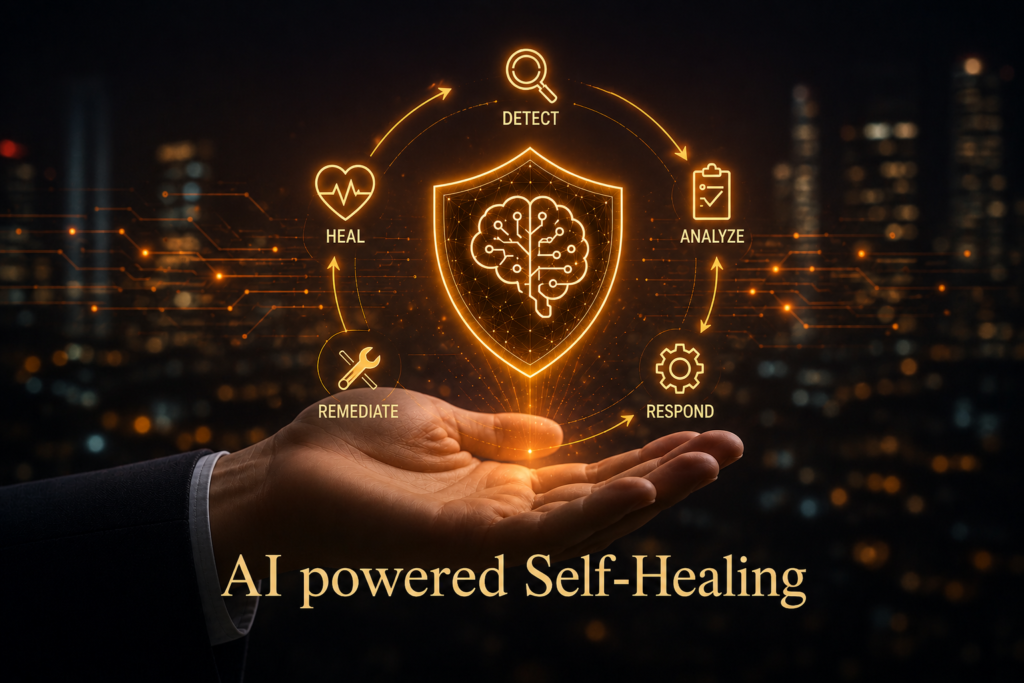
One useful way to understand Self-Healing Enterprise Platforms is through what can be viewed as the Autonomous Resilience Cycle. This conceptual framework illustrates how intelligent platforms continuously strengthen operational reliability through a repeating sequence of activities.
Observe The platform continuously collects operational information from infrastructure, applications, networks, databases, cloud services, security platforms, and user interactions. Instead of monitoring isolated components, it builds a comprehensive view of system behavior.
Interpret Artificial intelligence analyzes incoming information to identify anomalies, correlate related events, distinguish meaningful incidents from normal operational variation, and estimate probable root causes.
Respond Once sufficient confidence is established, the platform initiates corrective actions. These may include restarting services, reallocating computing resources, rolling back software deployments, adjusting network configurations, isolating compromised systems, or triggering automated workflows.
Learn Every operational event contributes new knowledge to the platform. Successful remediation strategies, recurring failure patterns, and operational outcomes become part of the system’s institutional memory, improving future responses.
The cycle then repeats continuously, enabling enterprise platforms to become progressively more resilient through operational experience.
How Self-Healing Enterprise Platforms Work
Although implementation approaches differ across organizations, most self-healing environments follow a common operational model. The platform begins by collecting telemetry from multiple enterprise systems. Metrics, logs, traces, configuration changes, infrastructure events, and application behavior are continuously analyzed to establish a dynamic understanding of normal operations.
When unusual behavior emerges, AI models evaluate the available evidence, identify likely root causes, estimate potential business impact, and determine whether automated remediation should proceed. Governance policies define which actions may be executed automatically and which require human approval. Following remediation, the platform validates system recovery, documents the incident, updates operational knowledge, and refines future response strategies based on observed outcomes.
A typical workflow includes:
- Continuous operational monitoring
- Detection of abnormal system behavior
- Correlation of related operational events
- Root cause identification
- Risk assessment
- Selection of remediation strategy
- Automated or supervised execution
- Recovery validation
- Continuous learning and optimization
This process enables organizations to reduce response times while improving operational consistency across increasingly complex technology environments.
Core Technologies Behind Self-Healing Platforms
Self-healing capabilities emerge from the combination of several advanced technologies working together.
Observability Platforms – Observability provides comprehensive visibility into enterprise systems through metrics, logs, traces, and event correlation. This continuous stream of operational information forms the foundation for intelligent analysis.
Artificial Intelligence – Machine learning models identify unusual behavior, detect anomalies, recognize recurring failure patterns, and estimate probable root causes using historical operational data.
Intelligent Automation – Automation engines execute predefined workflows and adaptive remediation actions that restore system stability without requiring manual intervention for every incident.
Policy-Based Governance – Governance policies establish operational boundaries, ensuring that automated actions remain consistent with business requirements, compliance obligations, and organizational risk tolerance.
Knowledge Repositories – Operational knowledge accumulated through previous incidents becomes a valuable resource for future decision-making. The platform continuously expands this knowledge base, improving remediation accuracy over time.
Enterprise Applications
Self-Healing Enterprise Platforms deliver value across virtually every industry because uninterrupted technology operations have become essential for modern business.
Financial Services – Banks, payment providers, and financial institutions depend on continuous availability. Self-healing platforms can detect transaction bottlenecks, infrastructure failures, or performance degradation before customers experience service interruptions, automatically initiating corrective actions while maintaining operational integrity.
Manufacturing – Modern production environments rely on interconnected equipment, industrial software, robotics, and supply chain systems. Intelligent operational platforms monitor these environments continuously, reducing downtime by identifying equipment anomalies and coordinating corrective actions before production schedules are affected.
Healthcare – Healthcare organizations depend on reliable digital systems to support patient care, medical records, diagnostic equipment, and clinical operations. Self-healing capabilities help maintain service continuity by detecting infrastructure issues early and restoring critical systems with minimal disruption.
Retail and Digital Commerce – Online retailers experience constant fluctuations in customer demand, payment activity, inventory management, and logistics coordination. Self-healing platforms automatically respond to performance issues, scaling resources or correcting operational bottlenecks before they affect customer experience or revenue.
Business Benefits of Self-Healing Enterprise Platforms
The true value of a self-healing platform extends far beyond reducing system outages. These platforms reshape how technology operations are managed by shifting the emphasis from reactive incident response to continuous operational resilience. Instead of allocating significant resources to diagnosing recurring issues, engineering teams can devote more time to innovation, architecture improvements, and strategic initiatives. As the platform gains operational experience, it becomes progressively better at recognizing familiar patterns, selecting appropriate remediation strategies, and preventing disruptions before they affect business operations. This continuous learning process transforms resilience into an evolving capability instead of a fixed operational target.
Organizations implementing self-healing platforms can achieve several long-term advantages:
- Reduced unplanned downtime across business-critical systems
- Faster detection and resolution of operational issues
- Lower operational costs through intelligent automation
- Greater consistency in incident response
- Improved application performance and service reliability
- Better utilization of infrastructure resources
- Increased productivity for engineering and operations teams
- Stronger customer confidence through improved service availability
- Continuous optimization based on operational learning
- Higher overall business resilience
These benefits become increasingly valuable as enterprise environments continue expanding across cloud services, edge computing, distributed applications, and connected devices.
Self-Healing Platforms Versus Traditional IT Operations
Traditional IT operations rely heavily on human intervention throughout the incident lifecycle. Monitoring systems generate alerts, engineers investigate logs, infrastructure specialists isolate root causes, and operations teams implement corrective actions before normal service can resume. Although this approach has supported enterprise technology for many years, it becomes increasingly difficult to sustain as system complexity grows.
Self-healing platforms introduce a different operational model. Instead of waiting for engineers to coordinate every response manually, intelligent systems continuously analyze operational signals, identify likely causes, evaluate remediation options, and execute approved recovery actions automatically when appropriate. The difference is not simply faster automation. It represents a change in how enterprise systems maintain stability.
For example, a traditional operations team may require several hours to detect, diagnose, and resolve a performance degradation affecting customer transactions. A self-healing platform can recognize abnormal behavior within minutes, allocate additional computing resources, restart affected services, validate recovery, and document the incident before customers notice a significant disruption.
Human expertise remains essential, particularly for architectural decisions, major incidents, and continuous improvement. The platform assumes responsibility for repetitive operational tasks, allowing specialists to focus on higher-value activities that require judgment and experience.
Common Misconceptions About Self-Healing Enterprise Platforms
As autonomous operations become more widely discussed, several misconceptions can create unrealistic expectations.
Misconception 1: Self-Healing Means Systems Never Fail No technology can eliminate every possible failure. Hardware defects, software bugs, cyber threats, and unexpected external events will always exist. Self-healing platforms are designed to minimize disruption, accelerate recovery, and reduce operational impact, not guarantee perfect availability.
Misconception 2: Automation Alone Creates a Self-Healing Platform Automation is only one component of the solution. A truly self-healing environment combines observability, artificial intelligence, operational knowledge, governance, and adaptive decision-making. Automated scripts without intelligent analysis cannot continuously improve or respond effectively to unfamiliar situations.
Misconception 3: Human Operations Teams Become Unnecessary Engineering teams remain central to enterprise operations. They define governance policies, validate remediation strategies, improve platform architecture, investigate unusual incidents, and oversee continuous optimization. Self-healing technology strengthens operational teams by reducing repetitive work, not replacing them.
Misconception 4: Every Operational Decision Should Be Automated Not every incident should trigger autonomous action. High-risk changes involving financial systems, healthcare platforms, critical infrastructure, or regulatory compliance may still require human approval. Successful platforms apply automation selectively based on business impact, confidence levels, and governance requirements.
Governance and Enterprise Adoption
Organizations introducing self-healing capabilities should establish a governance framework that balances automation with accountability. The first priority is defining which categories of incidents qualify for autonomous remediation. Low-risk operational tasks such as restarting services, reallocating computing resources, or clearing temporary processing queues are often suitable candidates. Higher-impact actions involving production databases, security controls, or customer-facing services may require additional validation.
Operational transparency is equally important. Every automated decision should generate detailed records describing the conditions detected, the reasoning behind the selected response, the actions executed, and the resulting system state. Comprehensive audit trails strengthen trust while supporting compliance and continuous improvement.
Organizations should also establish performance metrics that evaluate more than uptime alone. Measuring recovery speed, remediation accuracy, incident recurrence, automation effectiveness, and operational efficiency provides a more complete understanding of platform performance. Successful adoption depends on collaboration across infrastructure teams, application developers, cybersecurity specialists, business leaders, and governance functions. Self-healing platforms deliver the greatest value when they become part of an integrated operational strategy instead of an isolated technology initiative.
Building an Autonomous Operations Culture
Technology can automate many operational activities, but long-term success also requires a cultural shift. Traditional operations often reward rapid incident response. Autonomous operations place greater emphasis on preventing incidents, improving system design, and continuously strengthening resilience through learning. This mindset encourages organizations to ask broader operational questions:
- Why does this type of incident occur repeatedly?
- Which remediation strategies consistently produce the best outcomes?
- What operational patterns indicate emerging risks?
- How can recurring issues be eliminated permanently?
- Which manual activities should become automated over time?
As these questions become part of everyday operations, technology teams transition from reacting to failures toward continuously improving the reliability of enterprise systems.
The Future of Autonomous Enterprise Operations
Enterprise technology environments will continue growing in complexity as organizations expand cloud adoption, artificial intelligence, connected devices, distributed applications, and digital business services. Managing these environments through manual operations alone will become increasingly challenging. Future self-healing platforms are expected to coordinate infrastructure, cybersecurity, application performance, network operations, and business services through unified intelligence. Instead of operating as separate monitoring systems, these platforms will share operational knowledge across the enterprise, allowing corrective actions to consider technical dependencies as well as business priorities.
Advances in Decision Intelligence, Digital Twins, Multi-Agent Enterprise Systems, and AI Memory Architectures are also likely to strengthen self-healing capabilities. Intelligent platforms will not simply restore normal operations after an incident. They will evaluate alternative responses, anticipate downstream effects, preserve operational knowledge, and coordinate multiple specialized AI agents before executing remediation strategies. The long-term objective extends beyond operational efficiency. It is the creation of enterprise environments capable of adapting continuously while maintaining reliability under changing business conditions.
Conclusion
Reliable technology has become inseparable from successful business operations. Every customer interaction, financial transaction, production process, and digital service depends on systems functioning consistently despite increasing complexity.
Self-Healing Enterprise Platforms represent an important advancement in enterprise operations by combining observability, artificial intelligence, automation, and governance into a unified operational capability. They reduce downtime, accelerate recovery, improve operational consistency, and strengthen resilience through continuous learning.
The most resilient organizations will not rely solely on larger operations teams or more monitoring dashboards. They will build intelligent platforms capable of understanding their own operational behavior, responding to emerging issues, and improving with every incident. Self-healing technology provides the foundation for this next generation of enterprise operations, where resilience becomes an active capability embedded within the technology itself instead of a reactive process managed after failures occur.