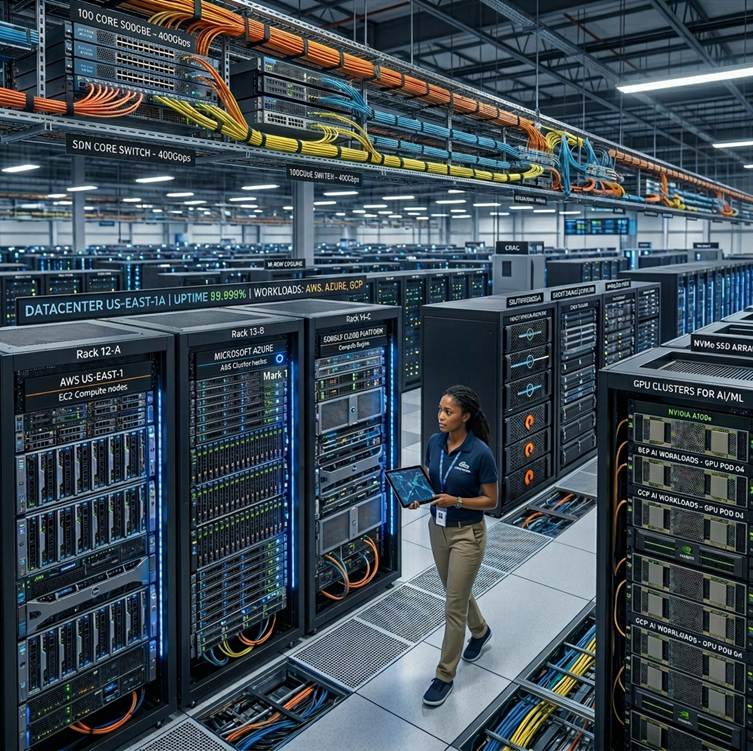


Serverless computing represents one of the most significant evolutions in cloud architecture. While the term “serverless” can be misleading — servers still exist — the responsibility for managing them shifts entirely to the cloud provider. Organizations no longer provision, patch, scale, or monitor underlying compute instances. Instead, they deploy code that runs in response to events, and the platform handles everything else automatically.
Serverless is not just a new hosting model. It is a new operational mindset.
Traditional cloud infrastructure still requires decision-making around instance types, scaling thresholds, patch management, and operating system maintenance. Even container orchestration platforms such as Kubernetes require cluster configuration and node management. Serverless computing abstracts these concerns further. Developers focus purely on business logic while the platform dynamically allocates resources as needed.
This shift dramatically reduces operational overhead and accelerates development cycles.
The Core Concept Behind Serverless
At its foundation, serverless computing revolves around Function as a Service (FaaS). Instead of deploying full applications to long-running servers, developers deploy small functions that execute in response to specific triggers. These triggers might include HTTP requests, file uploads, database updates, scheduled events, or message queue activity.
When a trigger occurs, the cloud platform automatically:
- Allocates compute resources
- Executes the function
- Scales capacity as needed
- Charges only for execution time
Once execution completes, resources are released.
This event-driven model contrasts sharply with traditional always-on servers, which consume resources continuously regardless of traffic.
Cost Efficiency Through Granular Billing
One of the most compelling advantages of serverless computing is its billing model. Instead of paying for idle compute time, organizations pay only for actual execution duration — often measured in milliseconds.
For workloads with unpredictable or intermittent traffic, this can significantly reduce costs. A function that executes only when triggered does not incur continuous expense.
However, cost efficiency depends on workload characteristics. High-volume, constant traffic may be more cost-effective on reserved infrastructure. Serverless shines in event-driven, bursty, or spiky workloads.
Cost predictability remains important. Although serverless eliminates idle capacity costs, high invocation rates can increase expenses quickly if not monitored carefully.
Scalability Without Configuration
Scalability in serverless environments is automatic. There are no scaling policies to configure, no auto scaling groups to manage. When traffic increases, the platform launches additional execution environments seamlessly.
This elasticity removes the need for capacity forecasting. Applications can handle sudden traffic spikes without prior planning.
However, scalability introduces new considerations. Functions must be designed to be stateless. Persistent data must reside in managed storage systems. Cold starts — the latency introduced when a function initializes — must be minimized through efficient design.
Architectural discipline remains essential even in highly abstracted environments.
Serverless Beyond Functions
Although FaaS is central to serverless computing, the concept extends further. Managed services such as databases, message queues, authentication systems, and API gateways contribute to serverless architecture by reducing operational responsibility.
For example, an application may consist of:
- API gateway handling HTTP requests
- Serverless functions executing business logic
- Managed databases storing data
- Object storage hosting static assets
The entire system operates without dedicated servers managed by the organization.
Providers such as Amazon Web Services, Microsoft Azure, and Google Cloud Platform offer comprehensive serverless ecosystems, enabling end-to-end application development with minimal infrastructure management.
Event-Driven Architecture
Serverless computing aligns naturally with event-driven architecture. In this model, system components communicate through events rather than direct service calls.
When an event occurs — such as a file upload — it triggers downstream processing functions automatically. These functions may generate additional events, creating asynchronous workflows.
Event-driven design enhances decoupling. Services operate independently, reducing tight dependencies and improving resilience.
However, distributed event flows require robust observability and monitoring. Debugging asynchronous workflows can be challenging without proper tracing systems.
Operational Simplicity and Developer Productivity
By removing infrastructure management tasks, serverless platforms empower developers to focus on code. There are no operating systems to patch, no load balancers to configure, and no scaling thresholds to tune.
This simplicity accelerates innovation. Development teams can prototype features quickly and deploy globally without infrastructure planning.
Serverless environments also encourage microservices patterns. Functions are small and focused, promoting modular design.
Yet operational simplicity does not eliminate responsibility. Developers must design efficient, secure, and resilient code. Observability, logging, and error handling remain critical.
Security in Serverless Environments
Security in serverless architectures follows the same shared responsibility model as other cloud services. Providers secure the underlying execution environment, while customers manage permissions, data protection, and code integrity.
Identity and access management plays a central role. Functions should operate with minimal permissions, accessing only required resources.
Since serverless functions are short-lived and event-driven, attack surfaces differ from traditional servers. There are fewer persistent endpoints, but API gateways and event sources must be secured carefully.
Secure coding practices remain essential.
Key Advantages of Serverless Computing
- No server management or patching
- Automatic and virtually unlimited scaling
- Fine-grained, usage-based billing
- Rapid deployment and iteration
- Strong alignment with event-driven design
These advantages make serverless particularly attractive for modern application development.
Challenges and Trade-Offs
Despite its benefits, serverless computing is not universally applicable. Long-running processes may exceed execution time limits. Vendor-specific implementations can increase lock-in risk. Cold start latency may affect performance-sensitive workloads.
Debugging distributed, event-driven systems requires sophisticated tooling. Observability must be integrated deliberately.
Architects must evaluate workload characteristics carefully before adopting serverless.
The Strategic Role of Serverless
Serverless computing represents the highest level of infrastructure abstraction currently available. It continues the progression from physical servers to virtual machines, from virtual machines to containers, and from containers to fully managed execution environments.
As organizations prioritize agility, serverless enables rapid experimentation and global scalability with minimal operational overhead.
It does not eliminate the need for architectural planning. Instead, it shifts focus from infrastructure management to application design.
Serverless transforms infrastructure into an invisible layer, allowing teams to innovate without operational friction.