
Enterprise Software (SaaS) • 8 days ago • Neha Jamwal
Enterprise software has historically demanded attention. Employees logged into multiple dashboards, switched between applications dozens of times a day, and manually entered information across disconnected systems. Every business function came with another interface to learn and another workflow to remember.
A new generation of B2B SaaS is quietly changing that reality.
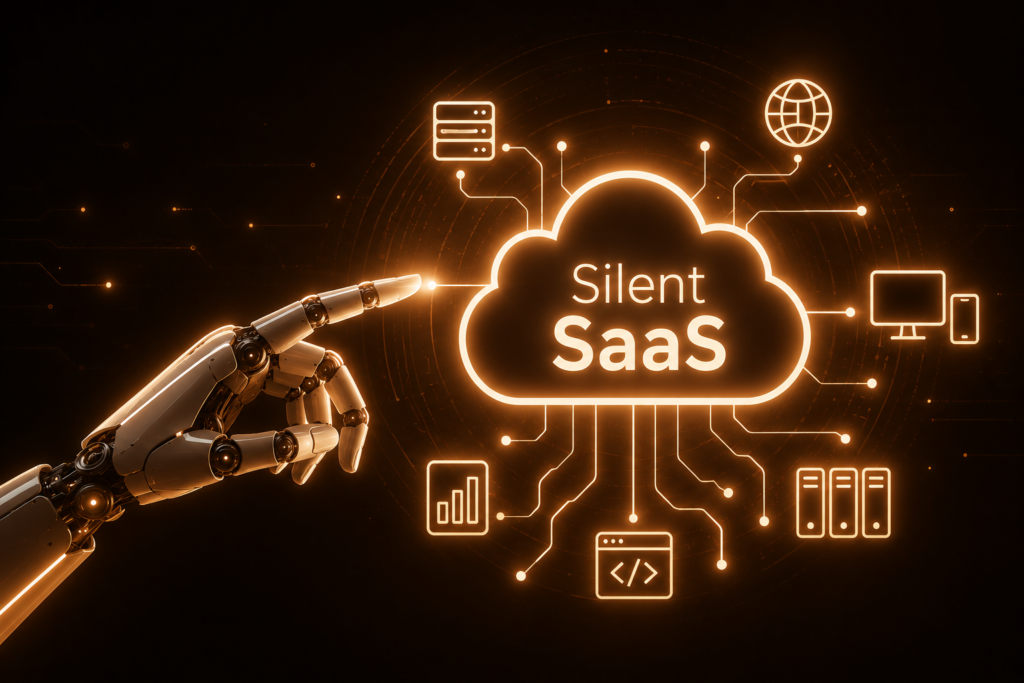
Instead of asking users to adapt to software, software is beginning to disappear into the background, embedding itself directly into business processes. The result is what many technology leaders are calling Silent SaaS—enterprise software that performs work automatically while requiring minimal user interaction.
Organizations no longer measure software success by the number of features available. They measure it by how little employees have to think about the software while completing their work.
The future of enterprise applications isn’t louder dashboards. It’s an invisible execution.
The Shift from Software Usage to Business Outcomes
For years, SaaS vendors competed by adding features. Every quarterly release introduced more reports, more buttons, more configuration options, and more analytics. While functionality expanded, user adoption often declined because complexity increased.
Modern enterprises have realized an uncomfortable truth: More software does not always create more productivity.
Employees spend valuable time:
- Updating CRM records
- Creating tickets
- Copying information between systems
- Approving repetitive workflows
- Searching for documents
- Following up on routine tasks
These activities create operational friction rather than business value. Silent SaaS removes these invisible inefficiencies by automating the process itself instead of merely digitizing it. The employee focuses on work while the software quietly manages everything else.
Enterprise Software Is Becoming Event-Driven
Traditional SaaS waits for user action. Modern SaaS reacts to business events.
When a customer signs a contract, multiple downstream processes can happen automatically without anyone opening five different applications. An intelligent enterprise platform can instantly:
- Create project workspaces
- Provision user accounts
- Generate invoices
- Notify implementation teams
- Schedule onboarding activities
- Update forecasting dashboards
- Trigger compliance workflows
Instead of software acting as a repository of information, it becomes an active participant in business operations. The application evolves from database to digital operations engine.
Why Invisible Automation Creates Competitive Advantage
Organizations often invest heavily in customer-facing innovation while overlooking internal operational speed. Yet companies that eliminate internal friction frequently outperform competitors because decisions move faster.
Invisible SaaS enables organizations to:
- Reduce process latency
- Minimize manual errors
- Standardize execution
- Increase employee productivity
- Accelerate customer onboarding
- Improve cross-functional collaboration
The cumulative effect is substantial. Saving a few minutes across thousands of daily business interactions creates significant organizational efficiency without requiring workforce expansion. Operational velocity becomes a strategic asset.
The Rise of Context-Aware Enterprise Applications
Traditional applications require users to provide context. Future-ready SaaS platforms build context automatically.
Instead of asking: “Which customer?”, “Which project?” ,”Which contract?”, “Which department?” the application already understands the relationship between data points.
Context-aware systems combine signals from multiple enterprise sources to deliver actions instead of information. For example, a procurement manager opening a purchase request may automatically see supplier performance history, budget utilization, contract status, delivery risks, approval recommendations, and compliance indicators without searching multiple systems.
The software becomes intelligent because context travels with the workflow.
The New Architecture of Silent SaaS
Enterprise platforms embracing invisible operations share several architectural characteristics.
Event-first design
Business events trigger workflows automatically instead of waiting for manual initiation.
Unified data intelligence
Applications consume information from multiple systems to create a single operational context.
Embedded automation
Automation exists inside business processes rather than as separate robotic workflows.
Predictive recommendations
The platform anticipates next actions based on operational patterns.
Low-friction user experience
Employees interact only when human judgment adds value. This architectural shift reduces unnecessary software interactions while improving overall business execution.
Why Employees Prefer Software They Barely Notice
The best enterprise applications often receive surprisingly little attention. Not because employees dislike them—but because they work seamlessly.
When software quietly:
- Routes approvals
- Resolves dependencies
- Synchronizes information
- Prevents duplicate work
- Detects anomalies
- Updates stakeholders
- Maintains compliance
Users spend less time managing systems and more time solving business problems. Employee satisfaction improves because technology becomes an enabler instead of an obstacle. Ironically, the most successful SaaS products may become the least visible.
Governance Matters More Than Automation
Invisible software cannot become uncontrollable software. As automation expands, governance becomes increasingly important.
Leading enterprise platforms include:
- Transparent decision logs
- Human approval checkpoints
- Configurable business rules
- Audit-ready process histories
- Version-controlled workflows
- Policy enforcement mechanisms
Organizations gain automation without sacrificing accountability. Trust becomes the foundation upon which intelligent enterprise software operates.
Industry-Wide Impact
Silent SaaS is transforming nearly every enterprise function.
Sales
Customer information updates automatically from communication activity, reducing administrative work.
Human Resources
Employee lifecycle processes execute seamlessly across recruitment, onboarding, payroll, and compliance.
Finance
Expense validation, reconciliations, approvals, and reporting happen continuously with minimal intervention.
Customer Success
Risk indicators trigger proactive engagement before issues escalate.
Procurement
Supplier evaluations and purchasing workflows adapt dynamically based on operational conditions.
Instead of isolated applications serving departments, organizations build interconnected operational ecosystems.
Measuring the Success of Invisible Enterprise Software
Traditional SaaS metrics focused on login frequency and feature adoption. Silent SaaS introduces a different success model. Key indicators include:
- Reduction in manual touchpoints
- Faster process completion
- Lower operational error rates
- Improved employee productivity
- Higher workflow consistency
- Increased automation coverage
- Reduced training requirements
Success is measured not by how often users interact with software, but by how effortlessly business outcomes are achieved.
The Future Belongs to Frictionless Operations
Enterprise software is entering a new era where competitive advantage comes not from having more applications, but from making applications disappear into daily work. Organizations investing in invisible automation, context-aware intelligence, and event-driven architecture are creating operational models that scale naturally with growth.
The next generation of SaaS will not ask employees to learn more screens or navigate more dashboards. It will quietly orchestrate business processes behind the scenes, allowing people to focus on creativity, strategy, and decision-making. In the evolving enterprise landscape, the software that receives the least attention may ultimately deliver the greatest business value.