
Emerging tech & Deep tech • 2 days ago • Shruti Das
Enterprise software has transformed how organizations manage information, automate workflows, and coordinate business operations. Financial systems process transactions, supply chain platforms monitor inventory, customer relationship management applications support sales, and artificial intelligence analyzes vast amounts of operational data. Despite these advances, most enterprise systems continue to interact with the physical world through conventional screens, reports, and dashboards.
Business operations, however, extend far beyond digital interfaces. Manufacturing equipment operates on factory floors, warehouse employees move inventory through distribution centers, engineers inspect critical infrastructure, healthcare professionals deliver patient care, and field technicians maintain assets across geographically distributed locations. Every one of these activities takes place within a physical environment where context, location, movement, and human interaction influence operational outcomes.
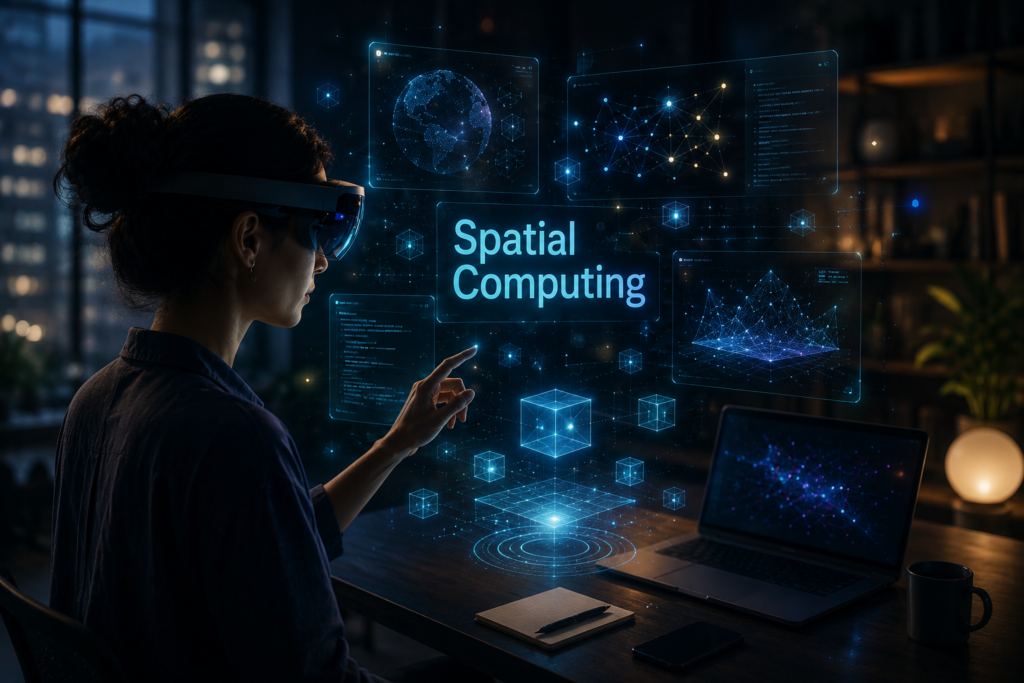
This gap between digital intelligence and physical operations has accelerated interest in Spatial Computing, an emerging field that enables computers to understand, interpret, and interact with three-dimensional environments. By combining artificial intelligence, computer vision, sensors, augmented reality, digital twins, spatial mapping, and real-time analytics, Spatial Computing allows digital information to become part of the physical workspace instead of remaining confined to traditional screens.
For enterprises, the significance extends far beyond immersive visualization. Spatial Computing enables employees to access information where work is happening, interact naturally with digital systems, and make decisions using real-time environmental context. As organizations continue investing in intelligent operations, Spatial Computing is emerging as an important bridge between digital enterprise platforms and the physical environments in which business value is ultimately created.
Understanding Spatial Computing
Spatial Computing refers to technologies that enable digital systems to perceive, understand, and interact with physical environments in three dimensions. Unlike conventional software that primarily processes structured digital information, spatial systems continuously interpret location, movement, objects, environmental conditions, and human interaction. The objective is not simply to display information differently. Spatial Computing allows enterprise applications to understand where activities occur, how people interact with equipment, and how physical environments influence operational decisions.
Imagine a maintenance engineer inspecting industrial equipment. Instead of consulting paper manuals or switching between multiple software applications, spatial technologies can recognize the equipment automatically, display maintenance history within the engineer’s field of view, highlight components requiring inspection, and provide guided repair instructions that remain aligned with the physical asset. The same principles apply across logistics, healthcare, construction, energy, retail, and many other industries where digital intelligence must operate alongside people, equipment, and real-world environments.
Why Traditional Enterprise Interfaces Are No Longer Enough
For decades, keyboards, monitors, and mobile devices have served as the primary interfaces between employees and enterprise software. These tools remain highly effective for administrative work, reporting, communication, and planning. However, many operational activities occur in environments where repeatedly shifting attention between physical tasks and digital screens reduces efficiency and increases the likelihood of errors. Several trends are driving the need for more contextual enterprise interfaces:
- Increasing operational complexity across physical environments
- Growth of connected devices and intelligent equipment
- Rising adoption of Digital Twins and IoT platforms
- Greater demand for real-time operational guidance
- Expansion of field operations and remote collaboration
- Growing expectations for faster employee onboarding and training
- Continuous pressure to improve safety, quality, and productivity
Spatial Computing addresses these challenges by placing digital intelligence directly within the physical context where work takes place.
The Spatial Enterprise Stack
A helpful way to understand enterprise Spatial Computing is through the Spatial Enterprise Stack. This conceptual framework illustrates how organizations build intelligent spatial capabilities by combining multiple layers of technology into a unified operational platform.
Environmental Sensing The foundation begins with sensors, cameras, LiDAR, GPS, industrial equipment, connected devices, and other technologies that continuously capture information about the surrounding environment.
Spatial Understanding Artificial intelligence interprets the collected information by identifying objects, recognizing locations, understanding movement, measuring distances, and constructing three-dimensional representations of physical spaces.
Contextual Intelligence Spatial information is combined with enterprise knowledge from Digital Twins, ERP systems, maintenance records, customer information, operational procedures, and AI Memory Architectures. This layer enables digital systems to understand not only where an activity is occurring but also why it matters.
Intelligent Interaction Employees interact naturally with enterprise systems using augmented reality, voice commands, gestures, wearable devices, mobile platforms, or intelligent visual interfaces that adapt to changing environments.
Autonomous Spatial Operations At the highest level, spatial intelligence works together with Decision Intelligence, Multi-Agent Enterprise Systems, robotics, and autonomous workflows to support increasingly adaptive business operations.
The Spatial Enterprise Stack demonstrates that Spatial Computing is not a standalone visualization technology. It is an intelligent enterprise capability that connects digital knowledge with physical operations.
How Spatial Computing Works
Spatial Computing integrates information from multiple technologies to create an ongoing understanding of physical environments. Sensors and connected devices continuously collect environmental information describing locations, movement, equipment status, surrounding conditions, and user interactions. Artificial intelligence interprets this information to recognize objects, estimate spatial relationships, and identify operational context.
Enterprise systems then contribute business knowledge such as maintenance history, inventory levels, work orders, engineering documentation, customer information, or safety procedures. Digital Twins provide additional operational context by representing the current state of physical assets. The resulting information is presented through interfaces appropriate for the task. Employees may receive visual guidance through augmented reality, voice assistance during inspections, interactive navigation inside facilities, or contextual recommendations while operating equipment.
A typical Spatial Computing workflow includes:
- Capturing environmental information
- Building a digital understanding of the physical space
- Identifying objects, assets, and activities
- Connecting spatial context with enterprise data
- Delivering contextual guidance
- Recording operational outcomes
- Continuously refining spatial understanding
This continuous cycle allows enterprise systems to become increasingly aware of the environments in which business operations take place.
Core Technologies Behind Spatial Computing
Several advanced technologies work together to support enterprise spatial intelligence.
Computer Vision enables intelligent systems to recognize equipment, people, objects, infrastructure, and operational activities within physical environments.
Artificial Intelligence interprets spatial information, identifies patterns, supports decision-making, and generates context-aware recommendations during operational activities.
Digital Twins provide continuously updated representations of physical assets and operational systems, supplying valuable context that enhances spatial understanding.
Augmented Reality overlays digital information onto physical environments, allowing employees to access relevant knowledge without interrupting ongoing work.
IoT and Edge Computing Connected devices and edge computing platforms continuously collect environmental information while enabling low-latency processing close to operational environments.
Enterprise Applications
Spatial Computing creates value across industries where digital intelligence and physical operations intersect.
Manufacturing Engineers receive guided maintenance instructions, production supervisors visualize operational performance directly on factory equipment, and quality inspections become more consistent through context-aware assistance.
Warehousing and Logistics Warehouse personnel navigate facilities more efficiently, locate inventory quickly, optimize picking routes, and receive real-time operational guidance while handling goods.
Healthcare Medical professionals access patient information, equipment guidance, and procedural support while remaining focused on patient care instead of switching between multiple information systems.
Field Services Technicians performing inspections or repairs receive context-aware guidance, remote expert collaboration, maintenance history, and equipment documentation while working on-site, improving first-time resolution rates and reducing service delays.
Business Benefits of Spatial Computing
The value of Spatial Computing extends far beyond immersive experiences or advanced visualization. Its greatest contribution is enabling enterprise systems to understand the physical context in which work takes place. By combining real-world awareness with digital intelligence, organizations can improve operational accuracy, accelerate decision-making, and deliver information precisely when and where it is needed. Employees no longer need to mentally bridge the gap between physical assets and disconnected digital systems. Information becomes available within the operational environment itself, reducing cognitive effort while helping teams complete complex tasks with greater confidence. Organizations implementing Spatial Computing can realize several long-term advantages:
- Faster execution of field and operational tasks
- Improved workforce productivity
- Reduced operational errors through context-aware guidance
- Better collaboration between remote experts and on-site teams
- Shorter employee onboarding and training cycles
- Improved equipment maintenance and asset utilization
- Stronger workplace safety through real-time operational assistance
- Better integration between physical operations and enterprise systems
- Increased visibility across distributed business environments
- Greater operational agility through contextual intelligence
These benefits become even more valuable when Spatial Computing works alongside Digital Twins, Decision Intelligence, AI Memory Architectures, and Multi-Agent Enterprise Systems to support increasingly intelligent enterprise operations.
Spatial Computing Versus Augmented Reality and Virtual Reality
Spatial Computing is frequently confused with augmented reality (AR) and virtual reality (VR). While these technologies are closely related, they are not interchangeable. Augmented reality overlays digital information onto the physical world through mobile devices, smart glasses, or other visual interfaces. Virtual reality creates immersive digital environments that replace the user’s physical surroundings.
Spatial Computing is significantly broader. It combines computer vision, environmental sensing, artificial intelligence, spatial mapping, enterprise data, Digital Twins, and intelligent interaction to help digital systems understand and respond to the physical world. Augmented reality and virtual reality become interaction methods within a much larger spatial ecosystem.
An enterprise maintenance solution illustrates the difference clearly. An augmented reality headset may display repair instructions for a technician. A Spatial Computing platform first identifies the equipment, understands its location, retrieves maintenance history from enterprise systems, references the associated Digital Twin, evaluates operational conditions, and then presents only the information relevant to that specific asset at that moment. The intelligence lies not in the display technology but in the system’s ability to understand physical context.
Common Misconceptions About Spatial Computing
As Spatial Computing continues gaining enterprise attention, several misconceptions still influence how organizations evaluate its potential. One of the most common assumptions is that Spatial Computing is primarily about wearable headsets. While augmented and mixed reality devices are certainly part of the ecosystem, they represent only one way of interacting with spatial environments. Cameras, smartphones, industrial sensors, robotics, drones, autonomous vehicles, and connected machinery all contribute to creating spatial awareness without requiring employees to wear specialized equipment. Another widespread misconception is that Spatial Computing is largely intended for gaming or consumer entertainment. Although gaming helped popularize immersive technologies, enterprise adoption is being driven by practical business applications across manufacturing, healthcare, construction, logistics, utilities, energy, and field services, where organizations use spatial intelligence to improve productivity, operational efficiency, safety, and decision-making. Some businesses also believe that realizing value from Spatial Computing requires fully immersive virtual environments. In reality, many successful implementations rely on far simpler experiences, such as context-aware maintenance guidance, warehouse navigation, remote inspections, asset visualization, interactive workforce training, and digital work instructions delivered through familiar mobile devices or lightweight interfaces. Equally important is the misconception that Spatial Computing replaces existing enterprise platforms. Instead, it functions as an additional interaction layer that complements technologies already in use. Enterprise resource planning systems, customer relationship management platforms, Digital Twins, artificial intelligence models, and operational databases continue serving their established purposes while supplying the contextual information that enables richer spatial experiences. Rather than replacing enterprise systems, Spatial Computing extends their value by making digital information more intuitive, contextual, and actionable within the physical world.
Challenges and Enterprise Adoption
Successfully implementing Spatial Computing requires thoughtful planning across technology, operations, and organizational readiness. The first challenge involves creating accurate digital representations of physical environments. Reliable spatial intelligence depends on high-quality sensor information, precise mapping, and consistent integration between physical assets and enterprise systems. Integration presents another important consideration. Spatial platforms often need information from ERP systems, maintenance applications, customer databases, Digital Twins, IoT platforms, inventory systems, and operational analytics. Building these connections requires well-defined architecture and strong data governance.
Organizations should also consider employee adoption. New interaction methods may require changes in established workflows, making training and change management essential for long-term success. Employees are more likely to embrace spatial technologies when they solve practical operational problems instead of introducing unnecessary complexity. Security and privacy remain important considerations as well. Spatial systems frequently process location data, video streams, environmental information, and operational activities. Governance policies should clearly define data ownership, access controls, retention practices, and acceptable use to maintain trust across the organization.
Building Intelligent Physical Workspaces
One of the most significant contributions of Spatial Computing is the creation of work environments that actively support employees instead of simply recording operational activity. Imagine a technician entering a production facility. The environment recognizes the equipment being serviced, identifies relevant safety procedures, retrieves maintenance history, highlights recently replaced components, and provides step-by-step guidance based on current operating conditions. The employee spends less time searching for information and more time solving the actual problem. The same principle applies across healthcare, logistics, energy, retail, construction, and public infrastructure. Enterprise knowledge becomes available exactly where it creates the greatest value, allowing employees to make better decisions while remaining focused on their physical tasks. As these capabilities mature, physical workplaces will become increasingly intelligent, responsive, and connected to enterprise operations.
The Future of Intelligent Physical Enterprises
Spatial Computing is expected to become a central component of intelligent enterprise architecture as organizations continue connecting physical operations with digital intelligence. Future enterprise environments will integrate Spatial Computing with Digital Twins, Decision Intelligence, AI Memory Architectures, Multi-Agent Enterprise Systems, Explainable AI, and Autonomous Business Systems to create highly adaptive operational ecosystems. Instead of operating as isolated technologies, these capabilities will exchange information continuously, providing employees with richer context while enabling enterprise systems to coordinate activities across both digital and physical environments.
This convergence also supports greater resilience. Intelligent platforms will understand not only what is happening inside enterprise software but also how physical assets, people, equipment, and environments influence operational performance. Organizations will gain the ability to simulate, monitor, optimize, and continuously improve operations using a unified understanding of both digital and physical systems. The enterprise of the future is unlikely to separate digital operations from physical work. Both environments will function as interconnected components of a single intelligent operating model.
Conclusion
Enterprise transformation has traditionally focused on improving digital systems, automating workflows, and expanding access to information. The next stage of innovation extends that intelligence into the physical environments where products are manufactured, services are delivered, infrastructure is maintained, and customers are served.
Spatial Computing provides the foundation for this evolution by enabling enterprise systems to understand physical context, connect operational knowledge with real-world activities, and support employees with intelligent, context-aware guidance. It strengthens productivity, improves collaboration, enhances operational visibility, and creates more responsive business environments.
The organizations that lead the next generation of enterprise innovation will not simply build smarter software. They will build smarter workplaces where digital intelligence and physical operations function as one integrated system. Spatial Computing represents a major step toward that vision, connecting enterprise knowledge with the real world in ways that will continue reshaping how organizations operate for years to come.