
Data, AI & Analytics • 4 days ago • Shruti Das
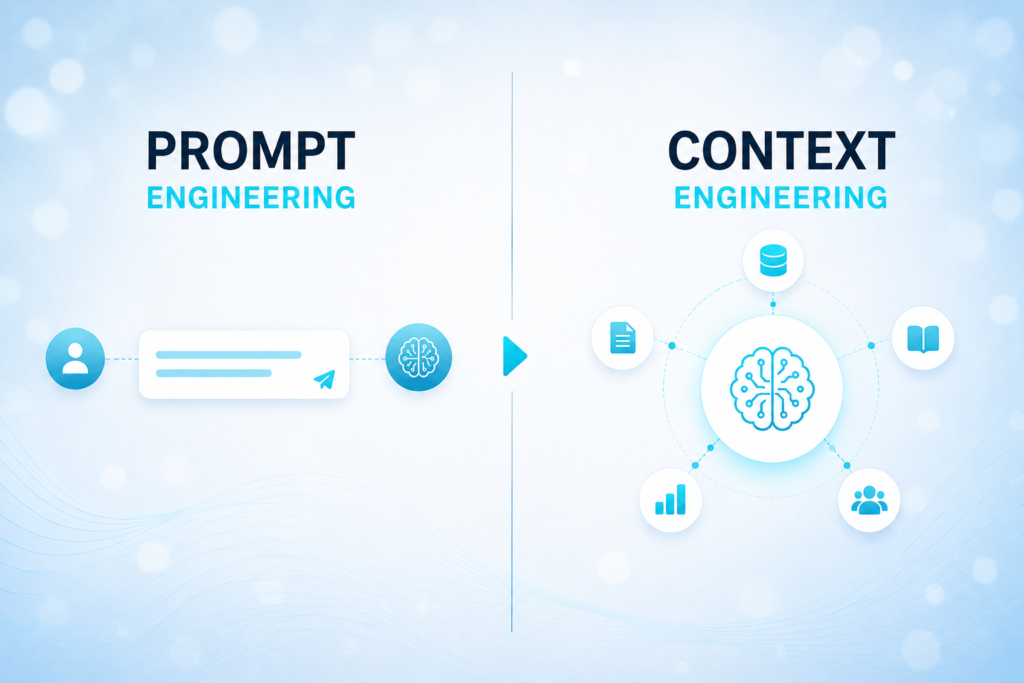
For many organizations adopting Artificial Intelligence, success initially appeared to depend on writing better prompts. Teams experimented with different instructions, adjusted wording, and refined queries to improve AI-generated responses.
While prompt engineering accelerated early AI adoption, enterprises are discovering a more fundamental challenge. Even the best prompt cannot compensate for incomplete, outdated, or irrelevant business information. An AI model asked to generate a strategic recommendation without access to customer history, operational metrics, product documentation, or internal policies will inevitably produce generic answers.
This realization has given rise to one of the most significant concepts in enterprise AI architecture—Context Engineering. Rather than focusing on crafting perfect prompts, context engineering focuses on delivering the right information, at the right time, in the right format, allowing AI systems to reason with business-specific knowledge. As enterprise AI evolves, competitive advantage will increasingly depend not on better prompts, but on better context.
What Is Context Engineering?
Context engineering is the practice of designing systems that provide AI models with relevant, structured, and trustworthy business information before generating responses. It transforms AI from a general-purpose language model into an enterprise-aware assistant capable of understanding organizational priorities, terminology, historical decisions, and operational constraints.
Context may include:
- Internal documentation
- Customer records
- Business policies
- Product catalogs
- Knowledge bases
- Analytics results
- Workflow history
- Operational metrics
- Regulatory guidelines
- Organizational vocabulary
Instead of expecting AI to “know” everything, context engineering ensures it receives the knowledge it needs when it needs it.
Why Prompt Engineering Has Limitations
Prompt engineering optimizes communication with AI. Context engineering optimizes understanding. An excellent prompt cannot overcome missing business knowledge. For example, asking an AI assistant to recommend pricing strategies without access to sales history or market segmentation data will produce generic suggestions.
Providing rich enterprise context enables AI to generate recommendations grounded in organizational reality. The quality of AI output depends more on the quality of supplied context than on the sophistication of the prompt itself. This represents a major shift in enterprise AI strategy.
Enterprise Knowledge Is Fragmented
Large organizations rarely store information in one location. Critical business knowledge exists across:
- CRM platforms
- ERP systems
- Data warehouses
- Collaboration tools
- Knowledge portals
- Customer support systems
- Cloud applications
- Project repositories
- Financial platforms
- Operational databases
AI cannot create meaningful insights unless these sources become discoverable and connected. Context engineering acts as the bridge between fragmented enterprise knowledge and intelligent AI reasoning.
AI Without Context Creates Confident Mistakes
One of the greatest risks in enterprise AI is not incorrect information. It is the confidently presented incorrect information. When context is unavailable, AI models naturally fill knowledge gaps using statistical reasoning. The response may sound convincing while being operationally inaccurate.
Context engineering reduces this risk by grounding AI responses in verified enterprise information. Recommendations become explainable. Answers become traceable. Decision-makers gain greater confidence because outputs originate from trusted organizational knowledge rather than generic assumptions.
Context Is Dynamic, Not Static
Business environments change continuously. Policies evolve. Products change. Customers expand. Regulations shift. Operational priorities adapt. Static knowledge repositories quickly become outdated.
Context engineering treats enterprise knowledge as a living ecosystem that evolves alongside business operations. AI systems receive continuously refreshed information rather than relying on historical snapshots. This ensures recommendations remain relevant even as organizations transform.
Why Context Improves Analytics
Analytics traditionally answers questions based on historical data. Context enriches analytics by explaining relationships behind the numbers. Revenue growth may correspond with product launches. Customer churn may coincide with service disruptions. Operational improvements may result from workflow redesign. Context engineering links analytical results with business events, documents, and organizational decisions. Executives gain understanding rather than isolated metrics. Insight becomes connected to business reality.
AI Agents Depend on Context
Autonomous AI agents are increasingly expected to execute complex business activities. They schedule workflows. Generate reports. Review contracts. Support customers. Recommend actions. Their effectiveness depends on contextual awareness.
An AI agent that understands company terminology, historical decisions, approval workflows, and operational policies performs significantly better than one operating in isolation. Context transforms automation into intelligent collaboration. The future of enterprise AI agents will be built upon context-rich architectures.
Building a Context Engineering Framework
Organizations preparing for advanced AI should establish structured context pipelines. Core capabilities include:
- Enterprise knowledge repositories
- Metadata management
- Semantic search
- Document indexing
- Business glossary management
- Data lineage tracking
- Knowledge validation
- Access governance
- Version management
- Context retrieval optimization
The objective is not collecting more information. It is delivering the most relevant information precisely when AI requires it.
Governance Strengthens Context
Reliable context depends on trusted governance. Without governance, outdated or conflicting information reduces AI reliability. Effective governance should include:
- Ownership of business knowledge
- Continuous quality reviews
- Standardized terminology
- Controlled access policies
- Metadata enrichment
- Audit trails
- Lifecycle management
- Validation workflows
Governed context creates governed intelligence. Trustworthy AI begins with trustworthy information.
Context Engineering as a Competitive Advantage
Many organizations will deploy similar AI models. Fewer will build superior context ecosystems. The difference will become increasingly visible. Companies with mature context engineering capabilities will generate more accurate insights, reduce decision latency, improve customer experiences, and accelerate innovation. Their AI systems will reflect organizational expertise rather than generic internet knowledge. Context becomes proprietary intelligence. Unlike algorithms that competitors can adopt, enterprise context is unique and difficult to replicate. This makes it a lasting strategic differentiator.
The Future of Enterprise AI
The evolution of enterprise AI is moving beyond larger models and more complex prompts. Success will depend on delivering the right knowledge to intelligent systems at the exact moment decisions are made. Context engineering represents the infrastructure that connects data, documents, analytics, governance, and organizational memory into a unified intelligence layer. It enables AI to reason with business understanding rather than language patterns alone. As enterprises continue investing in AI transformation, context engineering will quietly become one of the most valuable architectural capabilities behind every intelligent application.
Conclusion
Artificial Intelligence does not create business understanding on its own. It depends on the quality, relevance, and structure of the information it receives.
Context engineering bridges the gap between enterprise knowledge and AI reasoning by ensuring intelligent systems operate with accurate, timely, and meaningful business context. Organizations that invest in context-rich architectures will build AI systems that are more reliable, more explainable, and more valuable than competitors relying solely on model performance. In the next era of B2B Data and AI, the smartest organizations will not simply build better AI. They will build better context.