
Data, AI & Analytics • 1 day ago • Neha Jamwal
Enterprise analytics has traditionally focused on structured data. Organizations have relied on dashboards, reports, spreadsheets, and databases to understand business performance, monitor operations, and guide strategic decisions. While this approach has generated enormous business value, it represents only a fraction of the information available within a modern enterprise. Every day, organizations create vast amounts of unstructured content in the form of documents, emails, contracts, customer conversations, images, videos, audio recordings, engineering drawings, and operational logs. Until recently, much of this information remained inaccessible to traditional analytics platforms because it could not be easily organized into rows and columns.
Artificial intelligence is changing that reality. Advances in AI now allow organizations to analyze multiple forms of information simultaneously rather than treating each type of content as an isolated data source. This capability is known as Multimodal AI, and it is rapidly becoming one of the most important developments in enterprise analytics.
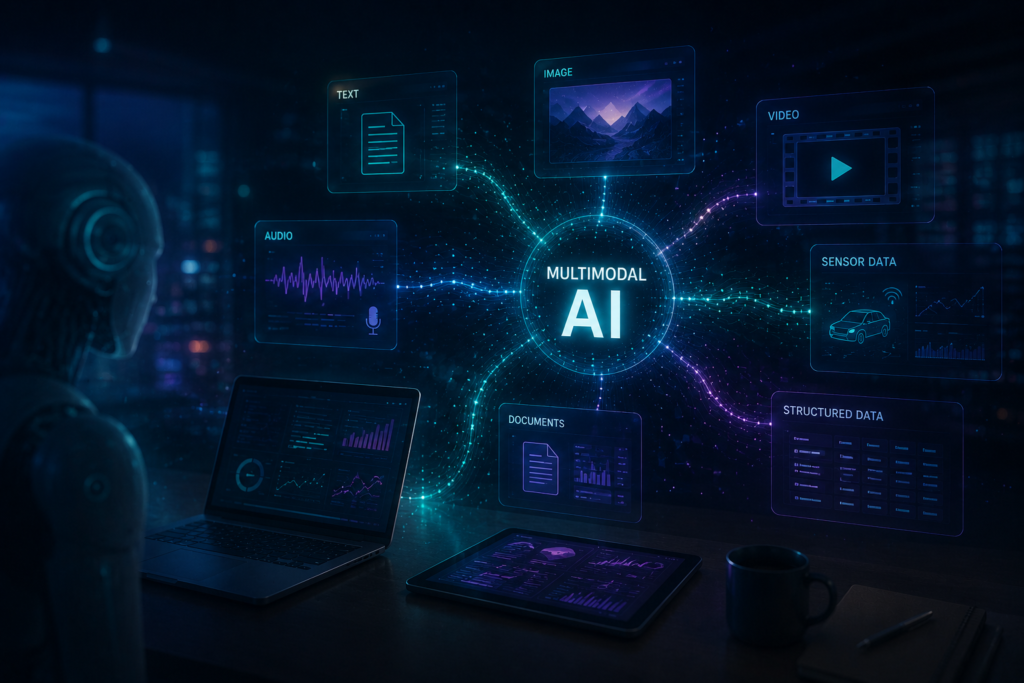
Instead of analyzing only structured business data, Multimodal AI can combine information from text, images, audio, video, documents, sensor data, and operational systems to develop a far more complete understanding of business activities. For enterprise leaders, this represents a major shift from analyzing individual datasets to understanding entire business processes through every form of available information.
As organizations continue investing in AI-driven decision-making, Multimodal AI is poised to redefine how enterprise analytics delivers business intelligence, operational insights, and competitive advantage.
What Is Multimodal AI?
Multimodal AI refers to artificial intelligence systems capable of processing, understanding, and combining multiple types of information within a single analytical workflow. Rather than relying on one format such as structured data or text alone, these systems analyze different data modalities together to generate richer and more contextual insights.
A Multimodal AI platform may simultaneously evaluate business documents, images, audio recordings, video content, emails, customer interactions, sensor data, operational databases, application logs, and knowledge repositories. By combining these sources, AI develops a broader understanding of enterprise activities than would be possible using any single dataset.
Why Traditional Analytics Has Reached Its Limits
Business intelligence platforms have historically excelled at analyzing structured information. They generate reports, visualize trends, and monitor key performance indicators with remarkable efficiency. However, today’s enterprise knowledge extends far beyond structured databases.
Customer feedback appears in emails and chat conversations, product inspections generate photographs and videos, meetings produce audio recordings, manufacturing systems generate sensor data, technical teams create design documents, and support centers record customer calls. Traditional analytics often excludes these valuable sources because they cannot be processed using conventional reporting methods. Multimodal AI removes this limitation by allowing organizations to analyze every significant source of enterprise knowledge within a unified analytical framework.
Building a Complete Business Picture
One of the greatest advantages of Multimodal AI is its ability to connect information that previously existed in isolation. Consider a product quality investigation. Traditional analytics may review manufacturing data and customer complaints separately, but Multimodal AI can evaluate production records, equipment sensor readings, inspection images, maintenance logs, customer support conversations, warranty claims, and technical documentation simultaneously. The result is a much richer understanding of both the problem and its root cause. Instead of analyzing isolated datasets, organizations begin understanding complete business events.
Improving Customer Intelligence
Customer behavior rarely exists within a single system. Organizations collect information through websites, mobile applications, emails, support interactions, surveys, social communities, product reviews, voice conversations, and sales engagements. Each source provides only part of the customer story.
Multimodal AI combines these signals to create a more comprehensive understanding of customer intent, satisfaction, preferences, and behavior. This enables organizations to deliver better customer experiences, more accurate recommendations, faster issue resolution, improved customer retention, personalized services, and smarter marketing strategies. The result is a more complete customer intelligence platform rather than disconnected analytical reports.
Unlocking Enterprise Knowledge
Many organizations possess decades of valuable business knowledge stored within documents that remain largely inaccessible to traditional analytics. Examples include technical manuals, standard operating procedures, engineering drawings, research reports, contracts, compliance documentation, training materials, and internal policies.
Multimodal AI makes these assets searchable, understandable, and available alongside structured enterprise data. Instead of limiting analytics to transactional systems, organizations can incorporate institutional knowledge into everyday decision-making.
Transforming Operational Analytics
Operational excellence increasingly depends on understanding events occurring across multiple systems at the same time. Manufacturing organizations may combine production data with equipment images and sensor readings, healthcare providers may analyze clinical notes alongside medical images and laboratory results, retail organizations may combine inventory information with in-store video analytics and customer purchasing behavior, and financial institutions may evaluate transaction data together with customer communications and supporting documentation.
Multimodal AI enables these organizations to identify patterns that remain invisible when each dataset is analyzed independently.
Artificial Intelligence Becomes More Context Aware
Enterprise AI performs significantly better when it understands context rather than isolated information. For example, a support ticket may contain only a brief customer description, but when combined with product images, purchase history, warranty information, previous conversations, and diagnostic reports, AI gains a much deeper understanding of the situation.
This broader context improves recommendation accuracy, decision quality, response relevance, risk assessment, predictive analytics, and operational efficiency. Rather than processing isolated records, AI begins understanding complete business scenarios.
Governance Becomes Even More Important
The ability to process multiple forms of enterprise information also increases governance responsibilities. Organizations must establish clear policies regarding data ownership, access permissions, privacy protection, information retention, regulatory compliance, metadata management, content classification, and auditability.
Strong governance ensures that Multimodal AI delivers business value while protecting sensitive enterprise information across every data source.
Measuring Business Success
Organizations implementing Multimodal AI should evaluate success according to measurable business outcomes rather than technological sophistication. Common indicators include faster decision-making, improved customer satisfaction, higher search accuracy, better operational visibility, increased employee productivity, more accurate predictions, reduced manual analysis, greater knowledge reuse, improved compliance, and enhanced business agility.
These measurements demonstrate whether enterprise analytics is becoming more intelligent, actionable, and valuable.
Characteristics of Multimodal Enterprises
Organizations successfully adopting Multimodal AI often demonstrate several common characteristics. They are data-driven, AI-enabled, knowledge-centric, strongly governed, context-aware, API-connected, secure by design, built for collaboration, focused on automation, and continuously learning.
These characteristics allow enterprises to maximize the value of every form of business information while supporting increasingly intelligent decision-making.
The Next Evolution of Enterprise Analytics
The future of enterprise analytics will not be defined by bigger dashboards or larger data warehouses. It will be defined by the ability to understand business operations through every form of available information. Structured databases will remain important, but they will increasingly be complemented by documents, conversations, images, videos, sensor data, and countless other sources of enterprise knowledge that have traditionally remained underutilized.
Multimodal AI represents the technology that brings these diverse information sources together into a unified analytical environment. By combining structured and unstructured data, organizations gain richer context, improve decision quality, accelerate innovation, and unlock valuable insights that conventional analytics simply cannot deliver.
As artificial intelligence continues to mature, enterprises that embrace Multimodal AI will gain a significant advantage. They will move beyond reporting what happened to understanding why it happened, how different business events are connected, and what actions should be taken next. In an increasingly information-rich business environment, the ability to analyze every form of enterprise knowledge may become one of the defining characteristics of truly intelligent organizations.