
Data, AI & Analytics • 11 days ago • Melvin Hall
Artificial Intelligence has become an integral part of modern business operations, powering customer support, predictive analytics, content generation, and decision-making. Yet despite impressive technological advances, many enterprises face the same frustrating reality: their AI systems are intelligent but forgetful.
An AI assistant may answer questions accurately today but fail to remember project decisions tomorrow. Analytics platforms generate insights without understanding historical business context. Search tools retrieve documents but struggle to connect related knowledge spread across departments.
The missing component is not a better language model or a faster processor.
It is organizational memory.
A new architectural concept is emerging within enterprise AI strategy—the Enterprise Memory Layer. Rather than treating data, documents, conversations, and decisions as isolated assets, organizations are beginning to build persistent memory systems that allow AI to understand context, relationships, and institutional knowledge.
In the coming years, competitive advantage may belong not to businesses with the most AI models, but to those with the richest organizational memory.
What Is an Enterprise Memory Layer?
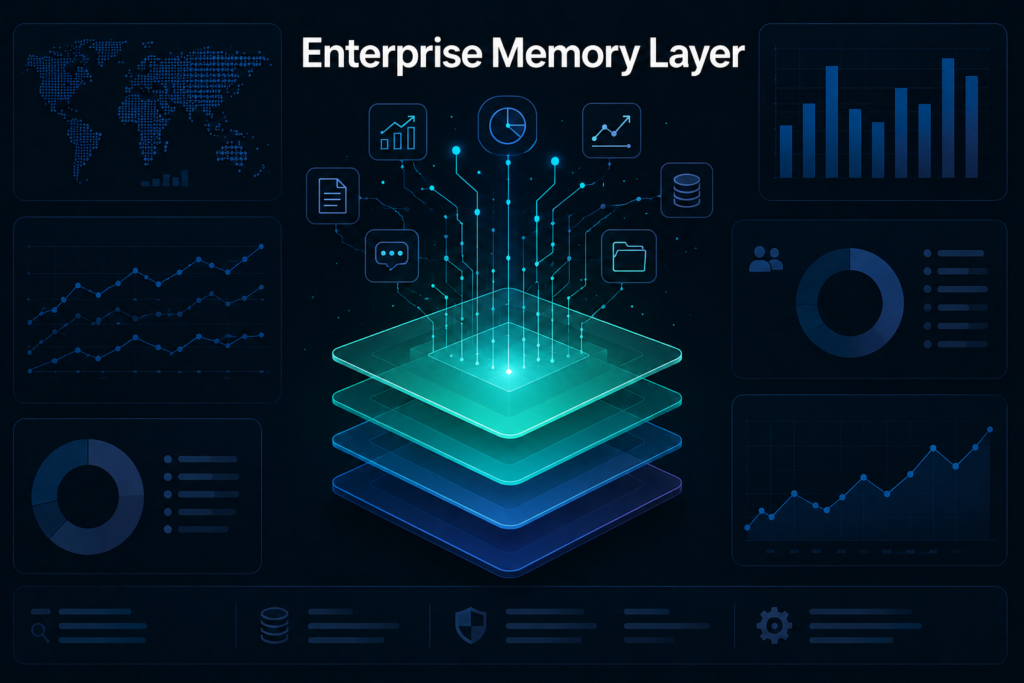
An Enterprise Memory Layer is a centralized knowledge foundation that continuously captures, organizes, and connects information generated across an organization. Instead of storing data in disconnected applications, the memory layer creates relationships between business events, customer interactions, documents, analytics, workflows, and operational decisions.
Unlike traditional databases that store structured records, a memory layer preserves business context. It enables AI systems to answer not only what happened, but also why it happened, who made the decision, and how similar situations were handled previously. This transforms enterprise knowledge into an active business asset rather than passive storage.
The Problem with Fragmented Knowledge
Large organizations generate enormous amounts of information every day. Meetings conclude with decisions. Projects create documentation. Analytics teams publish reports. Sales teams record customer interactions. Support teams resolve recurring issues. Operations teams refine business processes.
Unfortunately, this knowledge is scattered across collaboration platforms, email systems, cloud storage, CRM applications, ERP systems, and departmental repositories. Employees spend significant time searching for information that already exists. AI systems face the same challenge. Without connected organizational memory, intelligent systems repeatedly solve problems that the business has already solved. Knowledge fragmentation becomes an invisible productivity tax.
AI Is Only as Smart as Its Memory
Generative AI has demonstrated extraordinary capabilities, but enterprise adoption exposes an important limitation. Models generate responses based on available context. If business knowledge is incomplete, outdated, or inaccessible, AI outputs become inconsistent. Organizations often assume AI failures result from model limitations. In reality, the underlying problem is missing enterprise memory. Reliable AI requires:
- Trusted business knowledge
- Historical context
- Standardized terminology
- Connected documents
- Decision history
- Process relationships
- Business metadata
- Organizational expertise
The quality of AI increasingly depends on the quality of enterprise memory.
Memory Becomes a Strategic Data Asset
Traditional data strategies focus on collection. Modern enterprises must focus on retention, connection, and accessibility. Organizational memory extends beyond structured data by preserving relationships between people, projects, customers, systems, and outcomes. This creates a continuously evolving knowledge ecosystem that improves over time.
Instead of repeatedly recreating insights, organizations accumulate intelligence that strengthens future decision-making. Knowledge compounds in value when it remains discoverable and reusable.
Why Analytics Needs Business Context
Analytics platforms excel at identifying trends. However, dashboards rarely explain the operational circumstances behind those trends. Revenue declines may coincide with supply chain disruptions. Customer churn may align with product changes. Operational improvements may follow internal process redesigns. Without historical context, numbers lose meaning.
An Enterprise Memory Layer enriches analytics by connecting metrics with business events, strategic decisions, and organizational activities. Decision-makers gain understanding instead of observation. Context transforms reporting into intelligence.
Breaking Down Departmental Silos
Every department develops specialized knowledge. Finance understands profitability. Marketing understands customer behavior. Operations understand efficiency. Product teams understand innovation. Human resources understand workforce trends. When these insights remain isolated, enterprise intelligence remains fragmented.
A shared memory architecture enables departments to contribute knowledge while preserving governance and ownership. Information flows across business functions without sacrificing accountability. The result is stronger collaboration and faster organizational learning.
Enterprise Search Evolves into Enterprise Intelligence
Traditional search engines locate documents. Future enterprise platforms will locate answers. Instead of returning hundreds of files, intelligent systems will synthesize information from multiple sources while preserving context and traceability. Employees will ask: “What influenced our pricing strategy?” “Which projects solved a similar challenge?” “How did previous customers respond?” Answers will emerge from connected organizational memory rather than isolated repositories. Search becomes reasoning. Information becomes knowledge. Knowledge becomes action.
Governance Is Essential
Persistent memory introduces significant responsibility. Organizations must ensure that stored knowledge remains accurate, secure, and appropriately governed. Strong governance includes:
- Data ownership
- Version management
- Access controls
- Privacy policies
- Information lifecycle management
- Metadata standards
- Knowledge validation
- Audit capabilities
Without governance, memory becomes clutter. With governance, memory becomes a trusted strategic asset. The value of organizational intelligence depends on maintaining confidence in its accuracy.
AI Agents Will Depend on Memory
Autonomous AI agents are expected to perform increasingly sophisticated business activities. They will coordinate workflows, generate reports, recommend actions, and assist employees across departments. To operate effectively, these agents require more than instructions. They require organizational memory.
Memory enables AI agents to understand company terminology, historical decisions, customer preferences, operational constraints, and strategic priorities. Without memory, automation remains transactional. With memory, automation becomes adaptive. This distinction will define the next generation of enterprise AI systems.
Building an Enterprise Memory Strategy
Organizations preparing for intelligent operations should begin establishing memory-first architectures. Key priorities include:
- Unified knowledge repositories
- Metadata enrichment
- Semantic data relationships
- Business glossary standardization
- Cross-platform integration
- Knowledge lifecycle management
- AI-ready data governance
- Continuous quality monitoring
- Search optimization
- Organizational knowledge mapping
The objective is not simply storing more information. It is ensuring that knowledge remains connected, trusted, and reusable.
Conclusion
The future of enterprise AI will not be determined solely by increasingly powerful models. It will be determined by the quality of organizational memory supporting those models. Businesses that preserve context, connect knowledge, and make intelligence reusable will outperform organizations that continue treating information as isolated records.
The Enterprise Memory Layer represents the evolution of data management from storage to understanding. It enables analytics with context, AI with reasoning, and decision-making with institutional knowledge. As digital transformation continues to accelerate, organizations that invest in memory will create smarter systems, more informed employees, and stronger competitive advantages. In the age of intelligent enterprises, memory may become the most valuable asset of all.