
Data, AI & Analytics • 10 days ago • Shruti Das
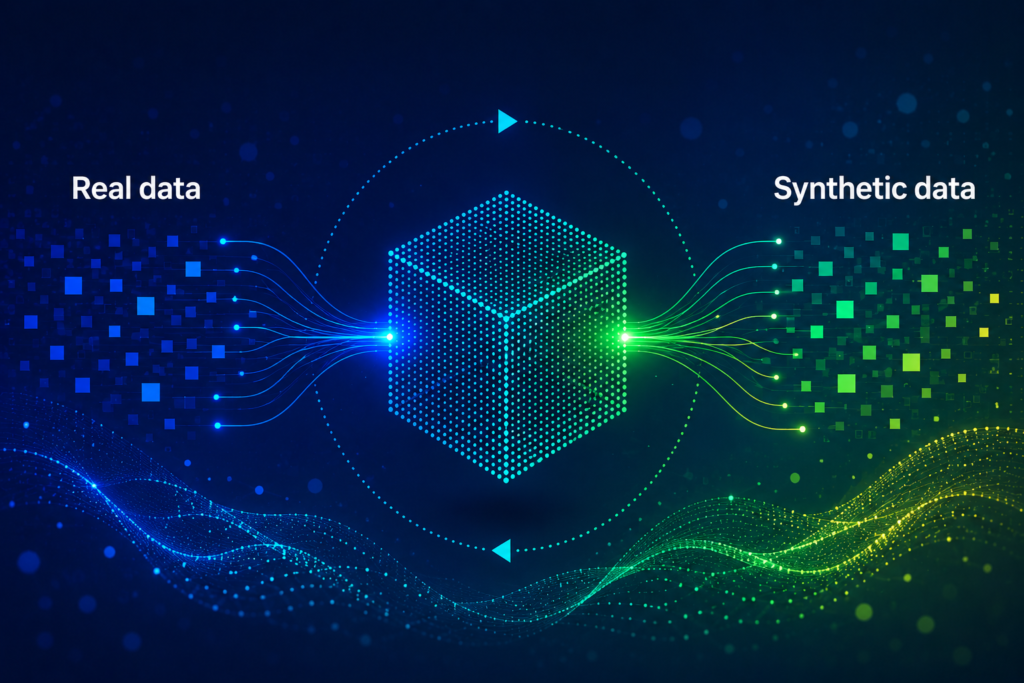
Artificial Intelligence has an insatiable appetite for data. The more diverse and representative the information, the better AI systems become at recognizing patterns, generating predictions, and supporting business decisions.
Yet enterprises face a growing dilemma.
Customer information is protected by privacy regulations. Financial records are highly confidential. Healthcare datasets contain sensitive personal information. Manufacturing data represents valuable intellectual property. Sharing or using this information for AI development introduces legal, ethical, and operational challenges.
To solve this problem, organizations are increasingly turning to an emerging concept that could redefine enterprise AI strategies—Synthetic Data. Rather than relying exclusively on real-world records, businesses can generate artificial datasets that statistically mirror real information without exposing actual individuals or confidential transactions. Synthetic data is rapidly evolving from an experimental technology into a strategic asset for B2B organizations seeking to accelerate AI innovation while preserving privacy and governance. The future of enterprise intelligence may depend not only on collecting data but on creating it.
What Is Synthetic Data?
Synthetic data is artificially generated information designed to replicate the characteristics, patterns, and statistical properties of real datasets. Unlike anonymized data, synthetic data does not represent actual individuals or business events. Instead, algorithms generate entirely new records while preserving meaningful relationships between variables. For example, an AI model can create millions of customer transactions that reflect realistic purchasing behavior without exposing any genuine customer information. The resulting dataset behaves like real data for analysis and model training while significantly reducing privacy risks. This makes synthetic data an increasingly valuable foundation for enterprise AI initiatives.
Why Traditional Data Is Becoming a Bottleneck
Modern organizations possess enormous amounts of information. However, using that information for analytics or AI development is often complicated by governance requirements.
Business teams must navigate:
- Privacy regulations
- Confidentiality agreements
- Intellectual property protection
- Cross-border data restrictions
- Customer consent requirements
- Internal security policies
- Data ownership concerns
- Compliance obligations
These constraints frequently delay innovation. Data scientists spend more time obtaining access than building intelligent solutions. Synthetic data removes many of these barriers by enabling experimentation without exposing sensitive business assets.
AI Development Requires More Than Privacy
Privacy is only one advantage. Enterprise AI projects often suffer from imbalanced or incomplete datasets. Fraud cases may represent only a tiny fraction of transactions. Equipment failures occur infrequently. Cybersecurity incidents are relatively rare. Training AI models using limited examples reduces predictive performance. Synthetic data enables organizations to generate additional scenarios that improve model learning. Businesses can create rare events, edge cases, and unusual operational situations that may never appear frequently enough in historical records. The result is stronger and more resilient AI systems.
Accelerating Analytics Innovation
Analytics teams often depend on production databases that cannot be freely accessed or modified. This slows experimentation. Synthetic datasets provide safe environments for innovation. Analysts can test hypotheses, validate algorithms, simulate business scenarios, and develop dashboards without risking operational systems. Development cycles become shorter. Collaboration improves. Innovation accelerates because access constraints no longer limit creativity. Data becomes available when needed rather than after lengthy approval processes.
Digital Twins and Synthetic Data
Many enterprises are investing in digital twins—virtual representations of factories, supply chains, financial systems, or customer ecosystems. Synthetic data enhances these environments by continuously generating realistic operational conditions. Organizations can simulate demand fluctuations, production disruptions, market changes, or supply chain bottlenecks without affecting real operations. Decision-makers gain opportunities to evaluate strategies before implementing them. Instead of reacting to uncertainty, businesses begin preparing for it through intelligent simulation. Synthetic data transforms digital twins into living laboratories for enterprise decision-making.
Building Fairer AI Models
Bias remains one of the greatest challenges in enterprise AI. Historical datasets often reflect incomplete representation or operational inconsistencies. As a result, AI models may unintentionally reinforce existing inequalities or overlook minority scenarios.
Synthetic data provides opportunities to rebalance datasets by generating additional representative examples. Organizations can improve fairness, reduce bias, and strengthen model robustness while maintaining statistical validity. Responsible AI depends not only on better algorithms but also on better training data. Synthetic generation offers a powerful mechanism for achieving this objective.
Reducing Business Risk Through Safe Testing
Deploying AI directly into production environments introduces uncertainty. Organizations need opportunities to test automation under controlled conditions. Synthetic environments allow enterprises to evaluate:
- Pricing strategies
- Demand forecasting
- Customer segmentation
- Inventory optimization
- Fraud detection
- Operational planning
- Resource allocation
- Supply chain resilience
Because the underlying information is artificially generated, organizations reduce exposure while maintaining analytical realism. Safe experimentation becomes an organizational capability rather than a project-specific exercise.
Governance Remains Essential
Synthetic data should not be viewed as a replacement for governance. Poorly generated datasets can introduce inaccuracies, unrealistic relationships, or unintended bias. Successful organizations establish governance frameworks covering:
- Data generation standards
- Statistical validation
- Metadata documentation
- Quality assurance
- Version control
- Business ownership
- Model transparency
- Ethical review processes
Synthetic data achieves maximum value only when treated as a managed enterprise asset. Quality remains more important than quantity.
The Competitive Advantage of Data Creation
Historically, organizations competed by collecting more information. Future leaders may compete by generating better information. Synthetic data democratizes innovation by enabling secure collaboration across business units, research teams, technology partners, and AI developers. Organizations become less constrained by privacy limitations while expanding analytical capabilities. Instead of waiting for operational events to occur naturally, businesses create representative scenarios that accelerate learning. The ability to generate intelligent data may become as valuable as the ability to store it.
Preparing for an AI-Driven Enterprise
Synthetic data is more than a technical innovation. It represents a strategic shift in enterprise thinking. Organizations preparing for long-term success should invest in:
- Data generation platforms
- Statistical validation frameworks
- AI governance policies
- Digital twin ecosystems
- Privacy-preserving analytics
- Metadata management
- Responsible AI practices
- Synthetic data quality monitoring
- Enterprise data catalogs
- Cross-functional collaboration
The objective is to create trusted information that supports innovation without compromising security or compliance.
Conclusion
The next generation of enterprise AI will not rely exclusively on historical business records. It will increasingly combine real information with intelligently generated synthetic data to build faster, safer, and more scalable analytical capabilities. Organizations that embrace synthetic data gain greater flexibility, stronger privacy protection, improved AI performance, and accelerated innovation.
Rather than viewing data scarcity as a limitation, forward-thinking enterprises are learning to create the information they need while preserving governance and trust. In the evolving landscape of B2B Data, AI, and Analytics, the organizations that master synthetic data will not simply analyze the future. They will help create it.